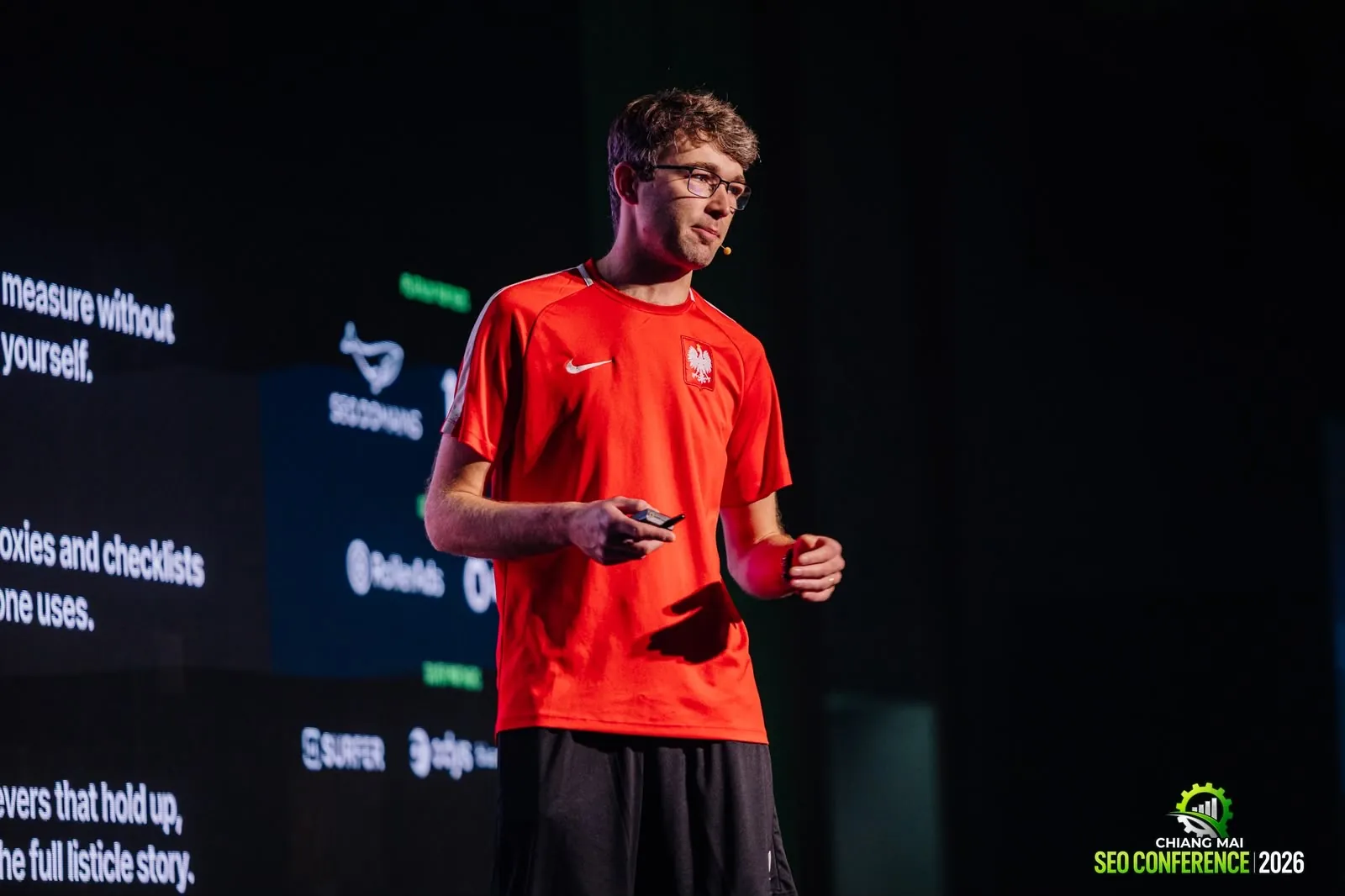
Chiang Mai SEO Conference · 13 November 2026
The story of 50M scraped LLM answers
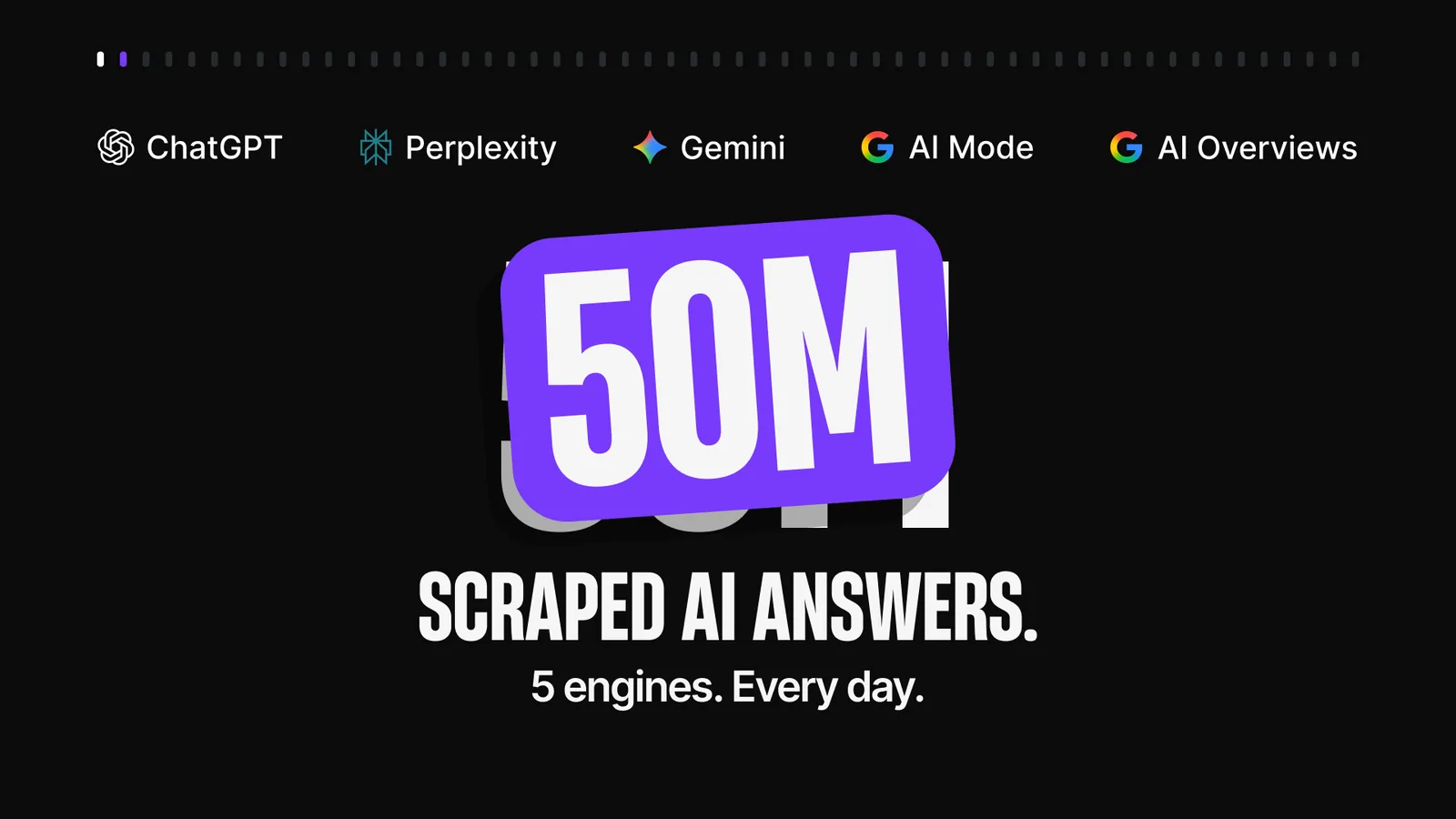
For a year and a half we recorded what five AI engines actually answer, every day, from the real interface. Here is how to measure AI visibility without fooling yourself, which popular proxies don’t hold up, and what actually gets you cited.
Slides
The full talk, 56 slides
Use the arrow keys or swipe. Each slide comes with the line I said on stage.
What the data says
Six numbers from the talk
From Surfer AI Tracker: about 50 million answers from ChatGPT, Perplexity, Gemini, Google AI Overviews and AI Mode.
- 40%
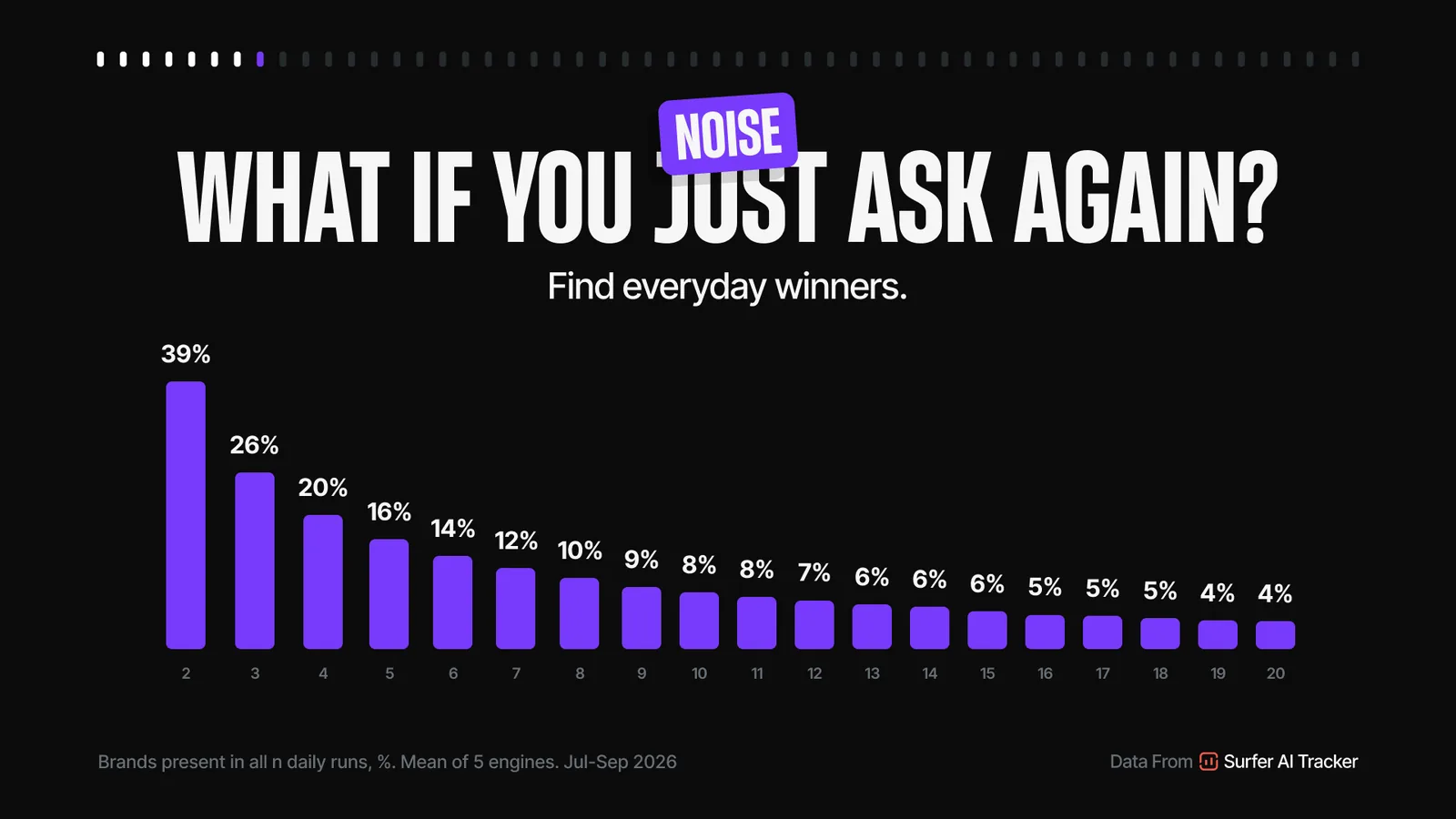
- of brands are shared by two runs of the exact same prompt. After 20 runs, only 4% appear every time.
- 29–42%
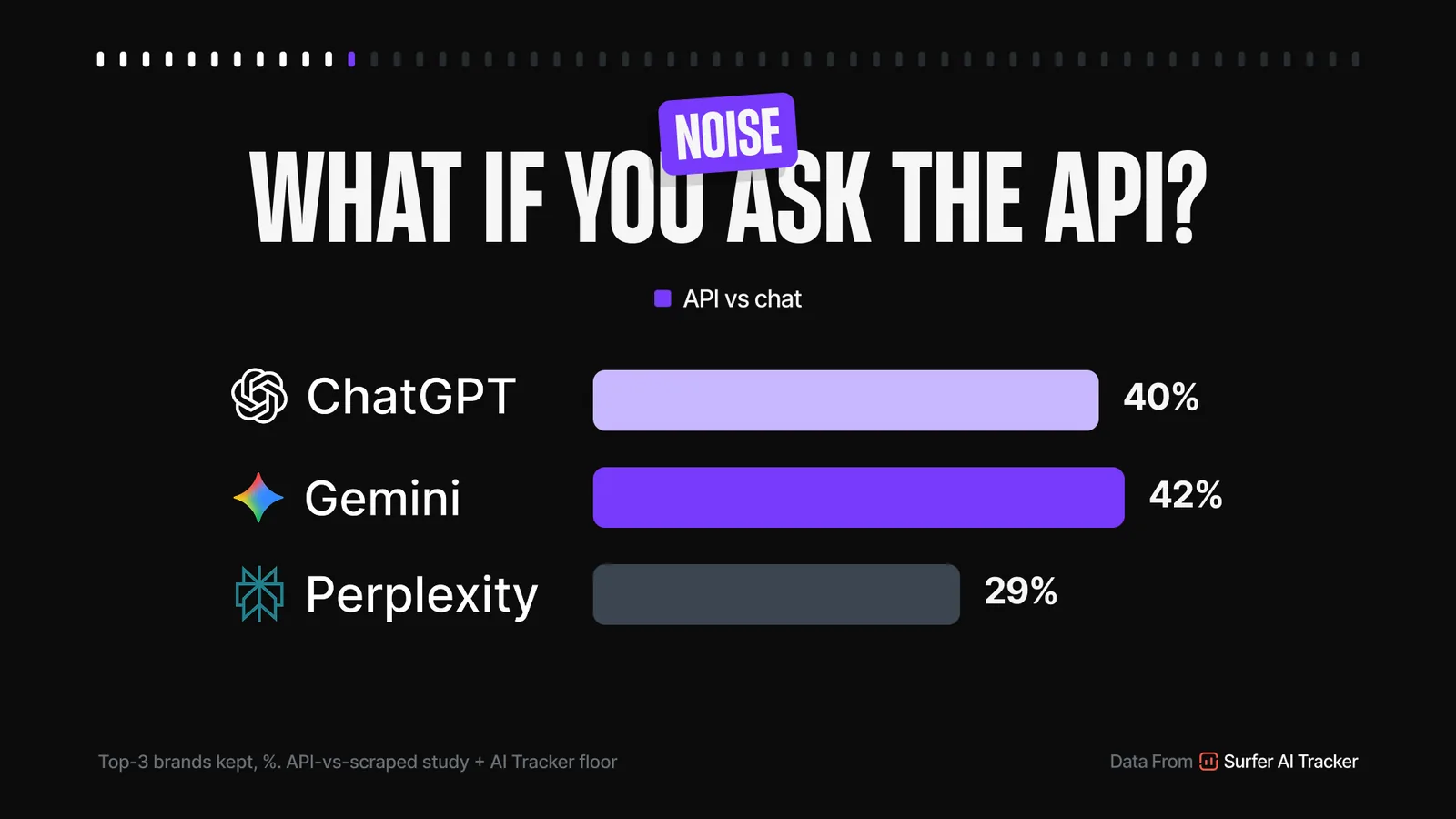
- of an API answer’s top-3 brands make the top 3 in the chat interface people actually use.
- 8.9%
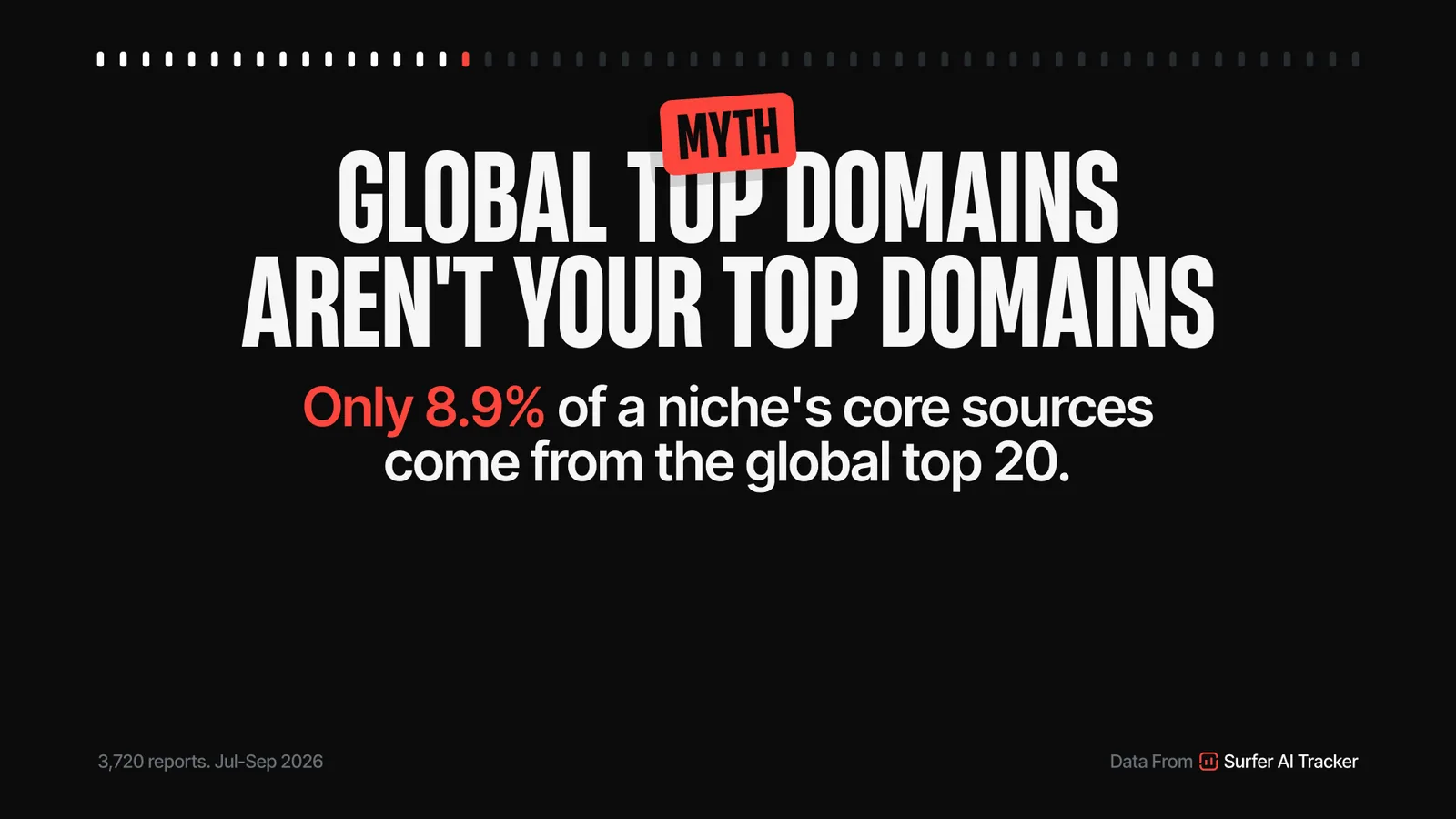
- of a niche’s core sources come from the global top 20 domains everyone tells you to chase.
- 95%
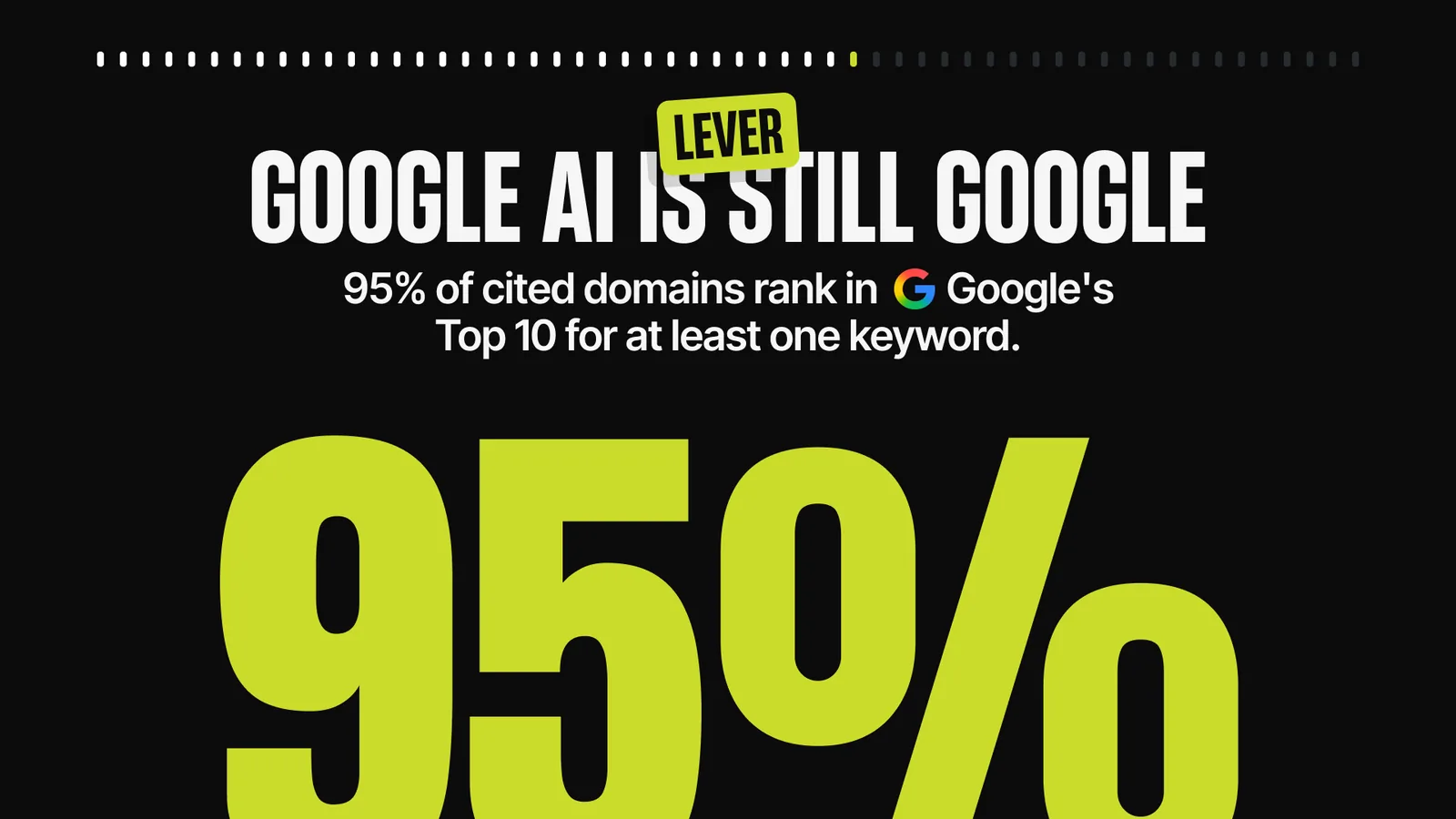
- of cited domains already rank in Google’s top 10 for at least one keyword.
- ⅓
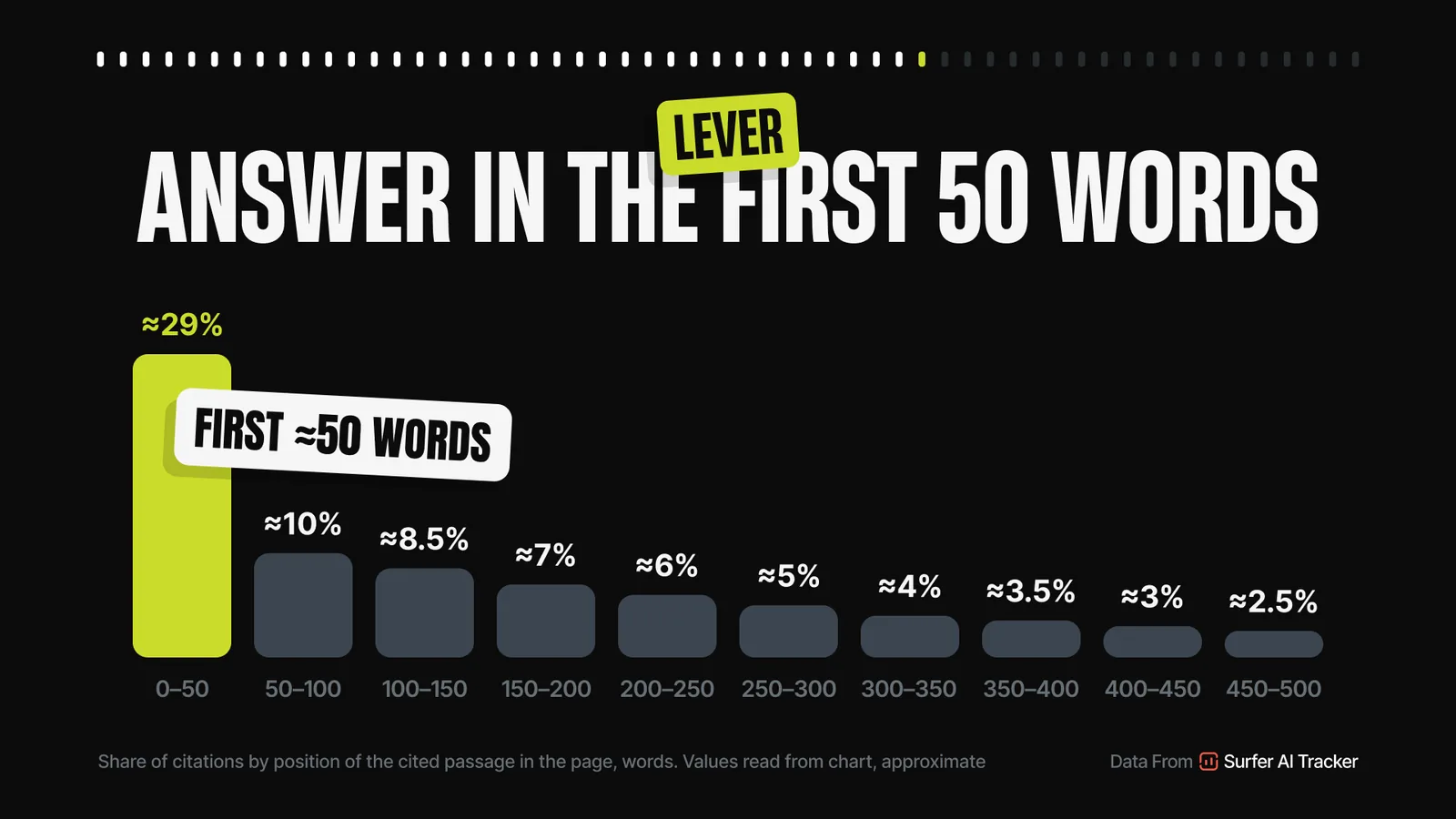
- of all citations come from the first 50 words of a page.
- 42% vs 13%
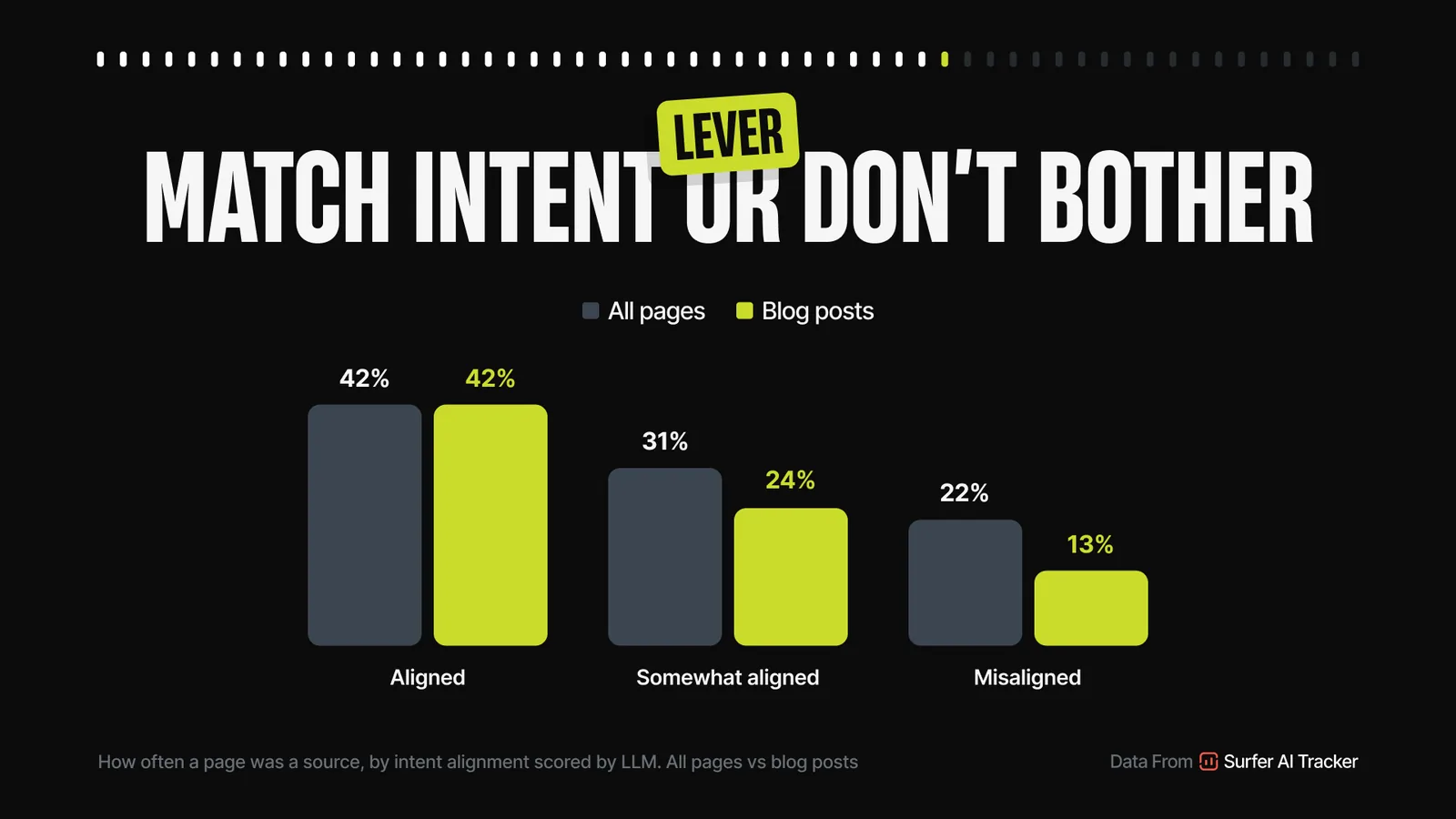
- how often a page that matches the intent is cited as a source, compared with an off-intent blog post.
The playbook
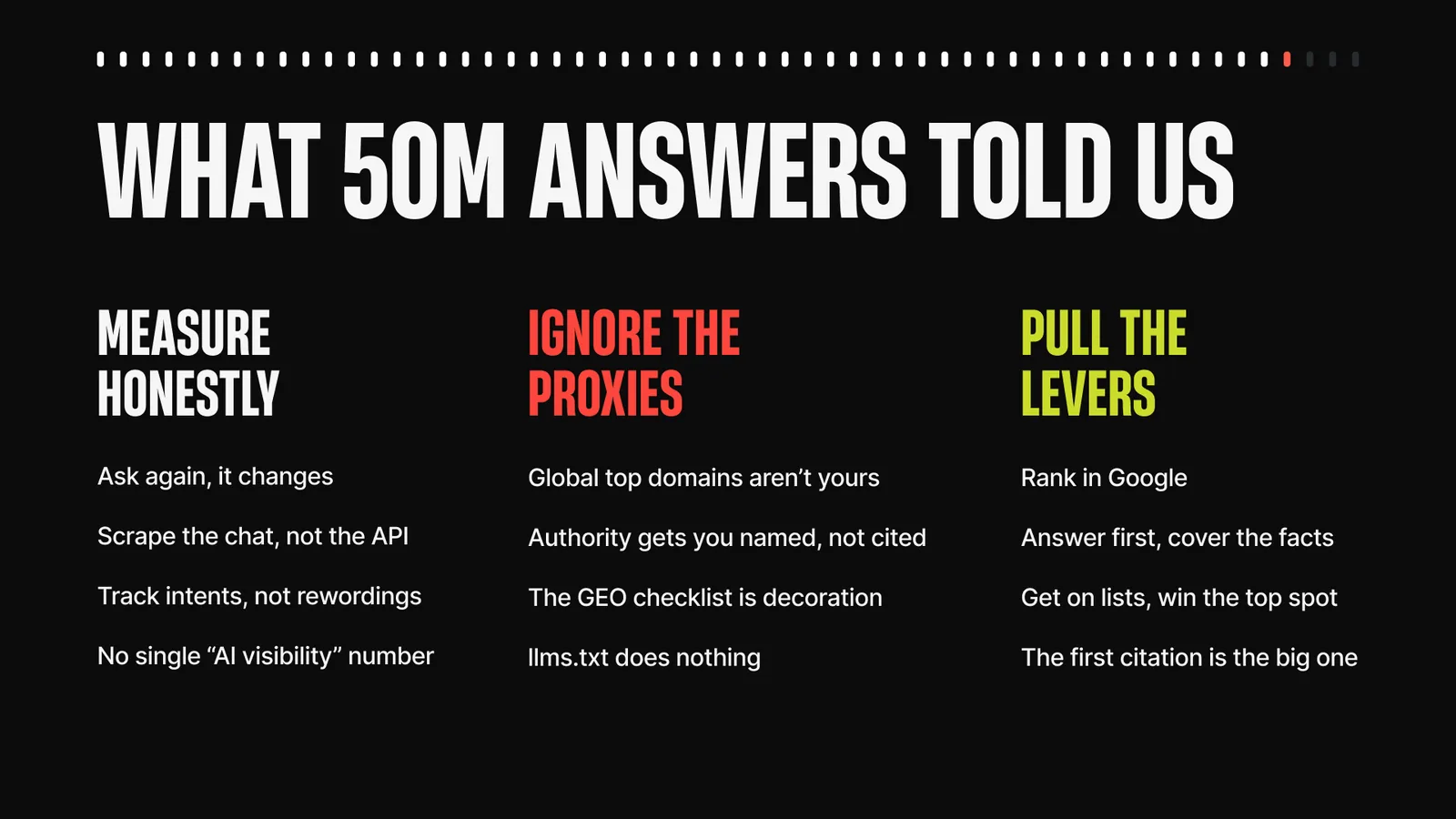
Measure honestly, ignore the proxies, pull the levers
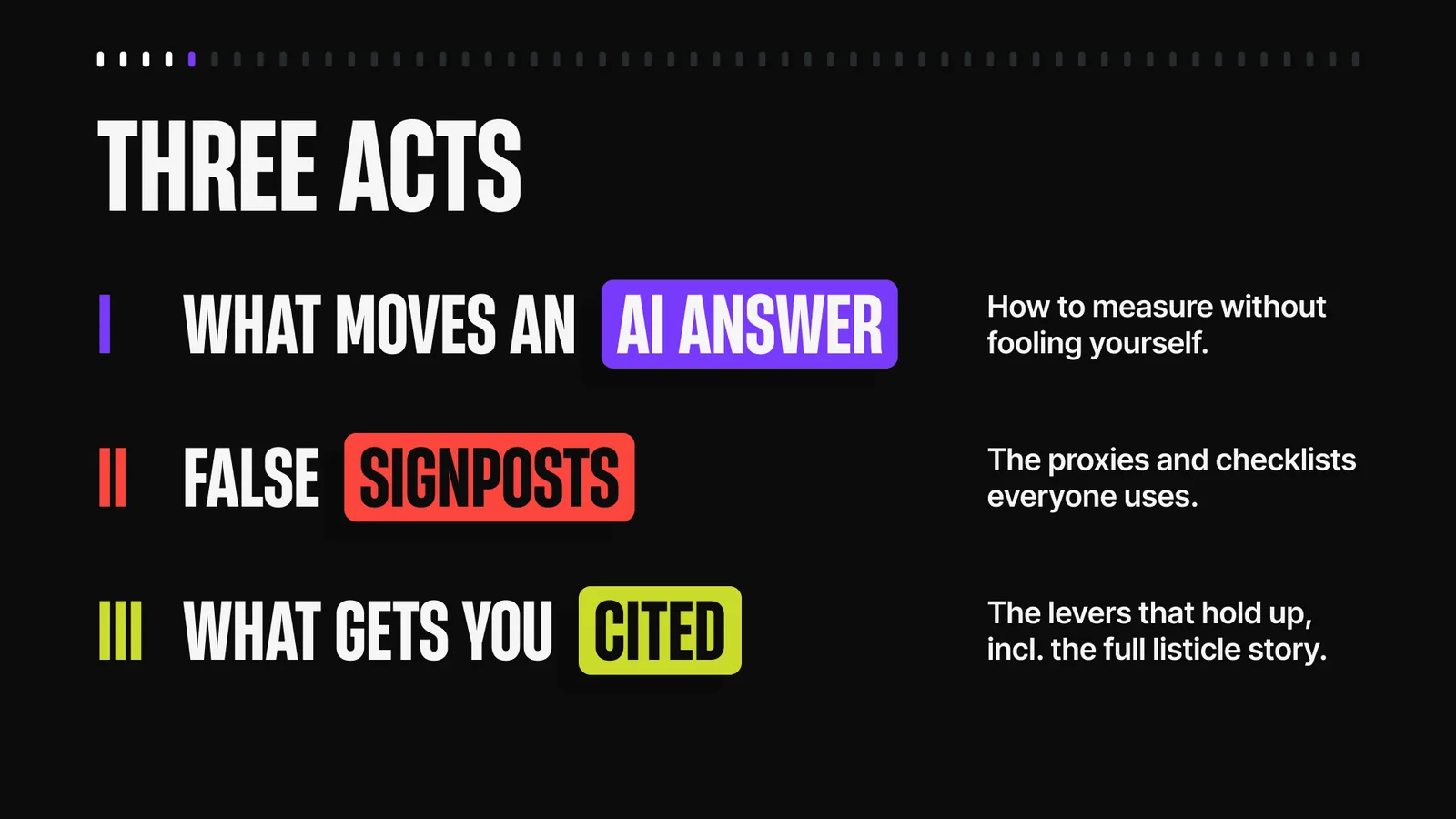
The three acts of the talk as a checklist. Start with measurement: without it you can’t tell a lever from noise.
AI answers are noisy. Some of it you can’t remove; the measurement error you can stop adding yourself.
- Rule
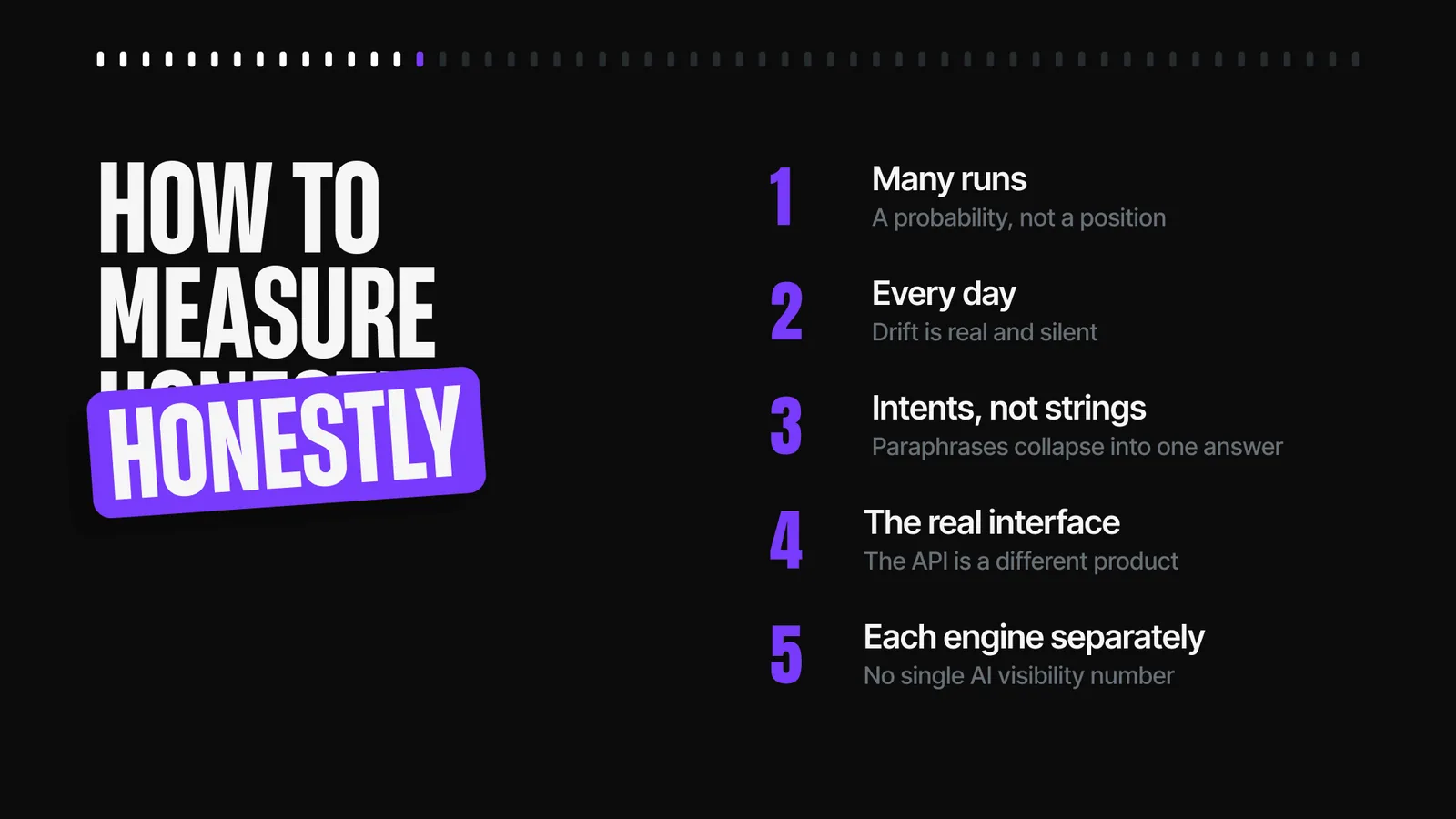
Run every prompt many times.
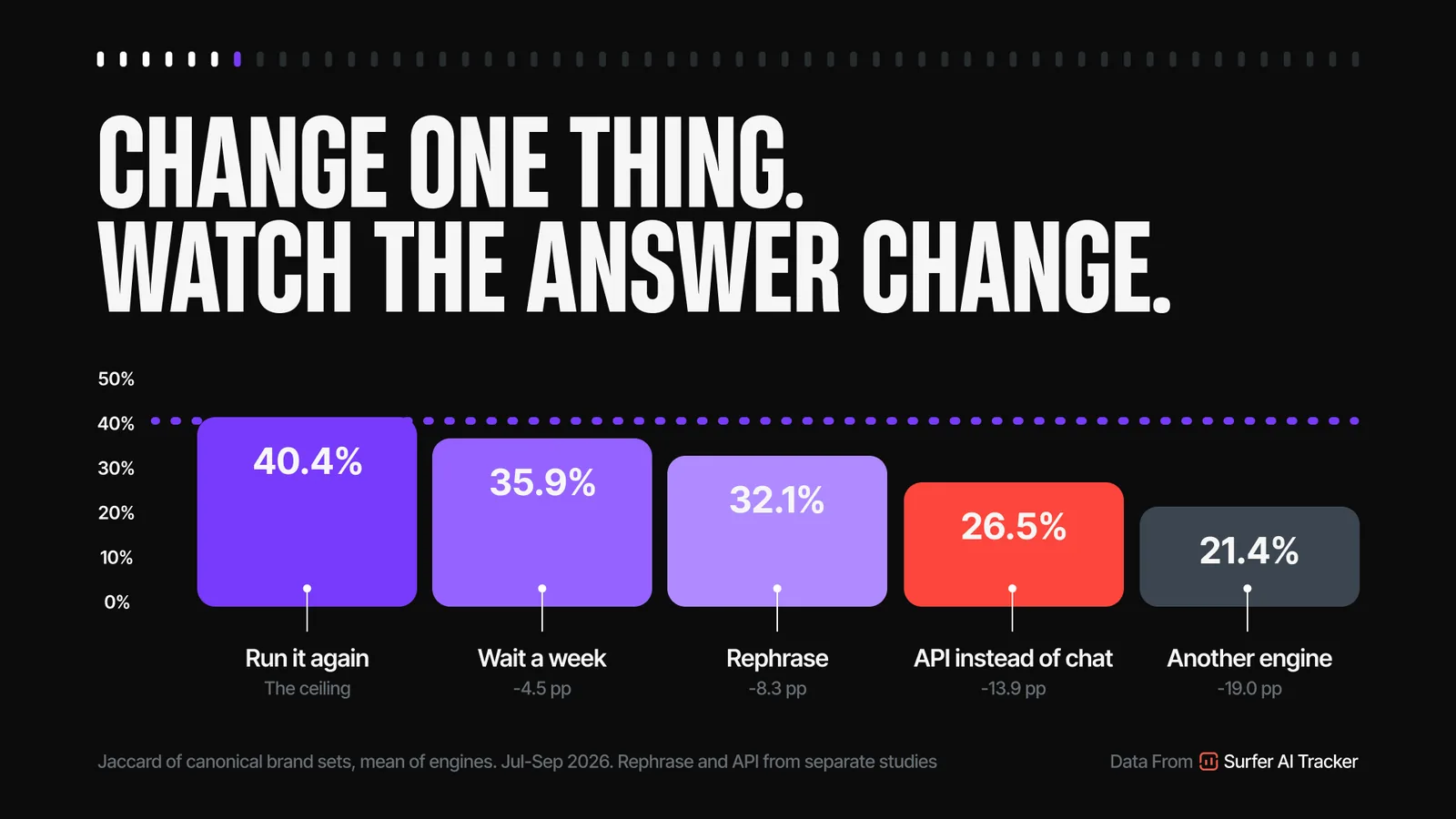
Two runs of the same prompt share only 40% of brands. After 20 runs, just 4% of brands appear every single time. One run is an anecdote.
- Rule
Track every day, judge over weeks.
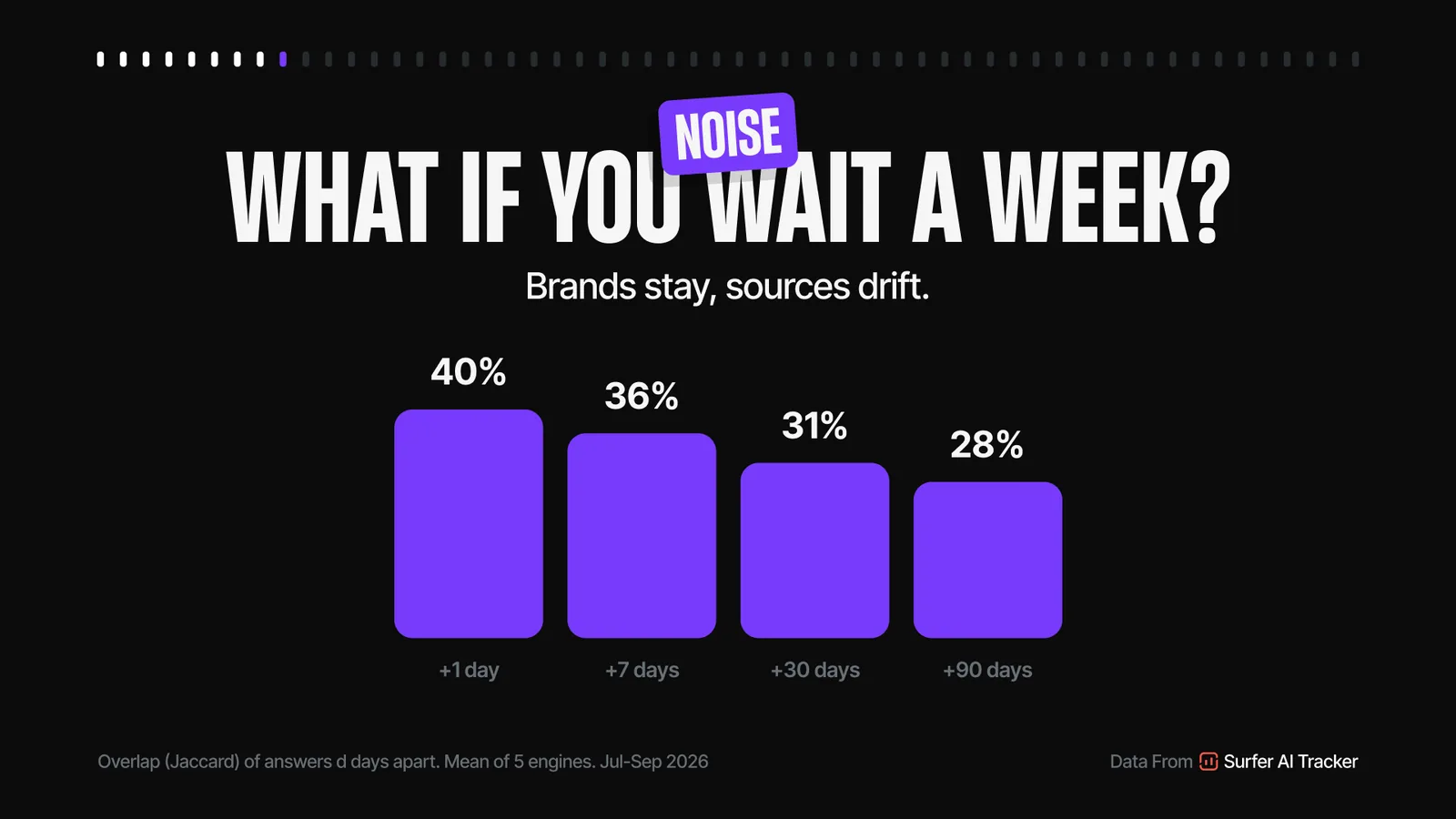
Day to day is mostly noise, but answers drift: brand overlap falls from 40% the next day to 28% after 90 days.
- Rule
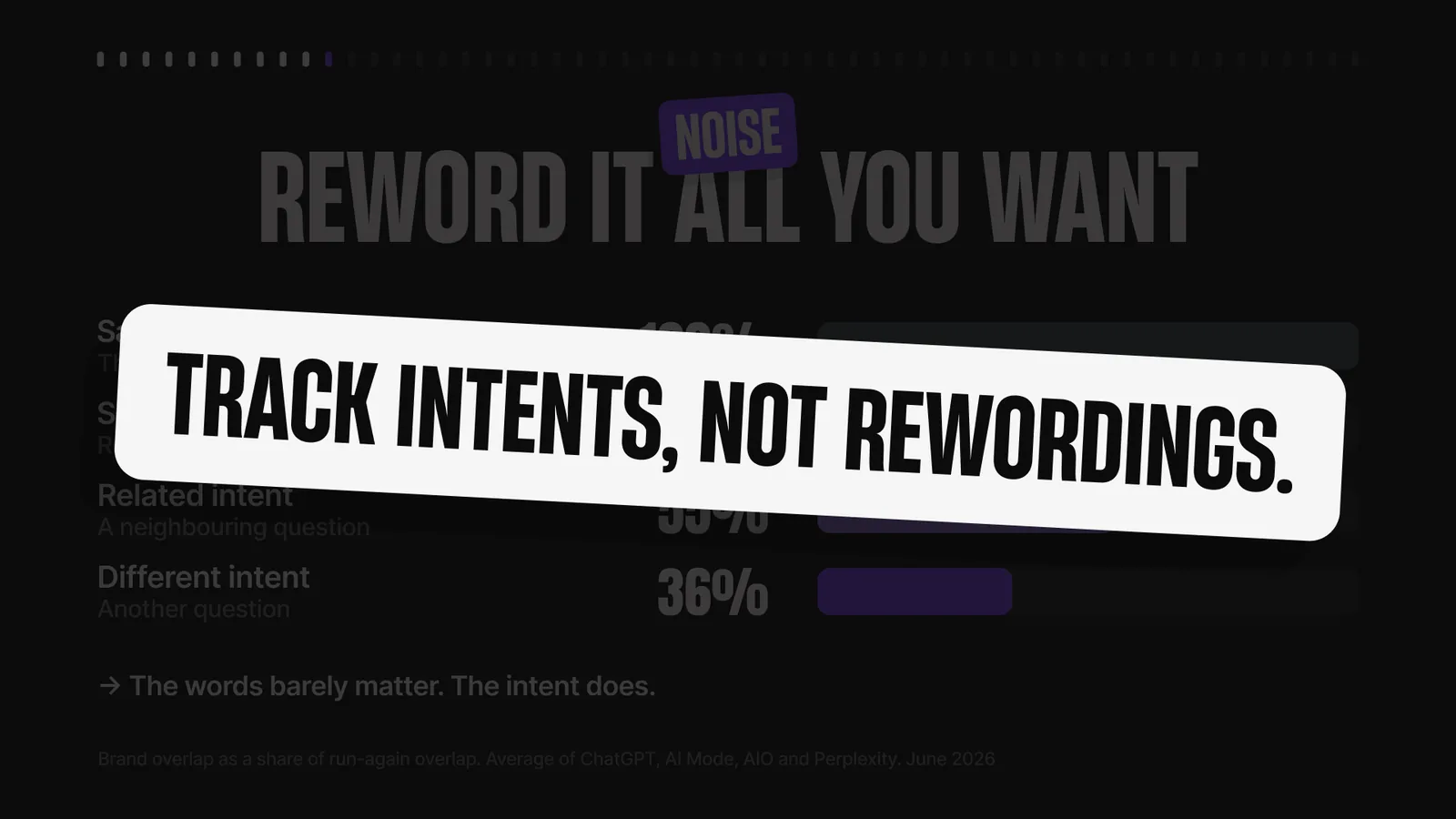
Track intents, not rewordings.
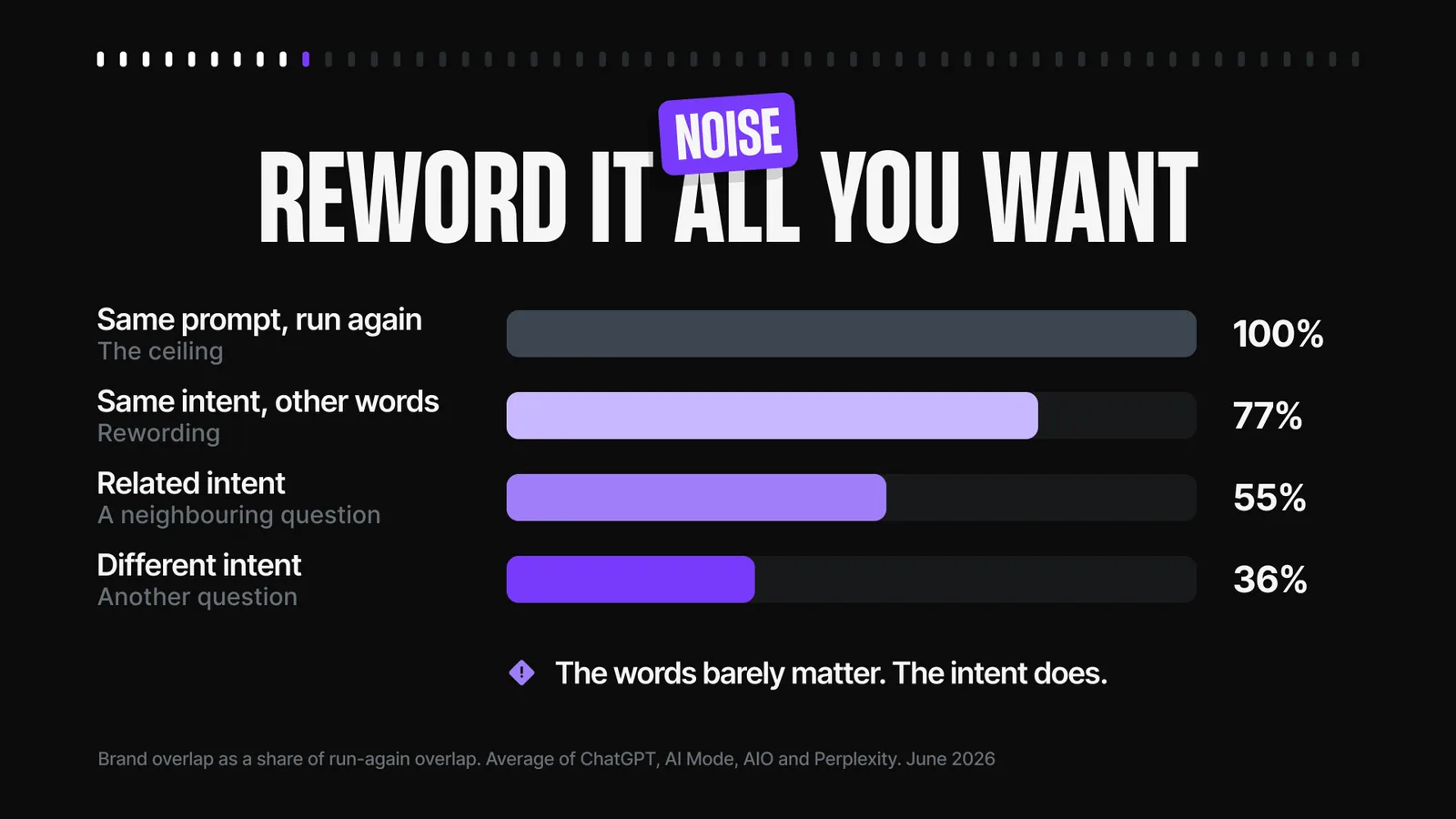
Rewording a question keeps about three quarters of its brands. A different intent keeps barely a third. A hundred variants of one question is money spent on the same answer.
- Rule
Scrape the real interface, not the API.
Only 29–42% of an API answer’s top-3 brands make the top 3 in the chat people actually use. The API is a different product.
- Rule
Report each engine separately.
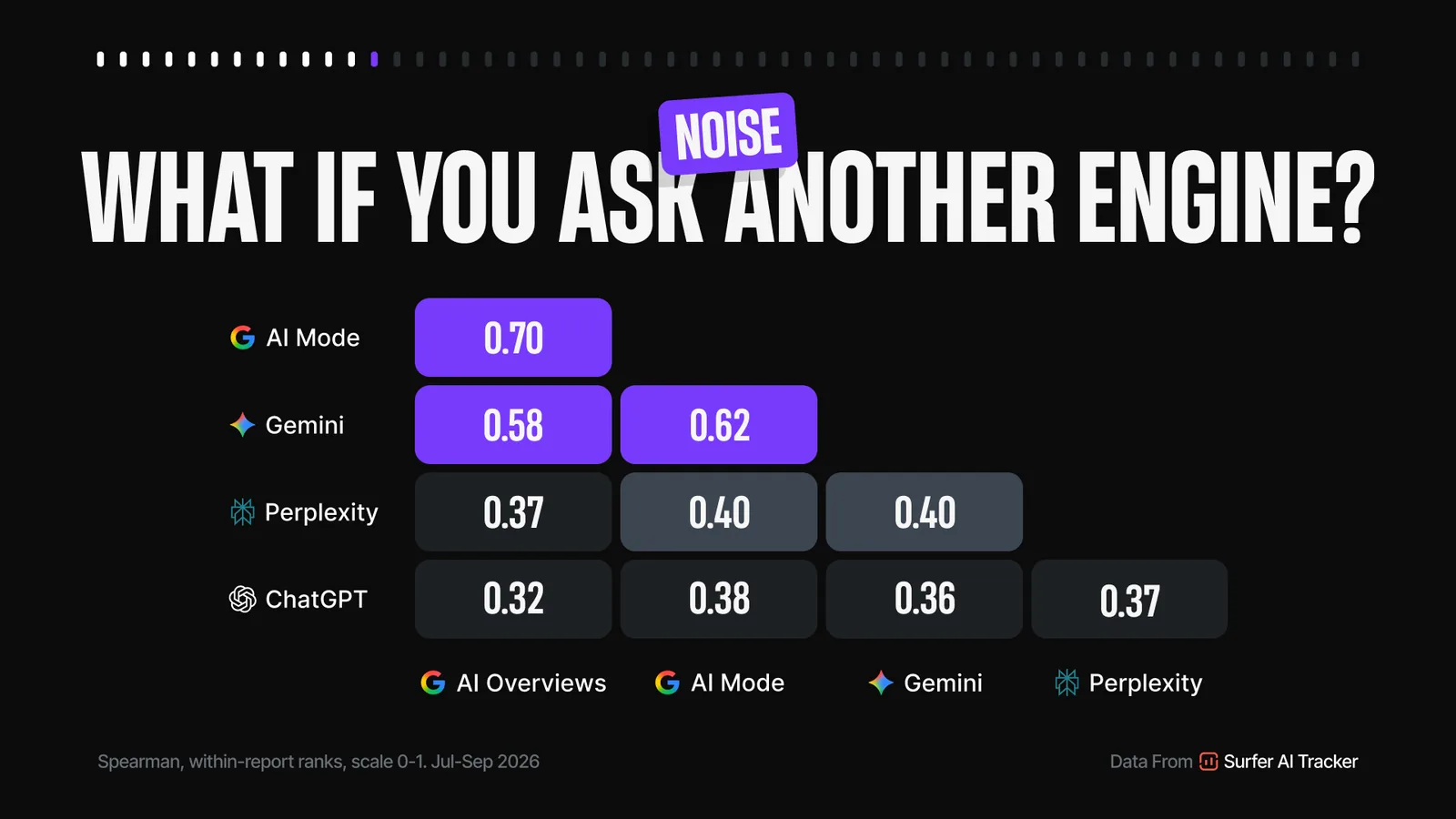
Google’s three surfaces move together; ChatGPT and Perplexity follow nobody. A single “AI visibility” number averages things that don’t belong together.
Because measuring is hard, everyone grabs a proxy. These are the popular ones, checked against citations.
- Myth
“Get on Reddit and Wikipedia, they win everything.”
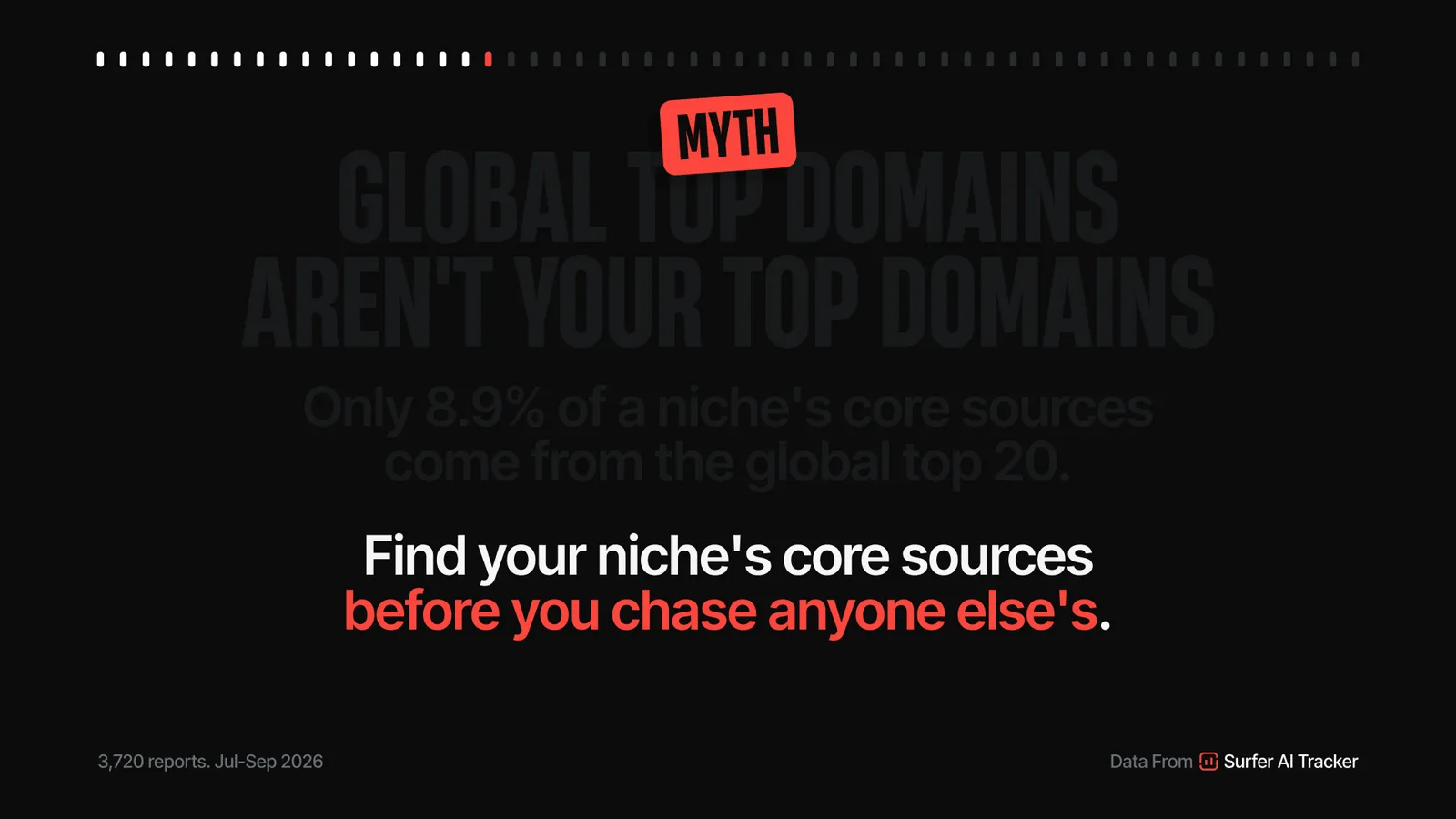
They top global rankings, but only 8.9% of a niche’s core sources come from the global top 20. Find the sources that win in your niche first.
- Myth
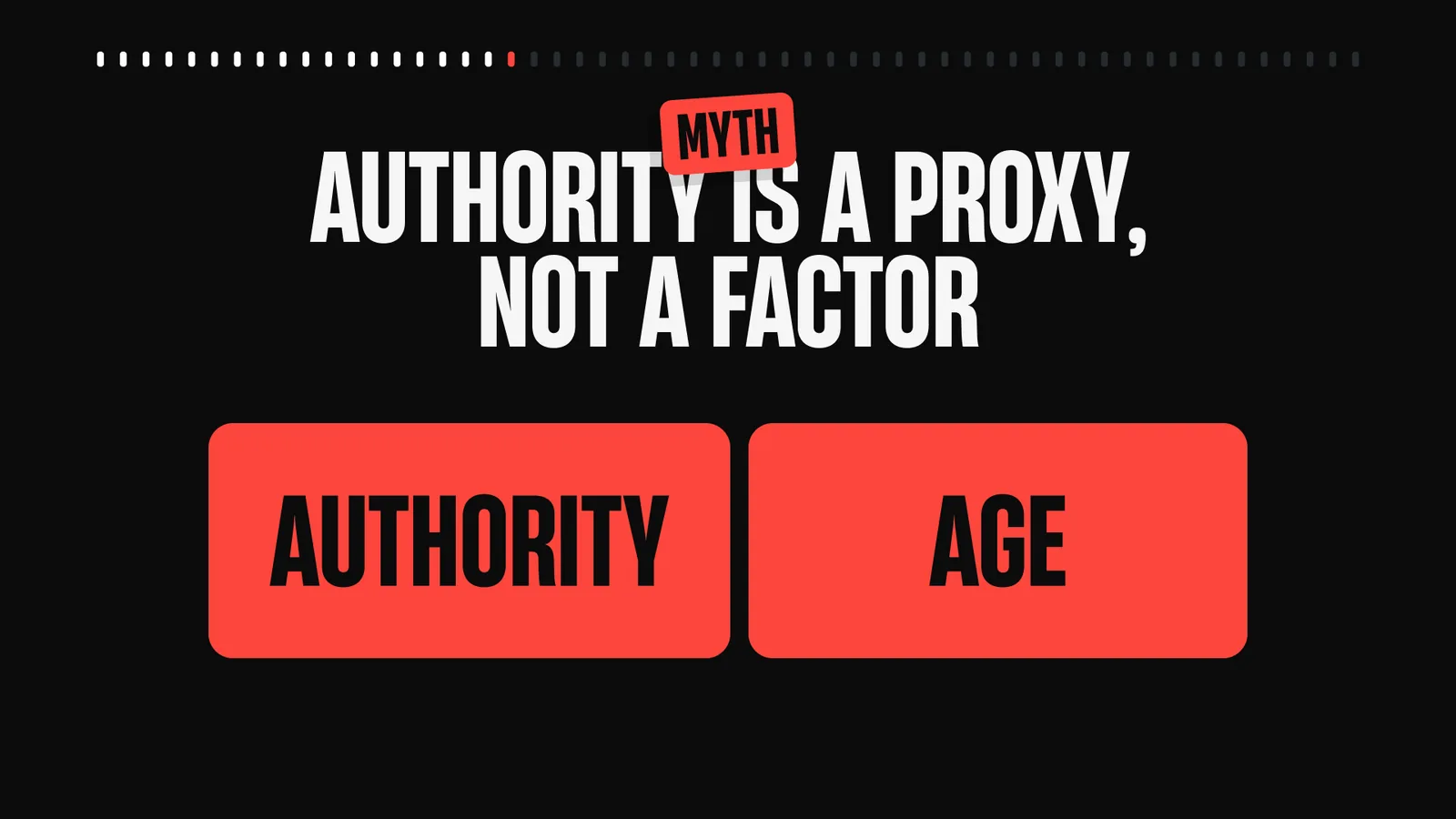
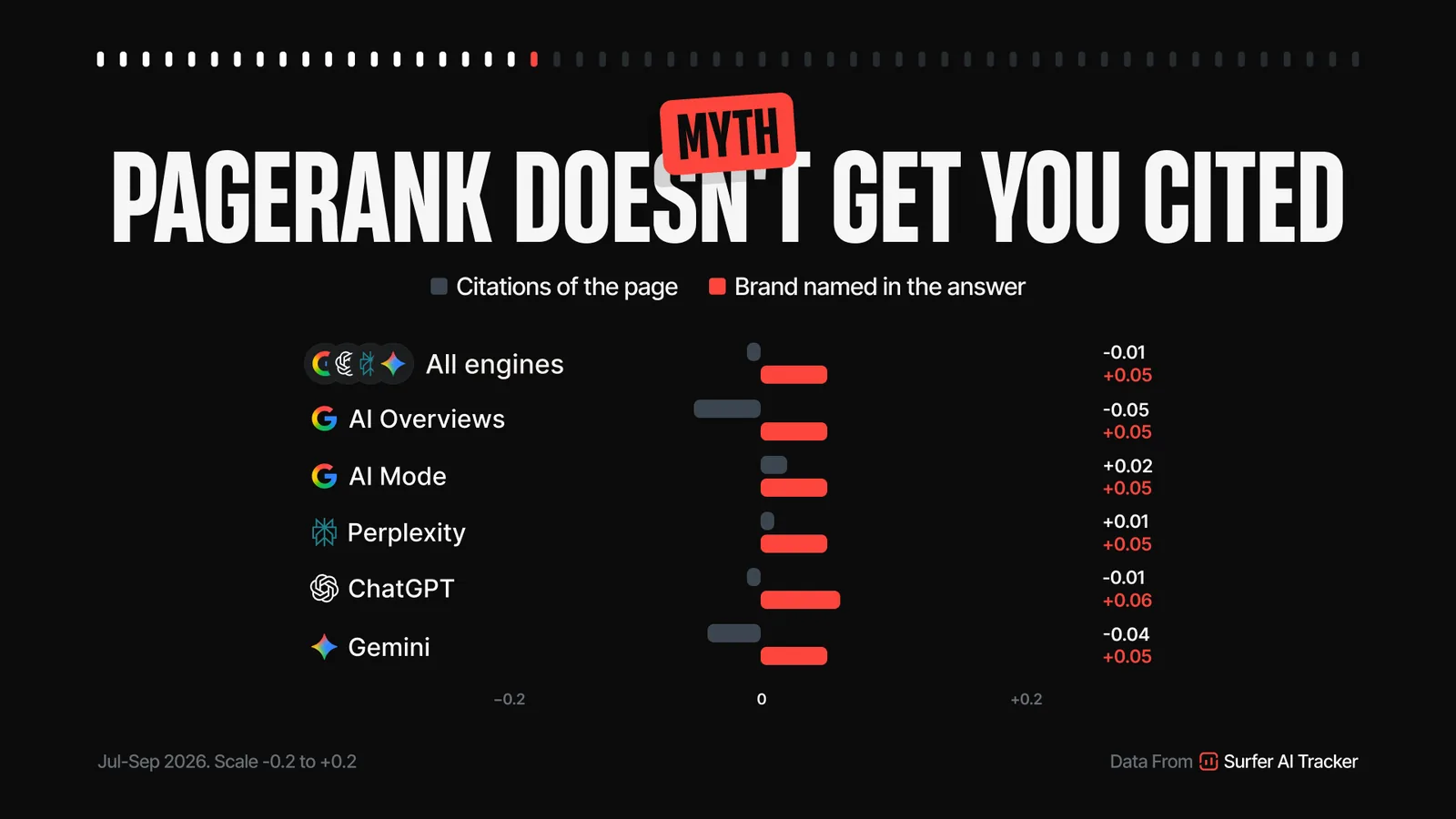
“Domain authority gets you cited.”
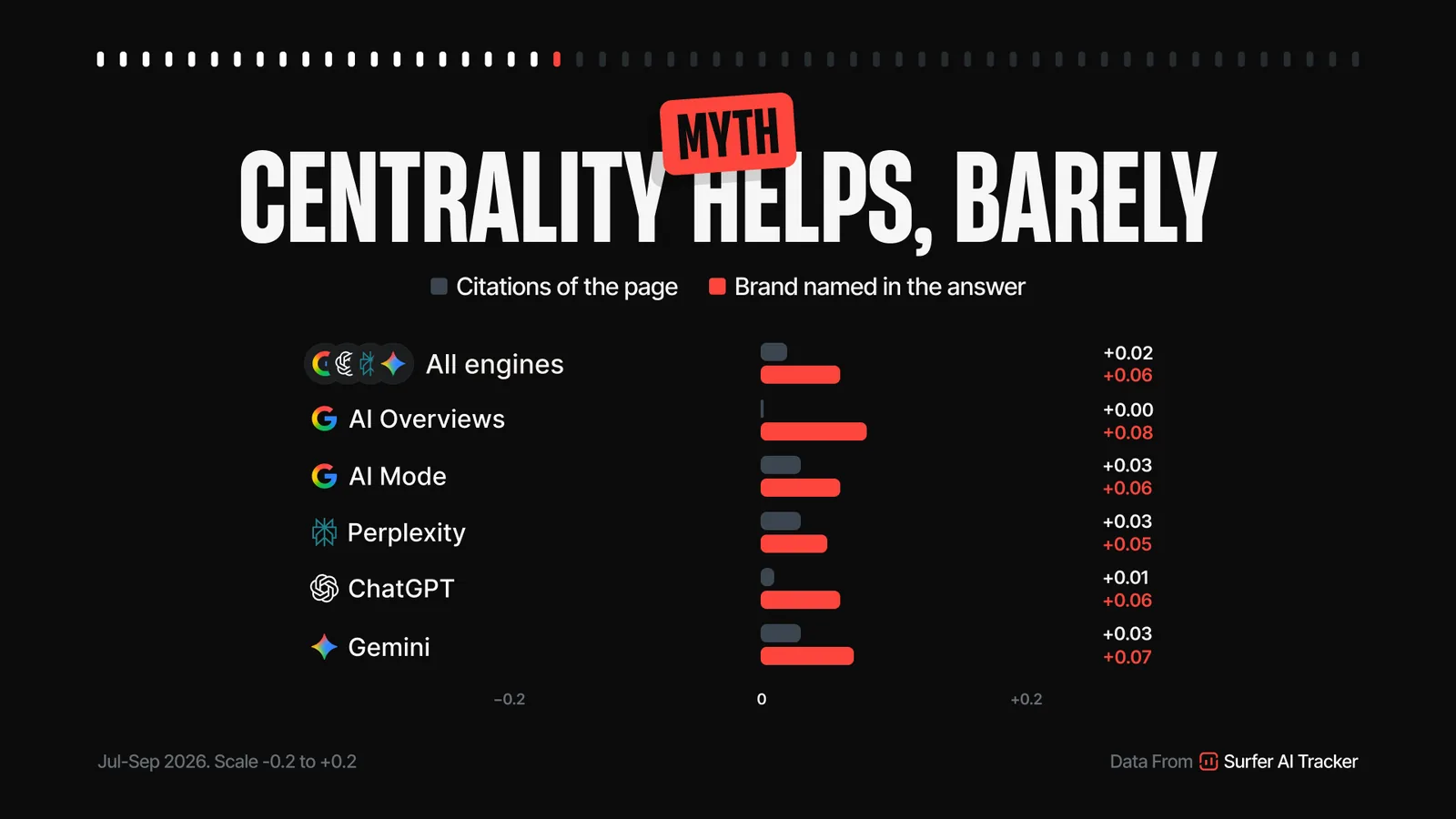
PageRank against citations is flat zero on every engine. Harmonic centrality is the one authority metric that points up, and covering the facts matters about eight times more.
- Myth
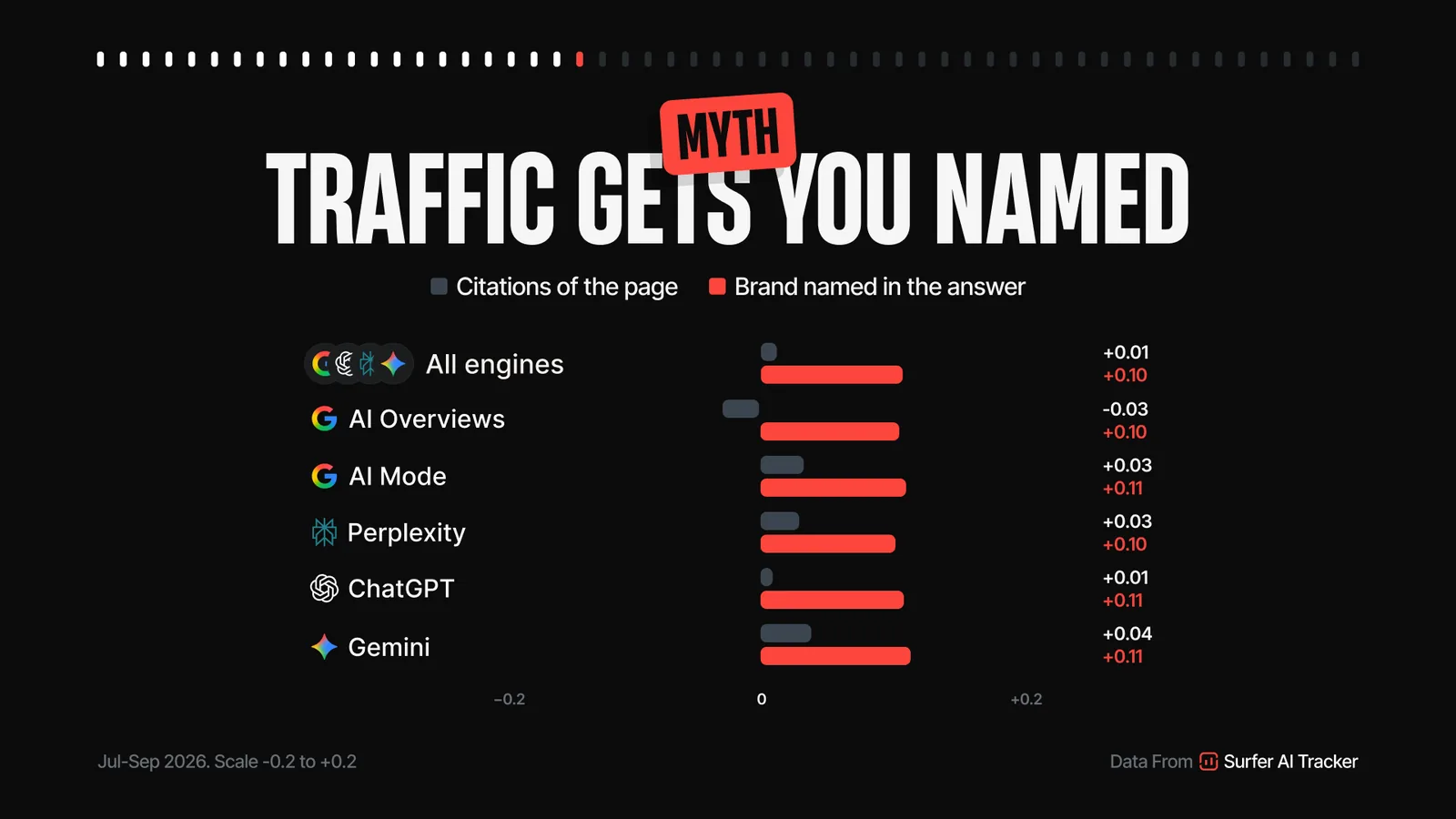
“Big sites get cited.”
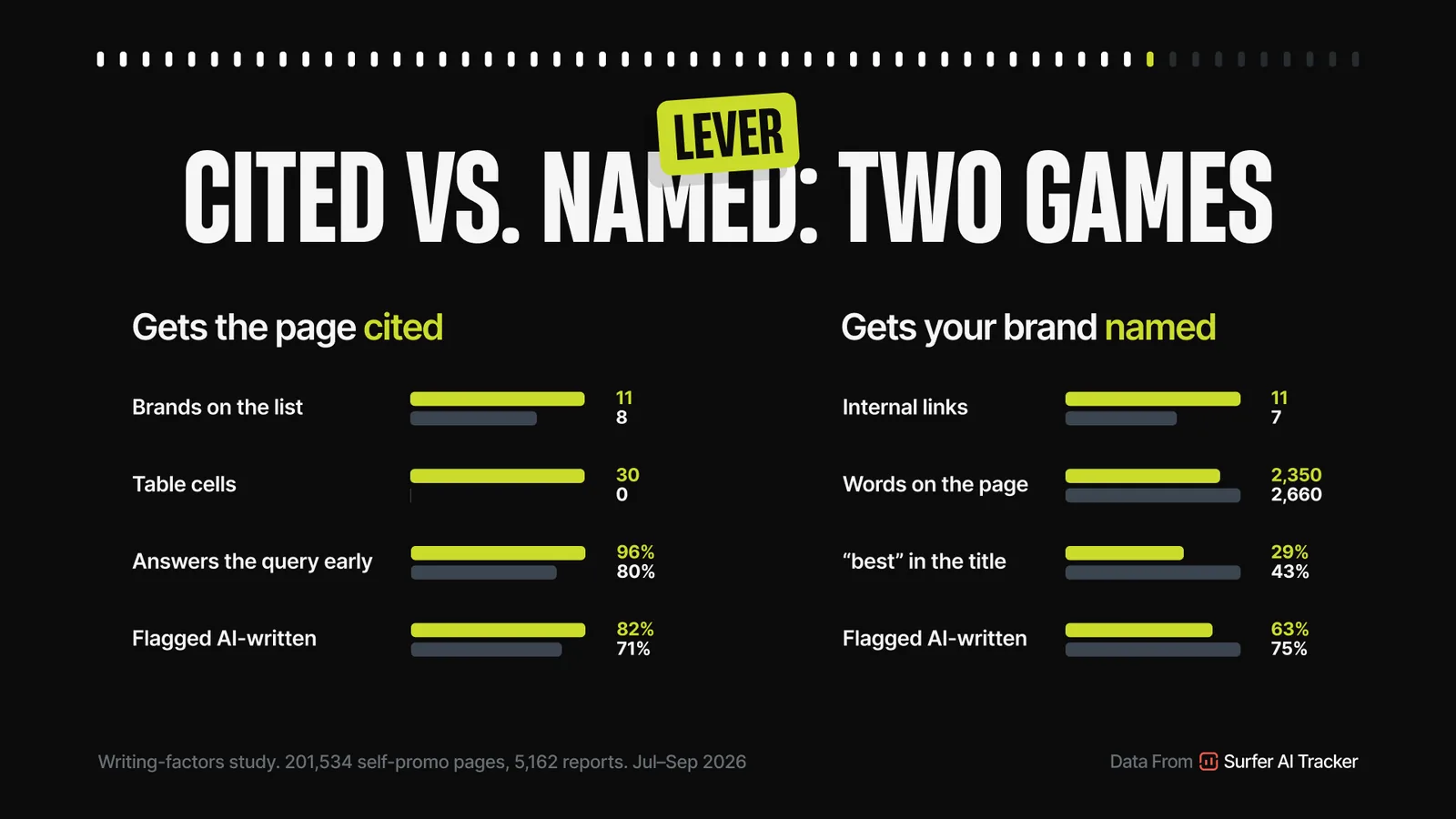
Big sites get their brand named more often, but their pages aren’t cited more. Big isn’t the same as cited.
- Myth
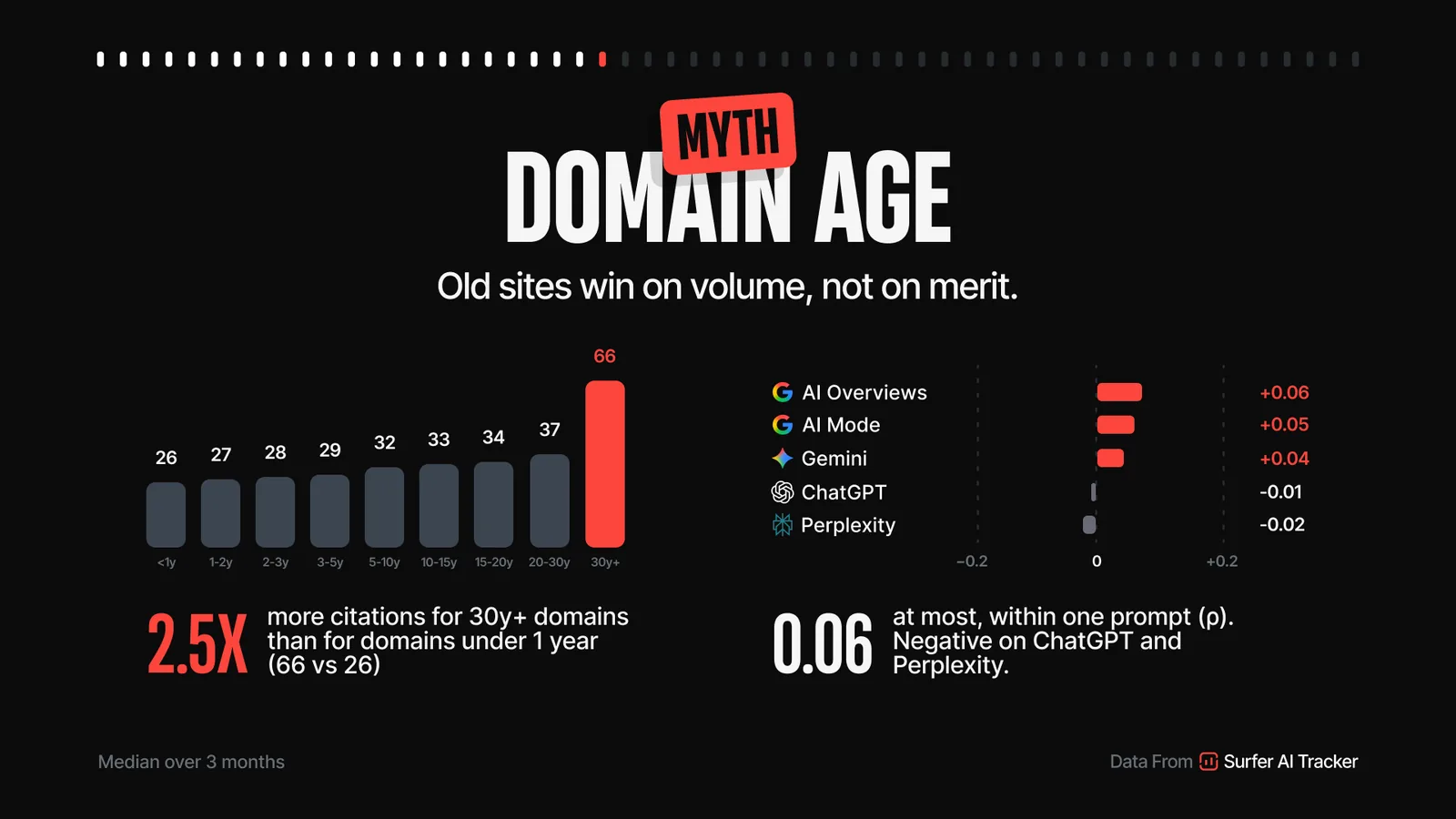
“Old domains are trusted more.”
Old domains win on volume because they have more pages. Inside one prompt, domain age barely matters and even flips sign on ChatGPT and Perplexity.
- Myth
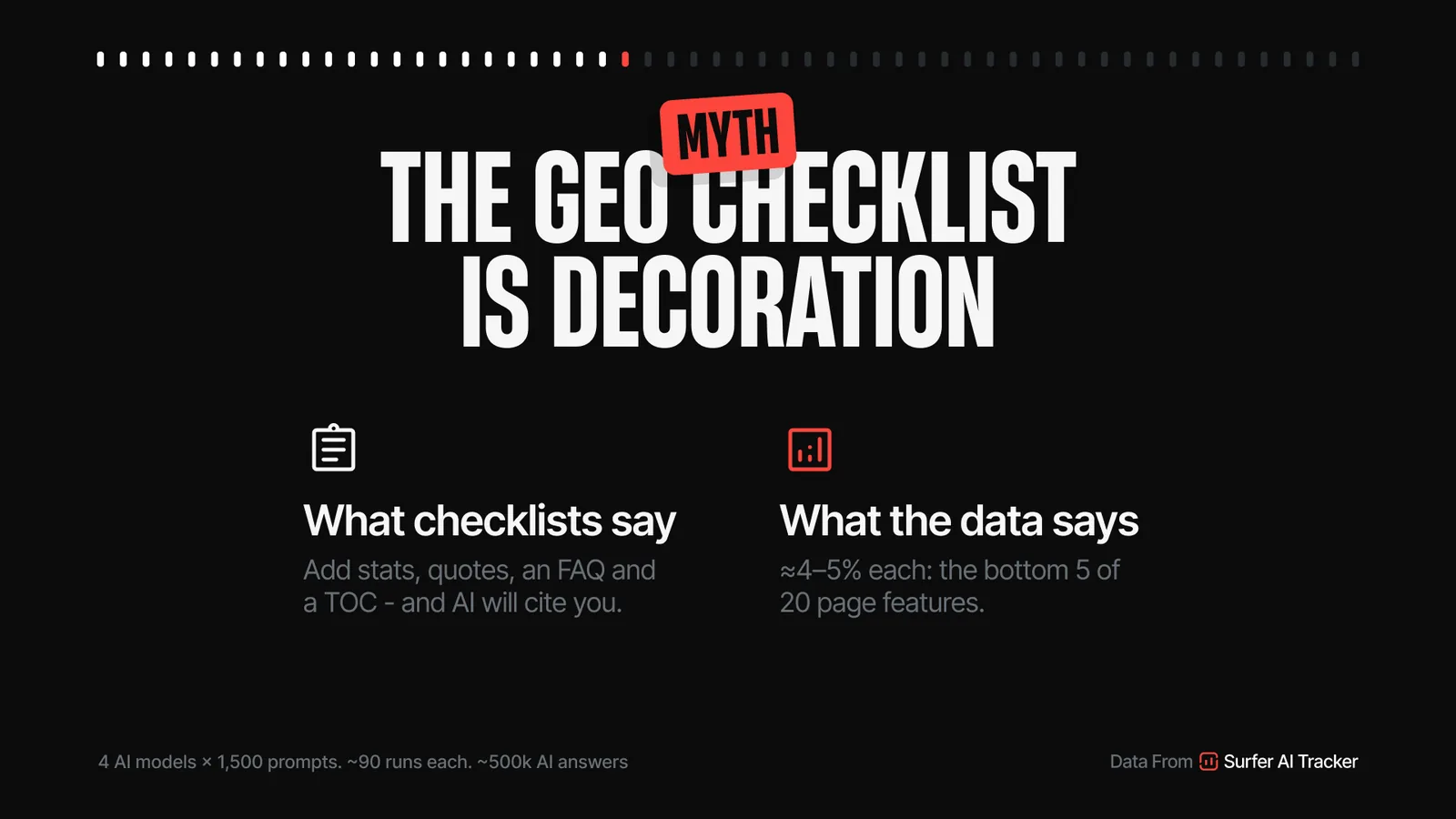
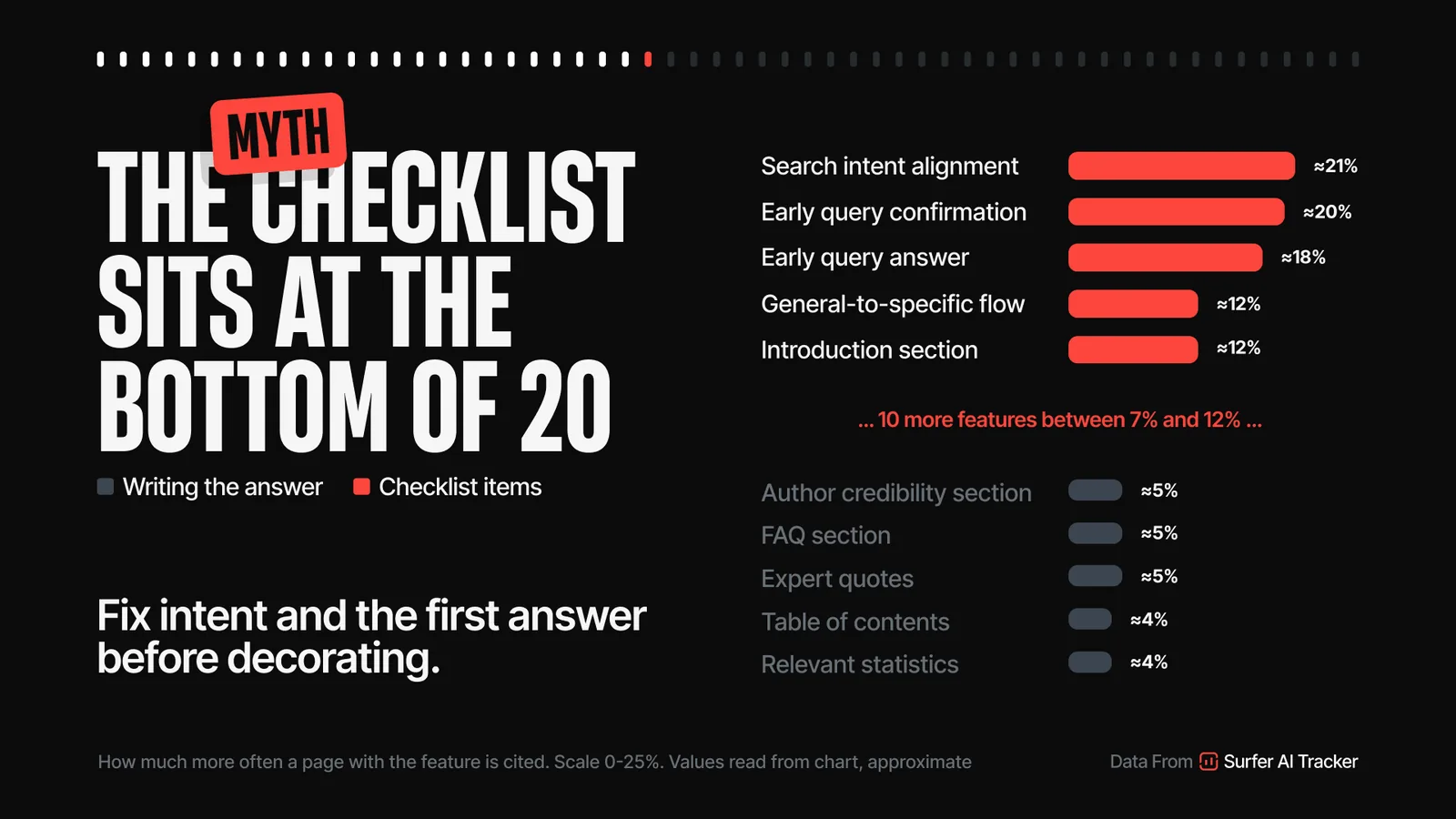
“Add stats, quotes, an FAQ and a table of contents.”
Every checklist item sits at the bottom of 20 page features. Answering the query early is worth four to five times more.
- Myth
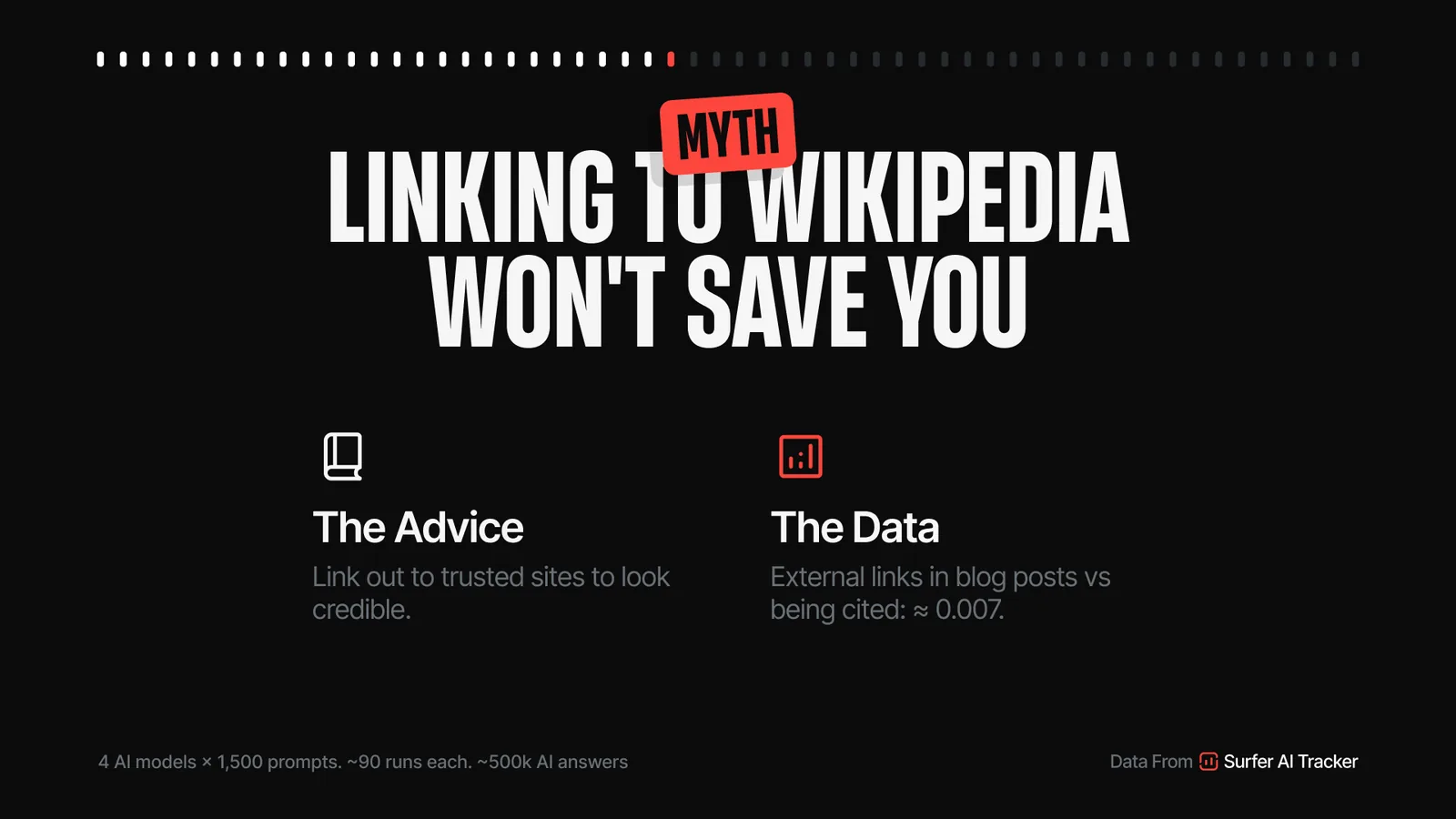
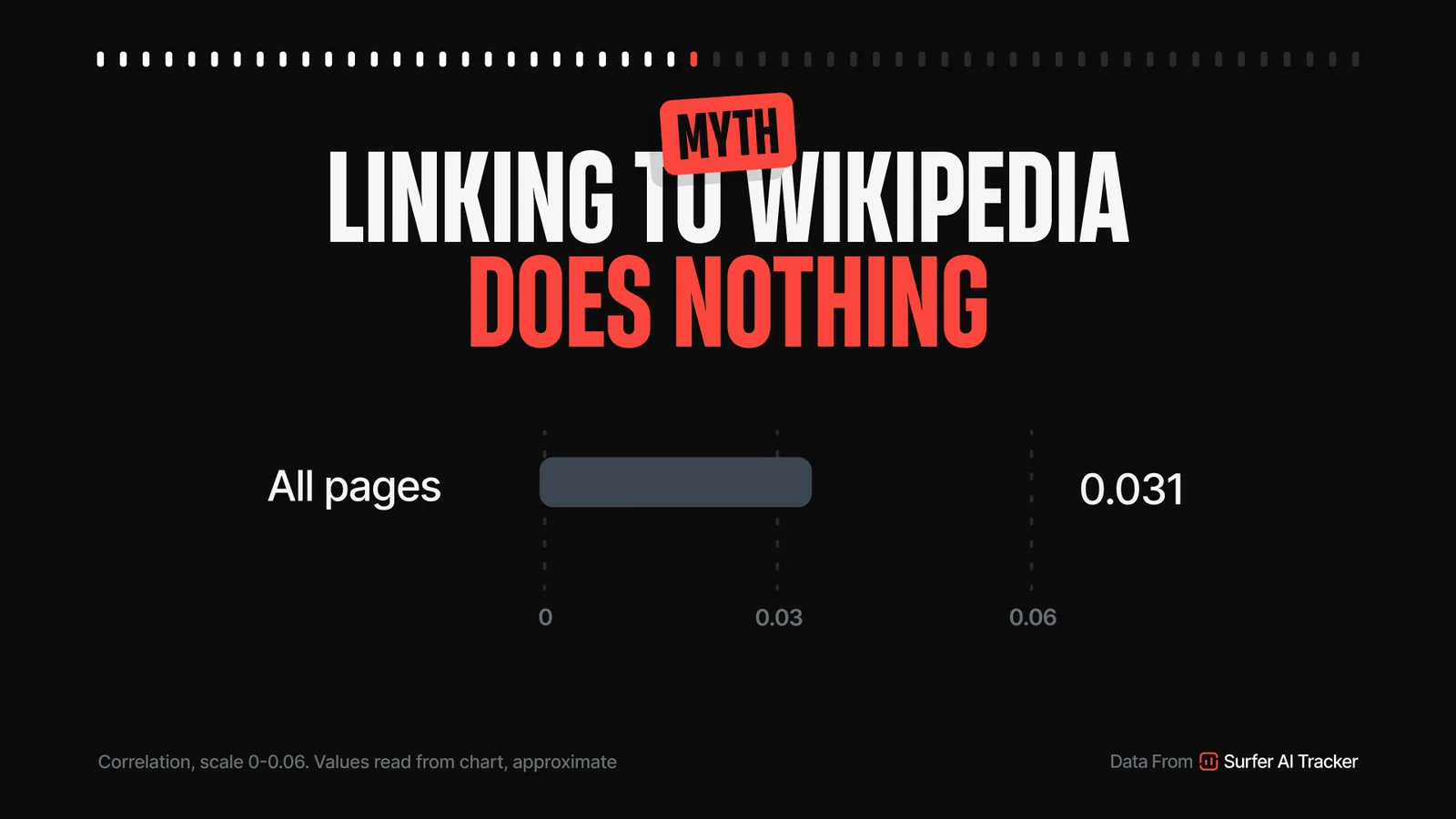
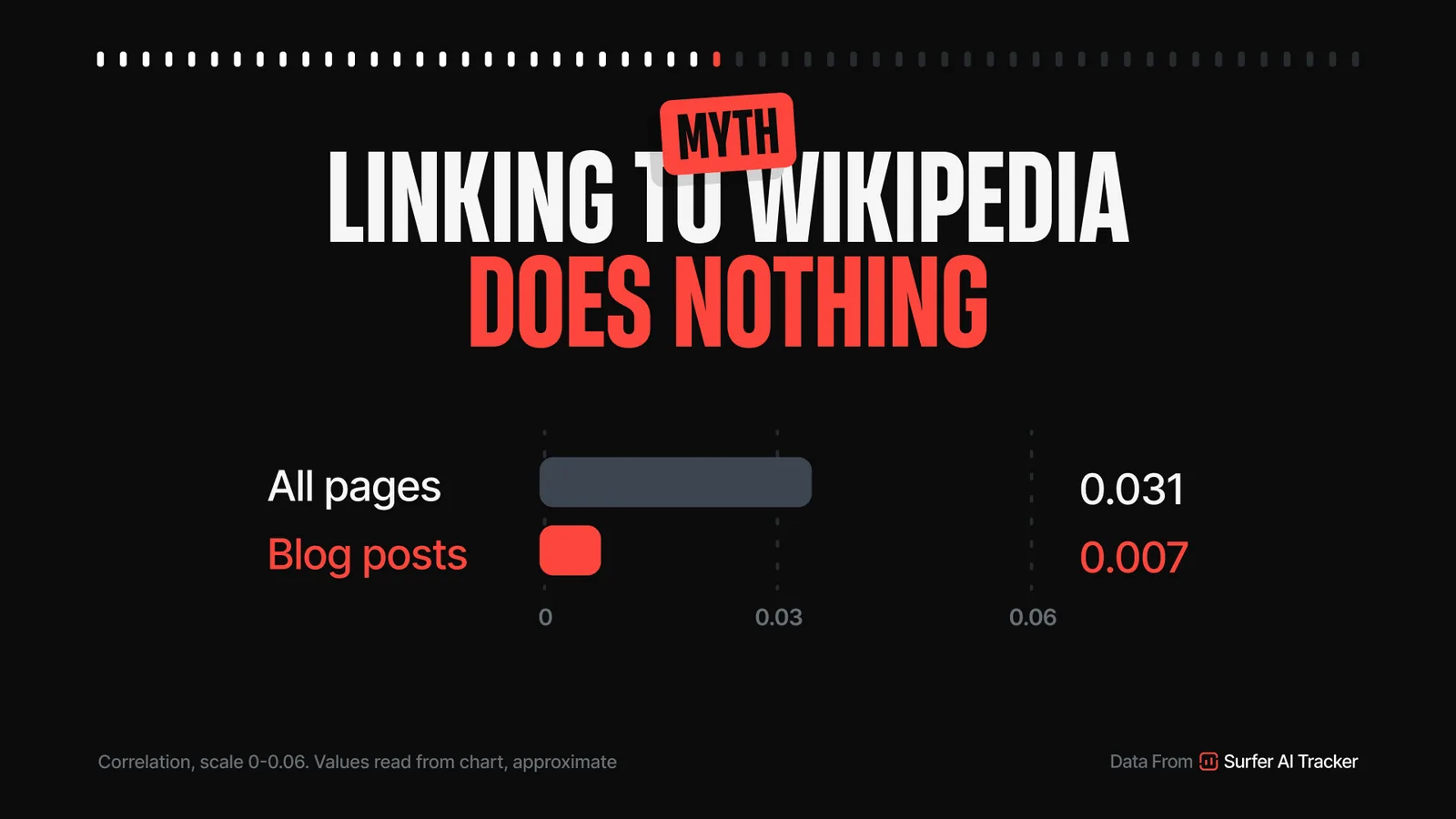
“Link to Wikipedia so AI trusts you.”
External links correlate with being cited at 0.03 across all pages and 0.007 in blog posts. That’s noise.
- Myth
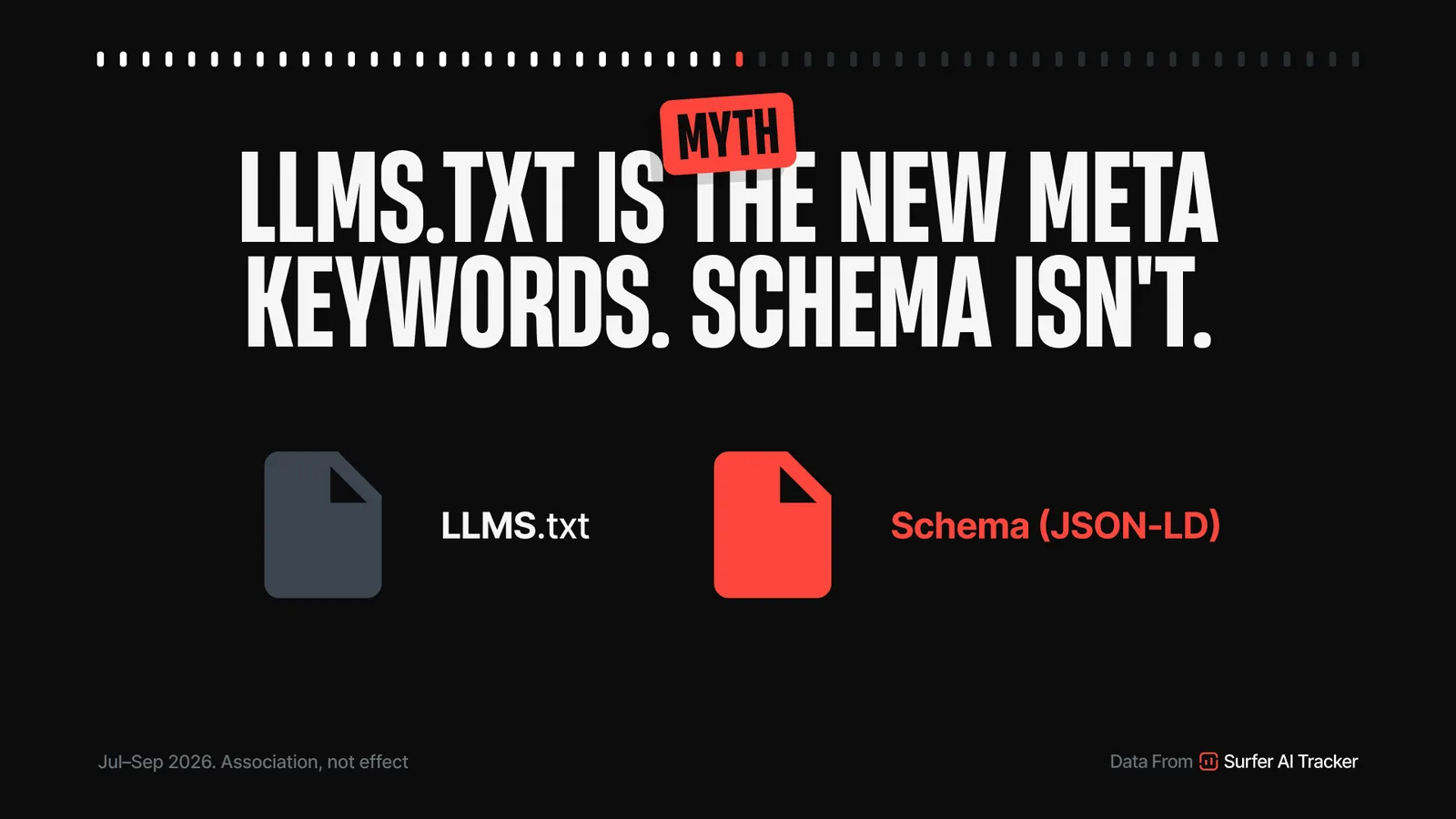
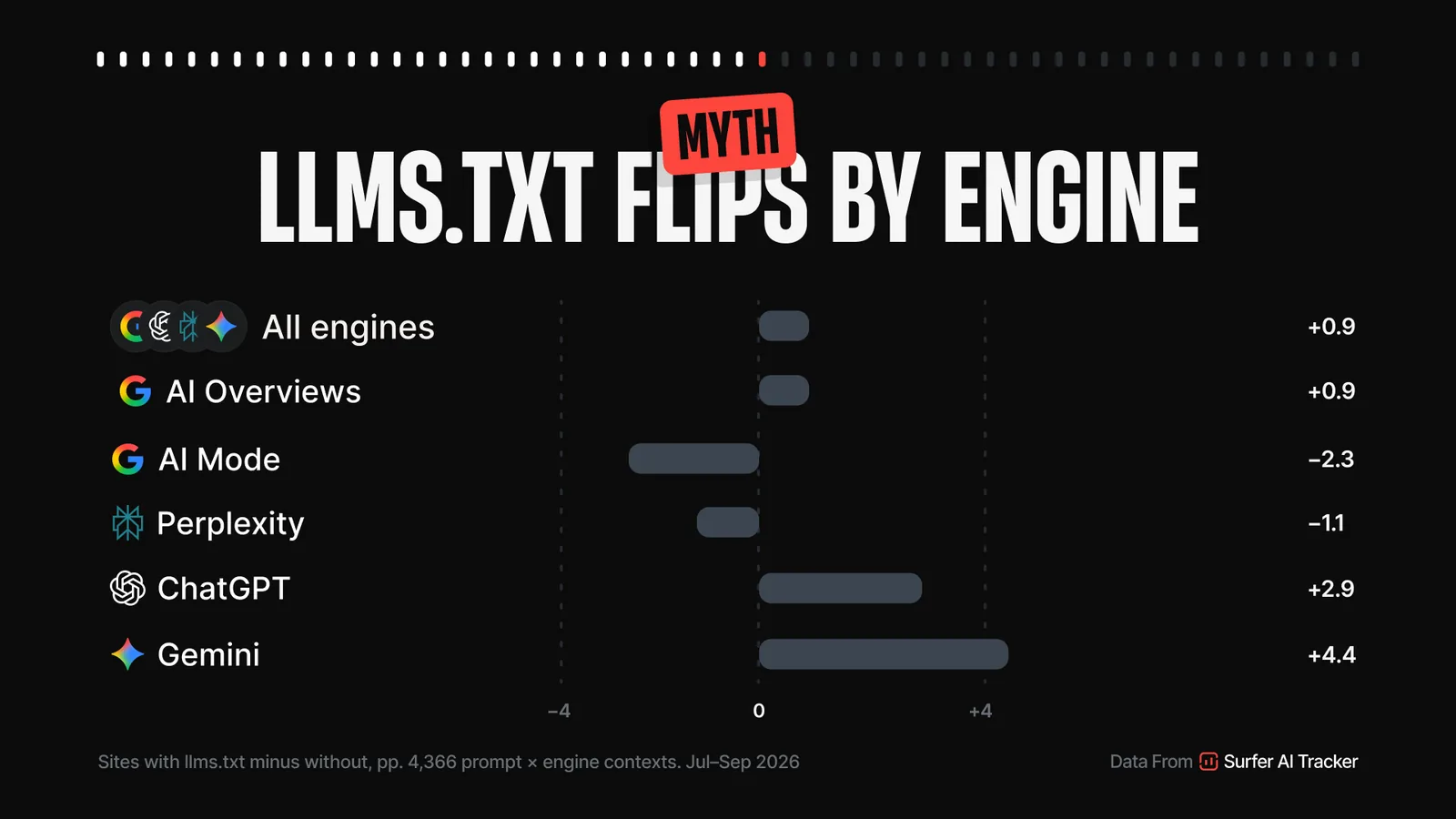
“Add llms.txt.”
llms.txt flips sign from engine to engine, up on Gemini and down on AI Mode. That’s not a signal.
- Partly
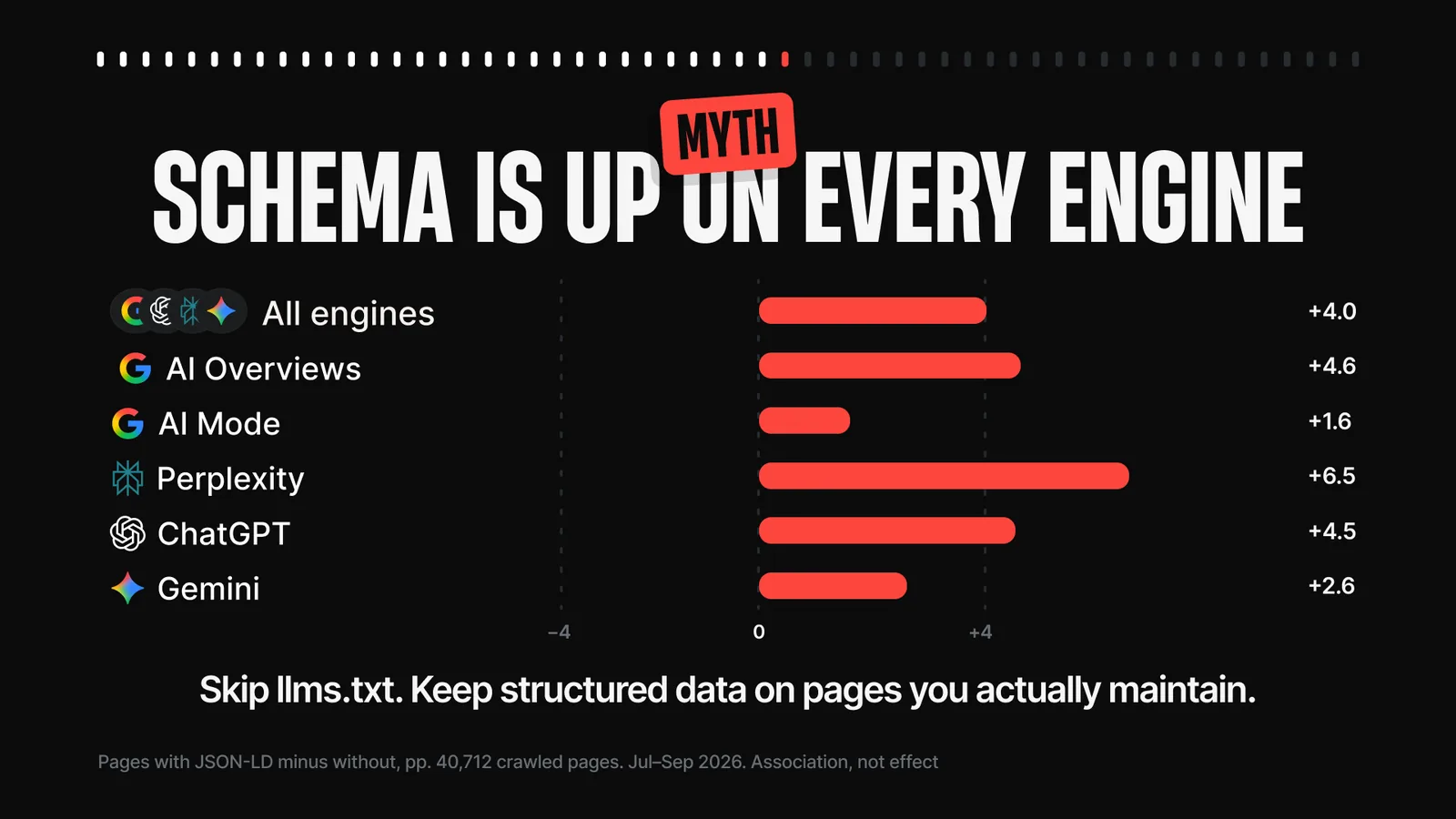
“Add schema.”
Schema is up on every engine, mostly because it marks sites someone actually maintains. Keep structured data on pages you look after; skip llms.txt.
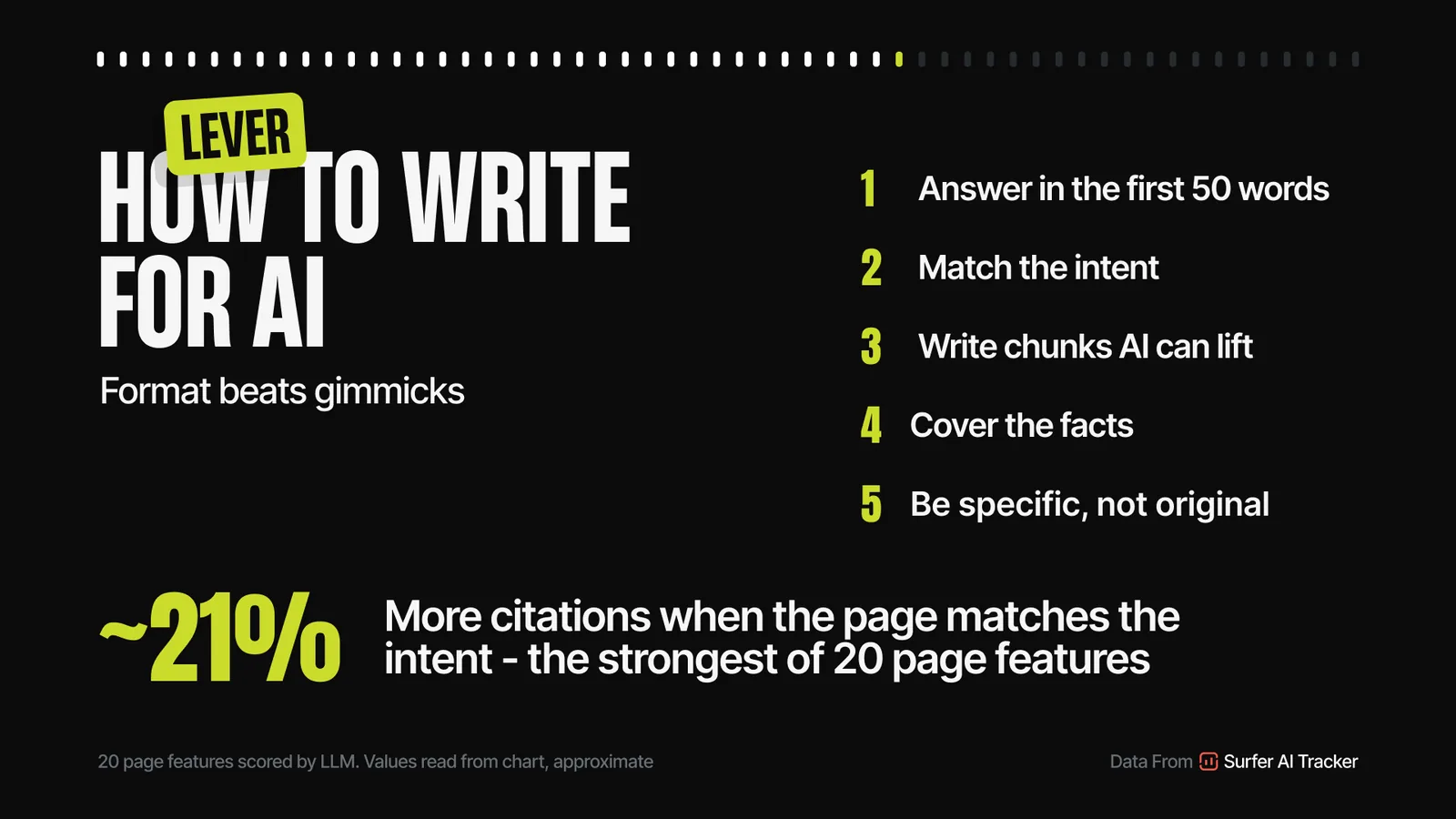
What holds up in the data. For the full listicle playbook, see the follow-up talk Who writes the list?
- Lever
Rank in Google first.
95% of cited domains rank in Google’s top 10 for at least one keyword. SEO isn’t dead; it’s the entry ticket.
- Lever
Go after the first citation of your own site.
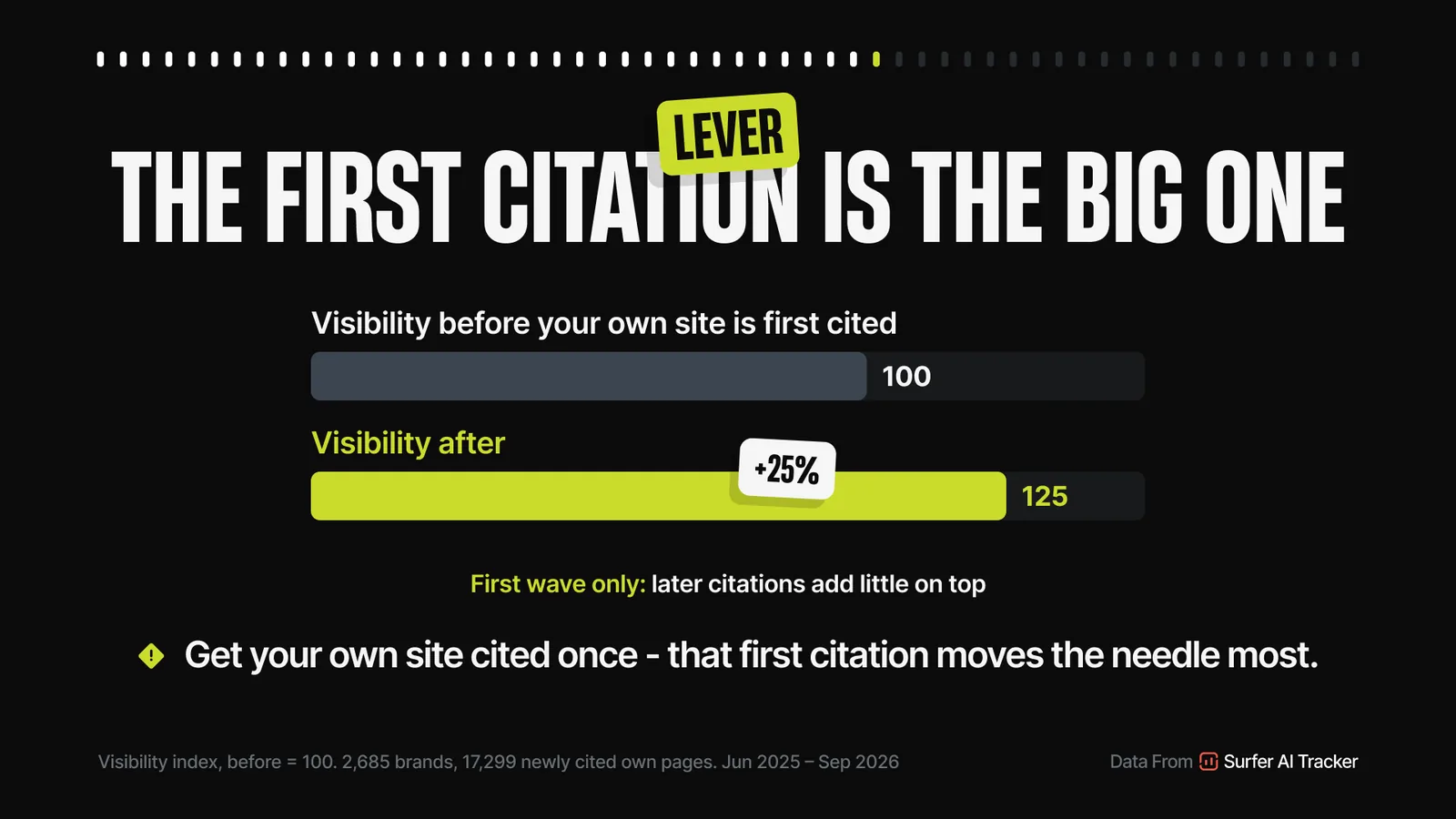
The first time your own site gets cited is worth about +25% visibility. Later citations add little on top.
- Lever
Answer in the first 50 words.
Almost a third of all citations come from the first 50 words of a page. Answer immediately, not after the intro.
- Lever
Match the intent exactly.
A page that answers exactly what was asked is a source 42% of the time; an off-intent blog post, 13%. The strongest single writing signal.
- Lever
Write in chunks AI can lift.
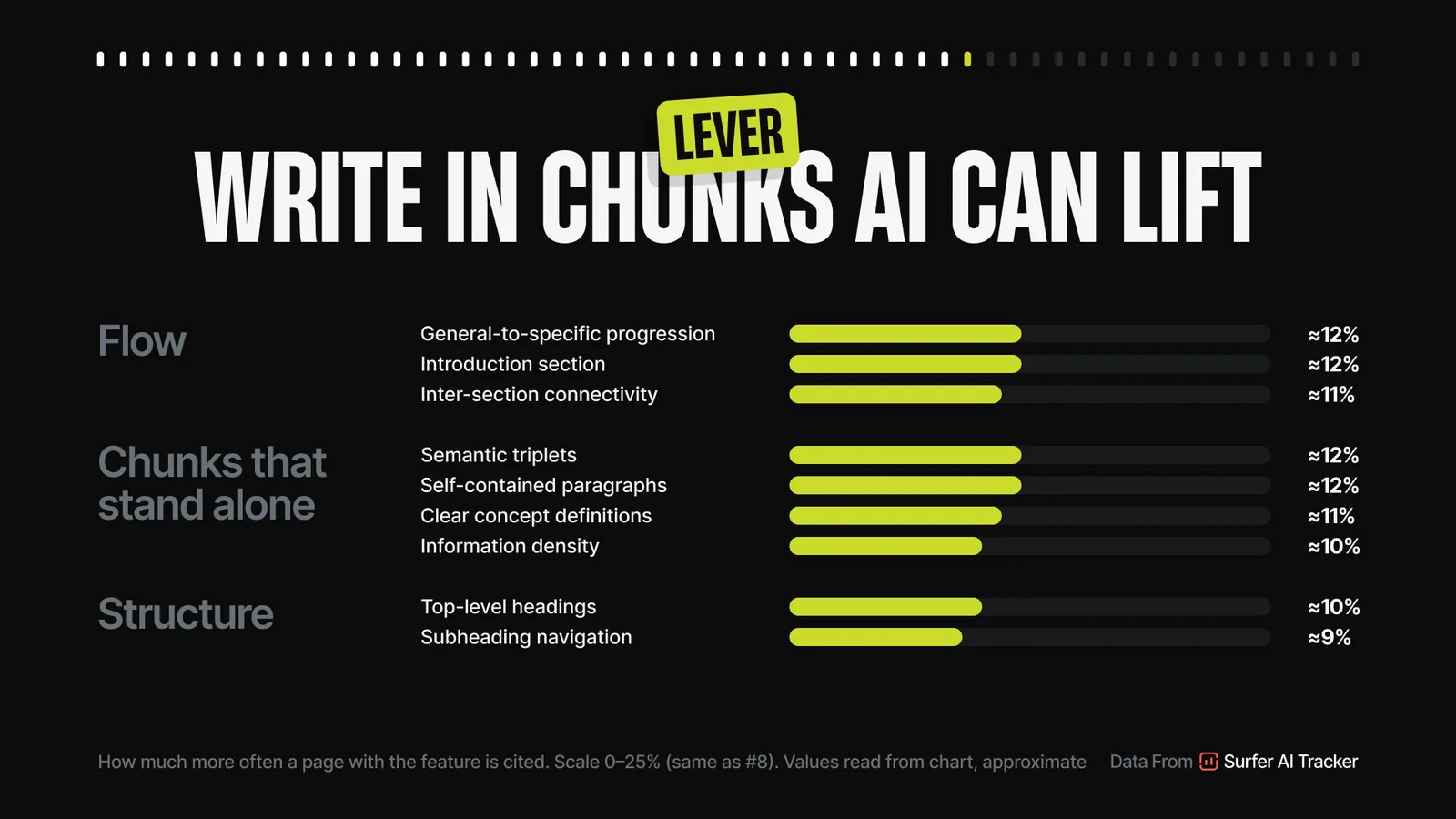
AI quotes passages, not pages. Every paragraph has to make sense on its own.
- Lever
Cover the facts.
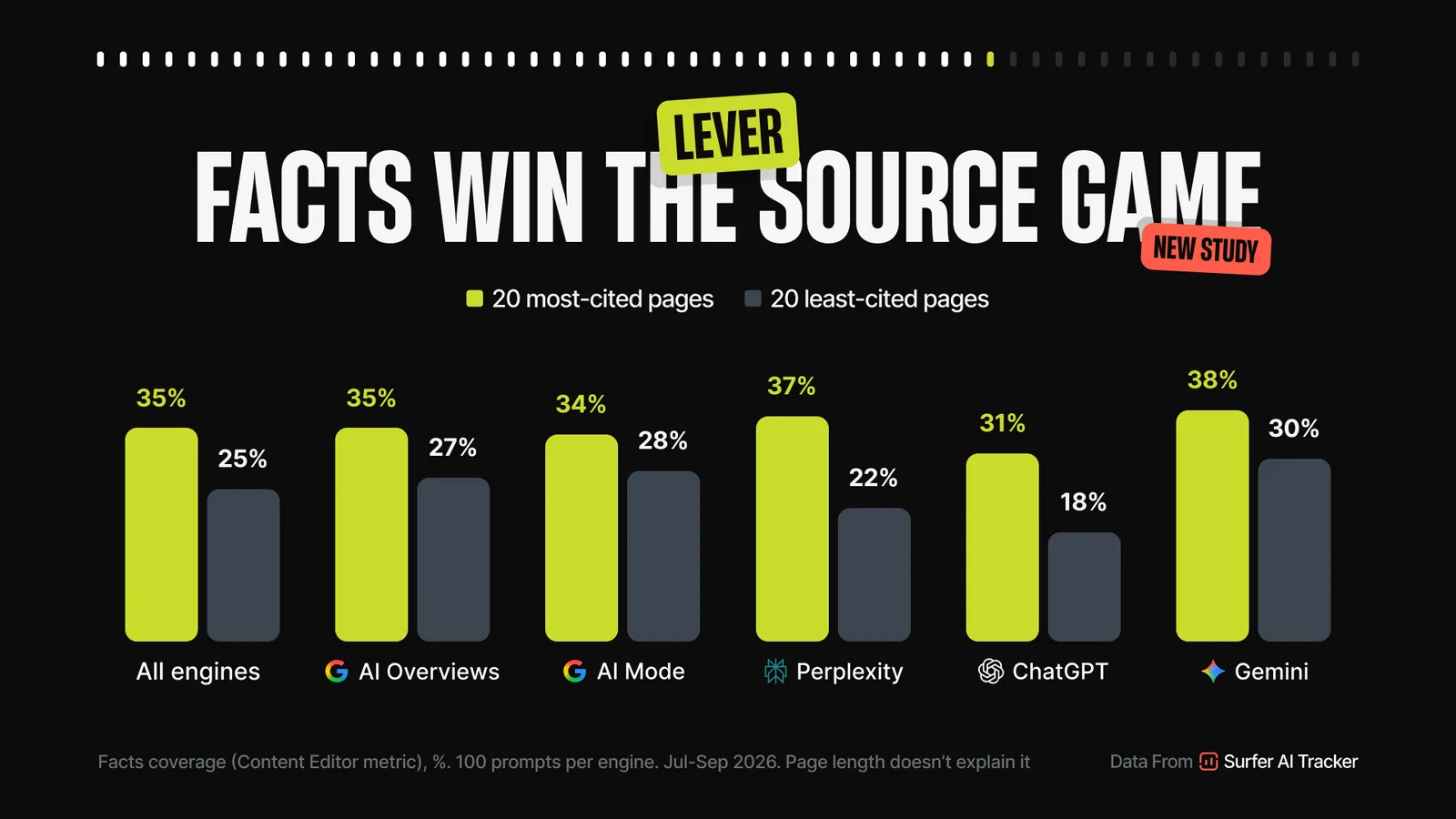
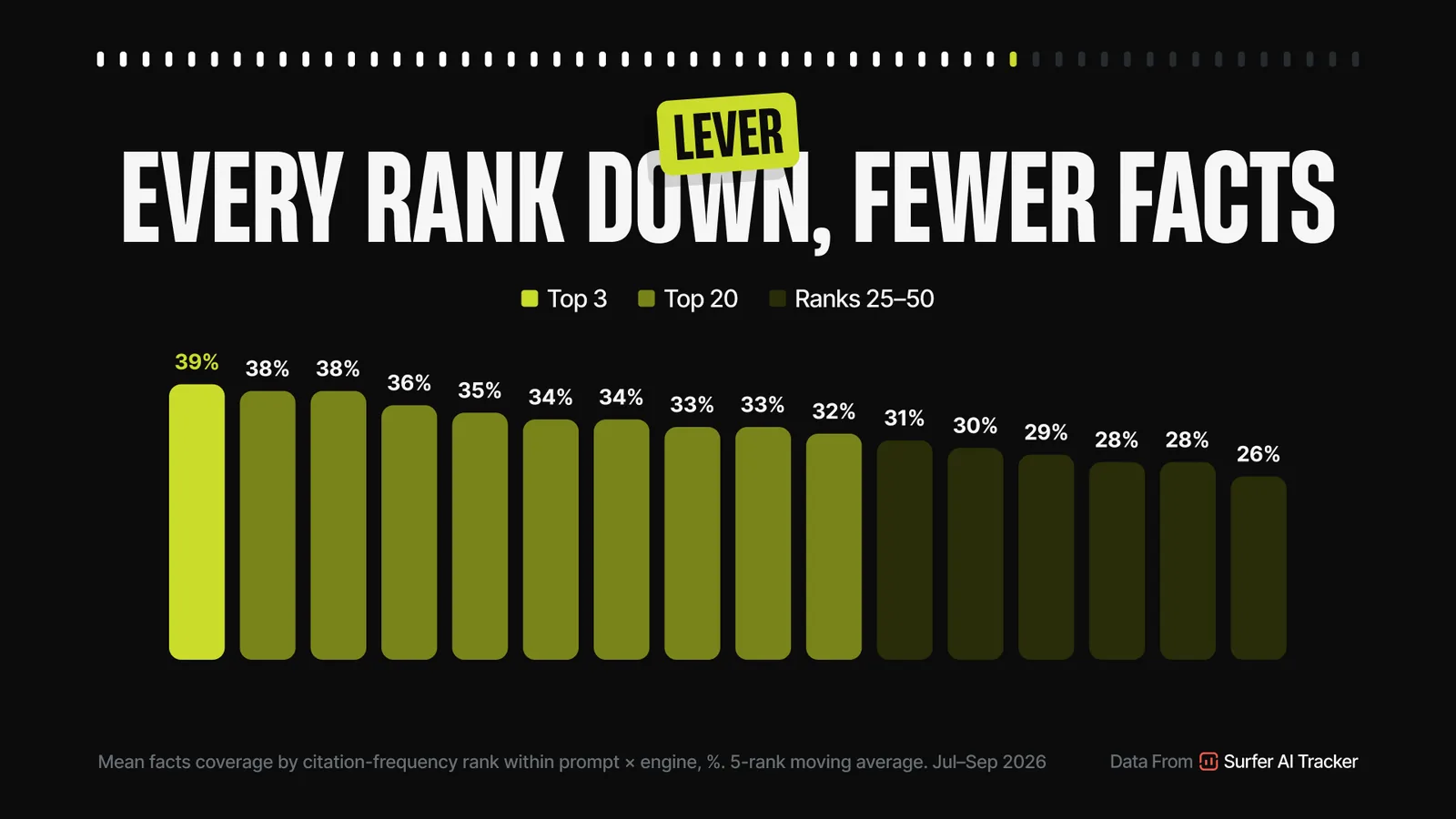
Coverage drops with every step down the ranking: 39% of the facts in the top 3, 26% by rank 50.
- Lever
Be unique through concrete detail.
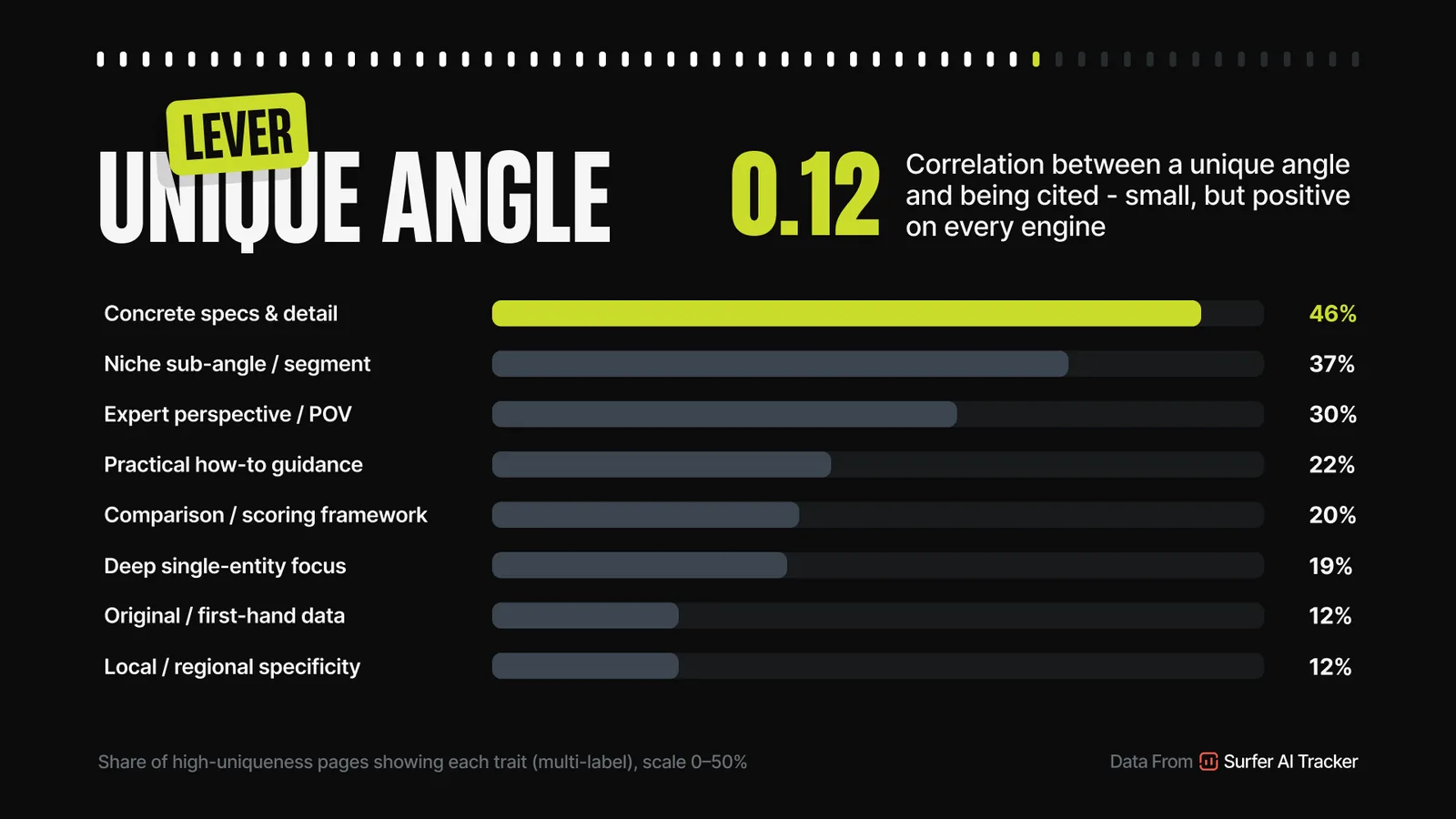
Unique pages win, and what makes them unique isn’t original research. It’s specific, concrete detail.
- Lever
Get on lists, at the top.
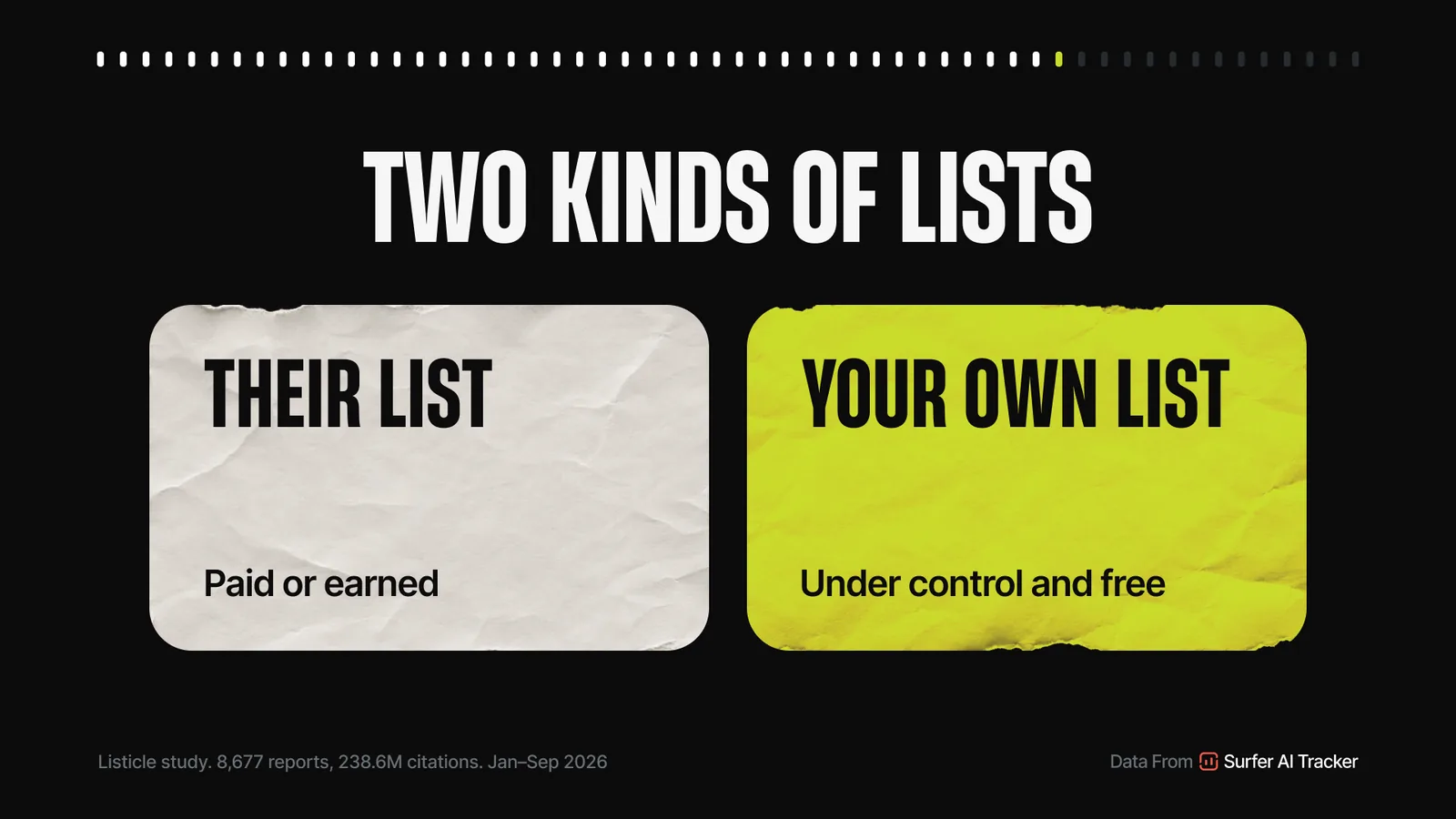
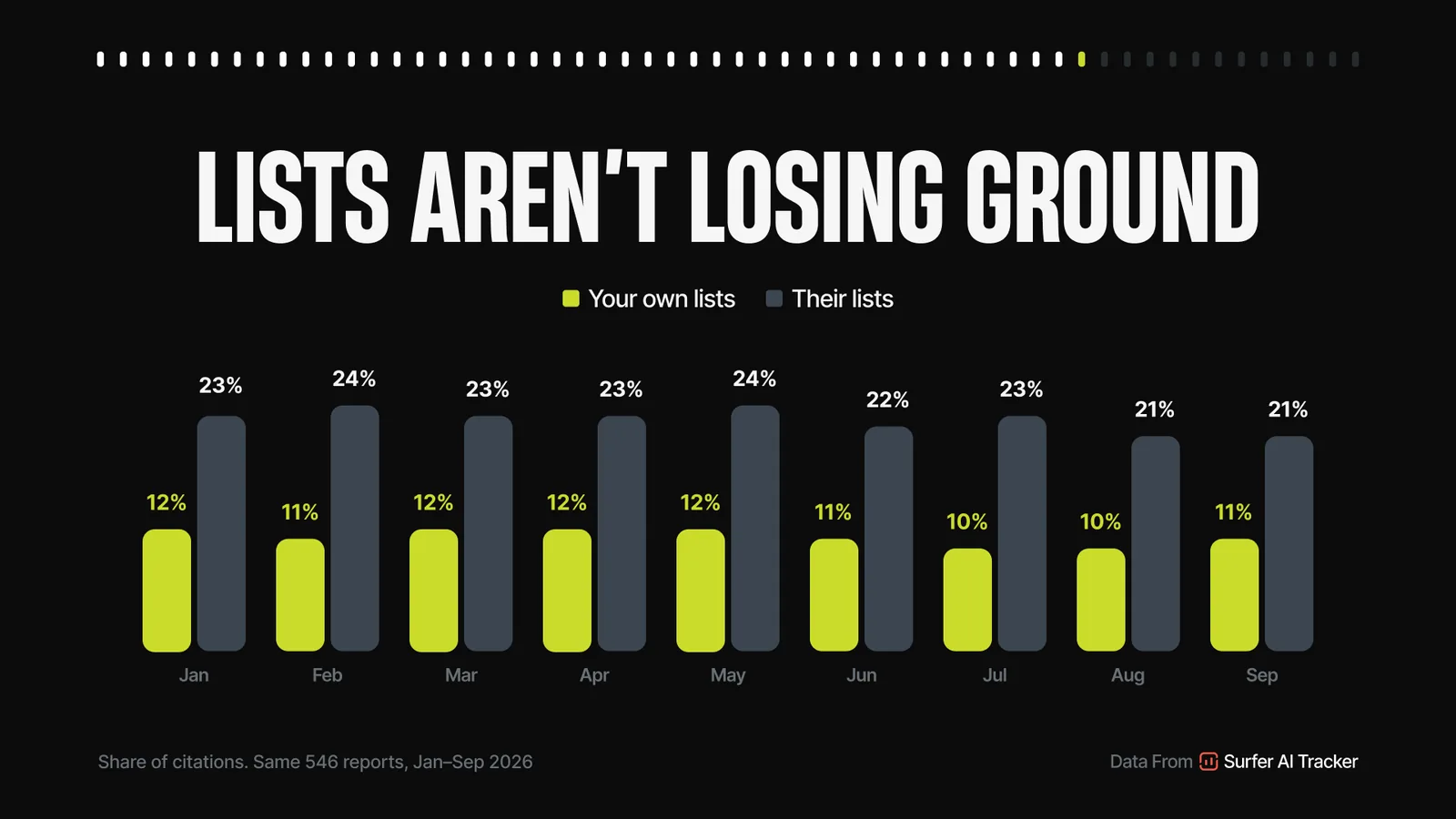
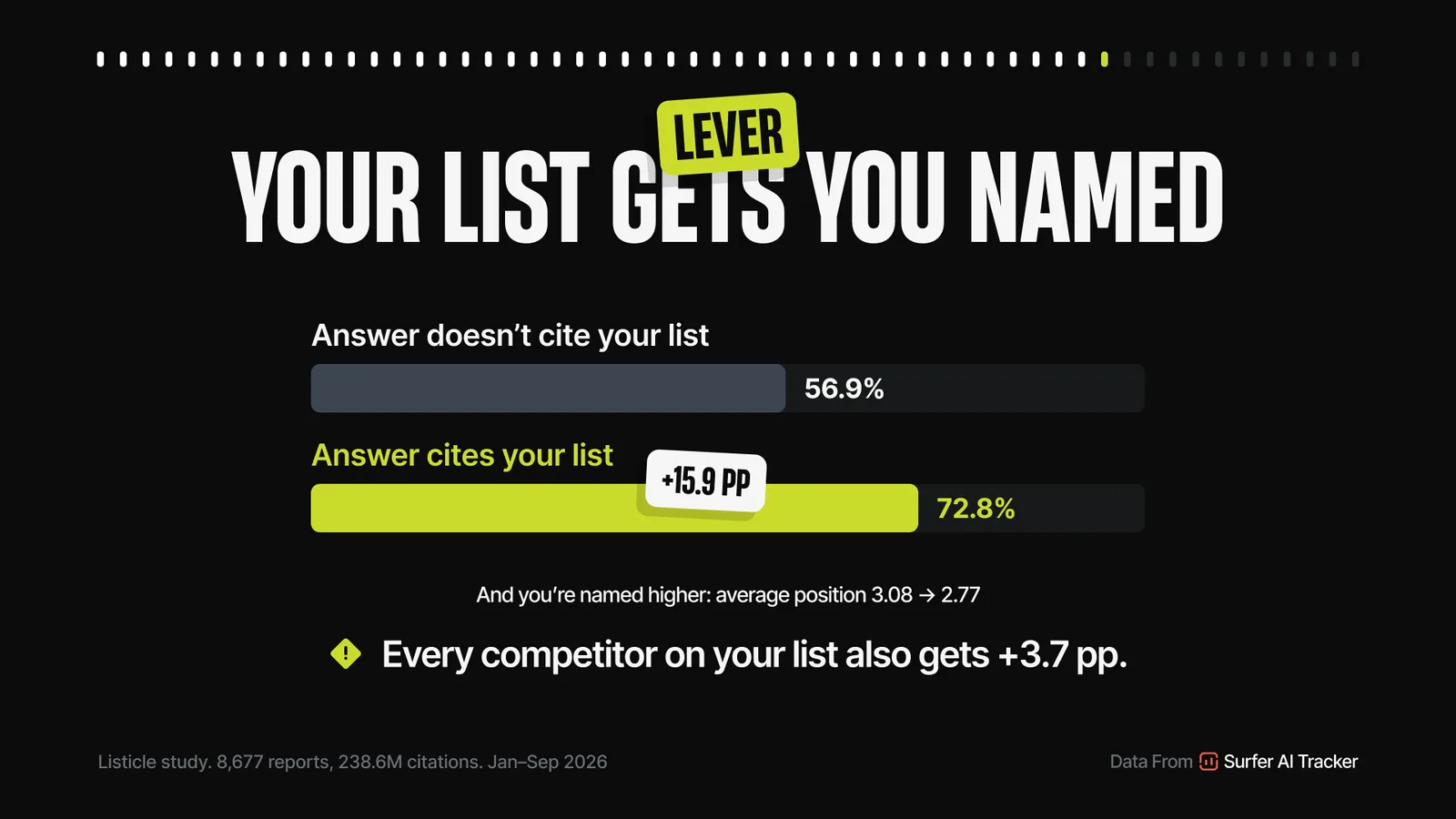
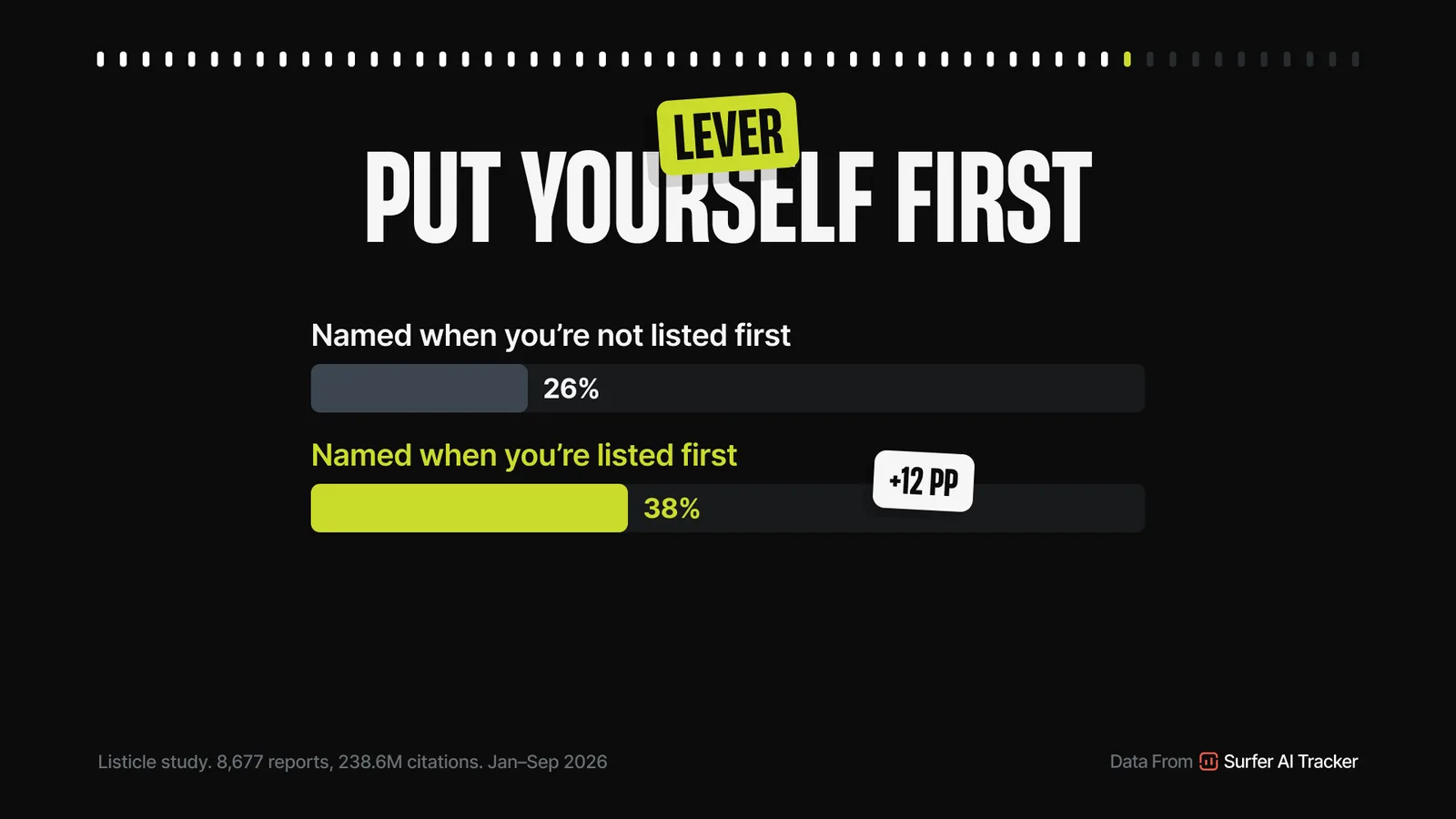
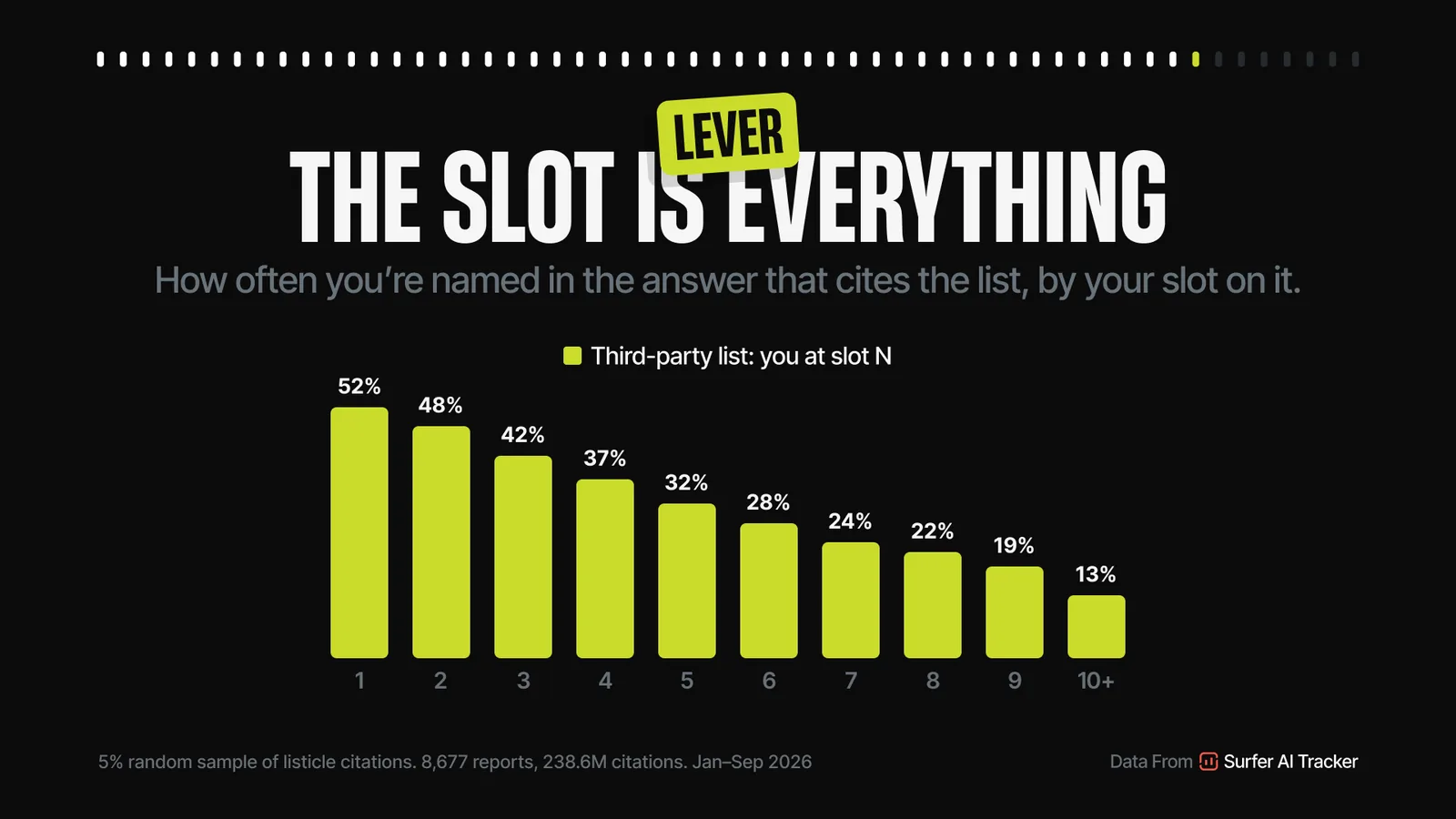
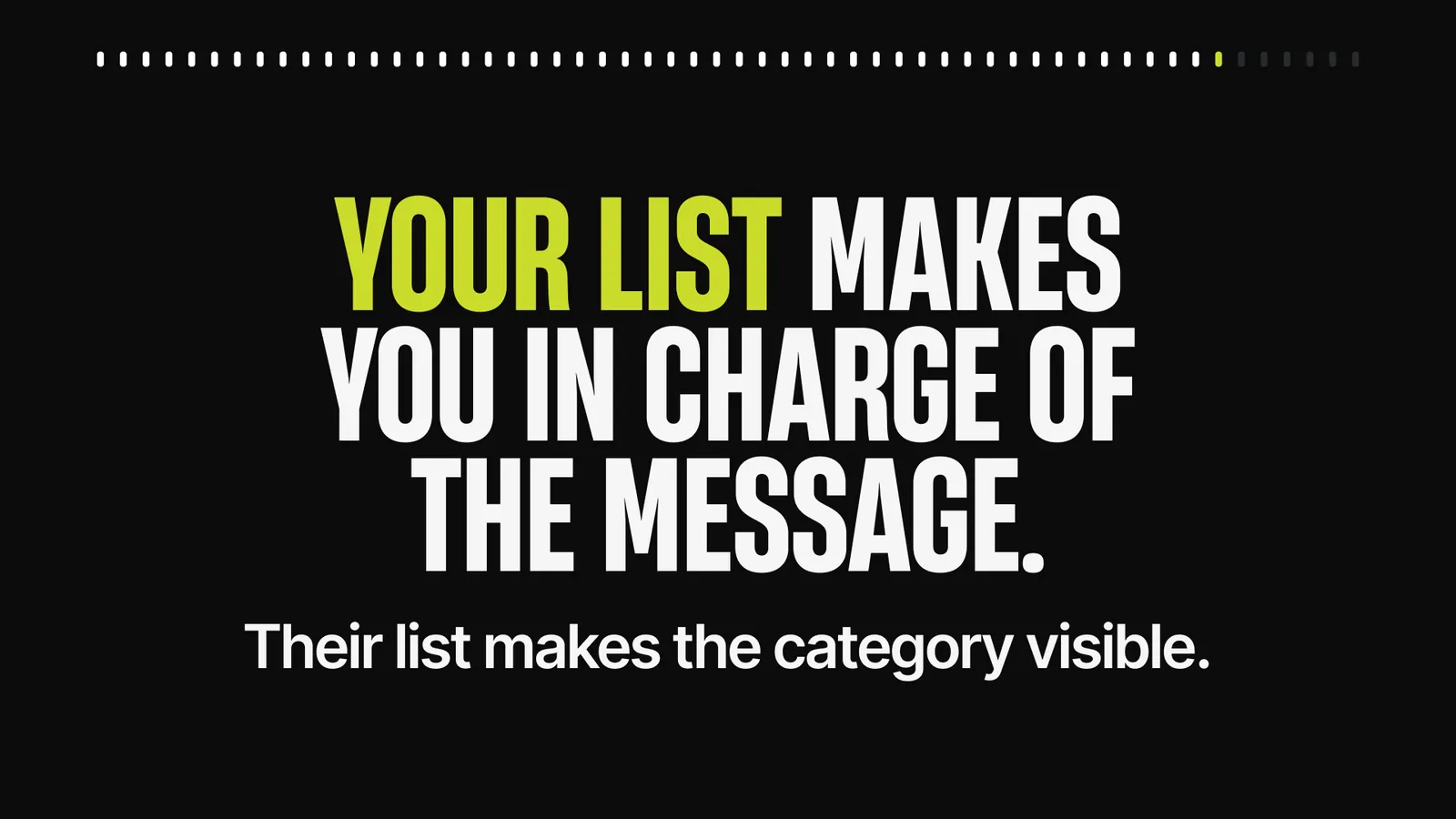
On someone else’s list your brand is named about half the time at #1 and barely at all at #10. On your own list, put yourself first: 38% instead of 26%.
- Lever
Build a set of lists, not one.
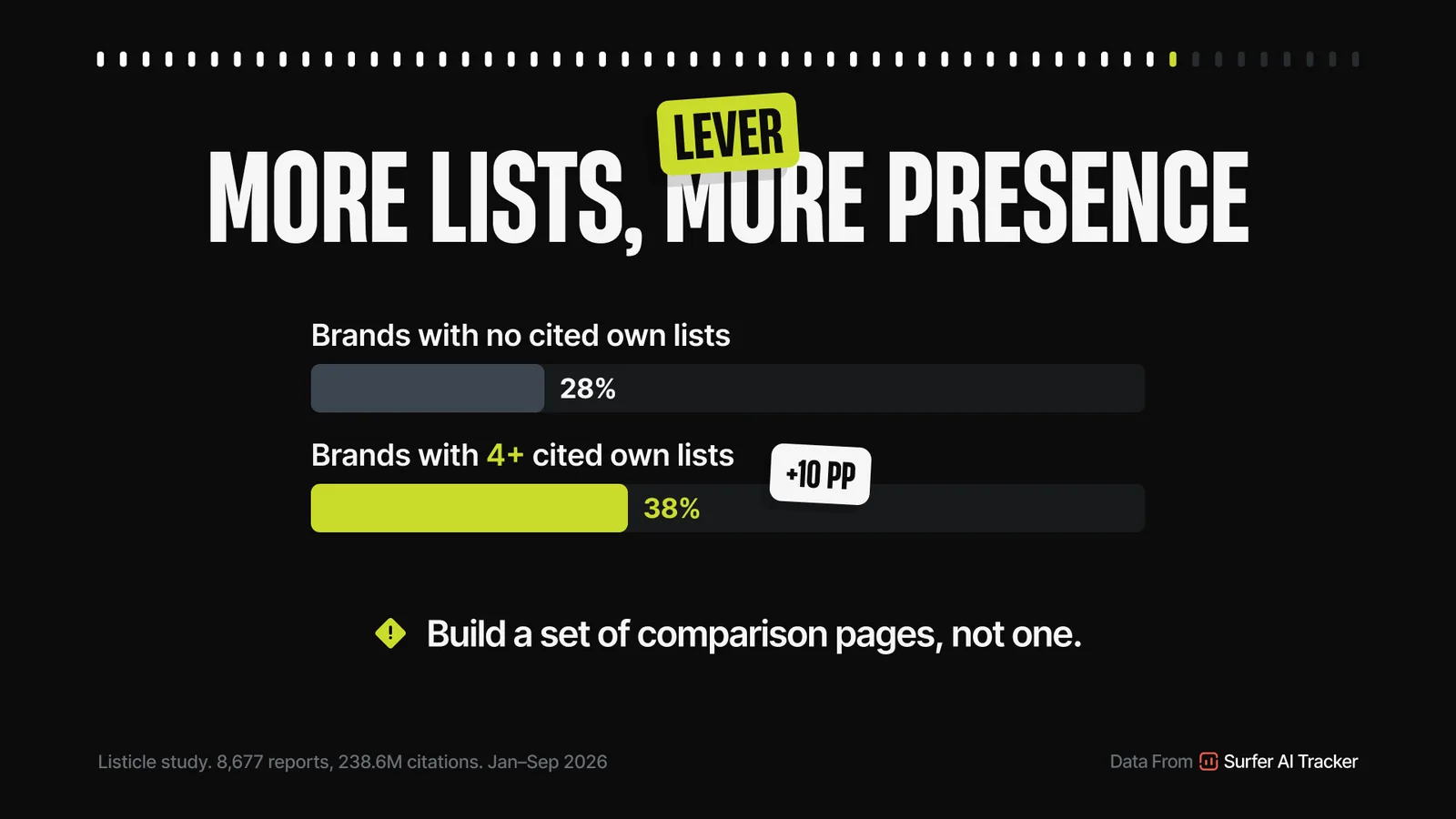
Brands with four or more cited lists of their own are mentioned in 38% of answers, against 26% with none.
- Lever
Keep pages alive.
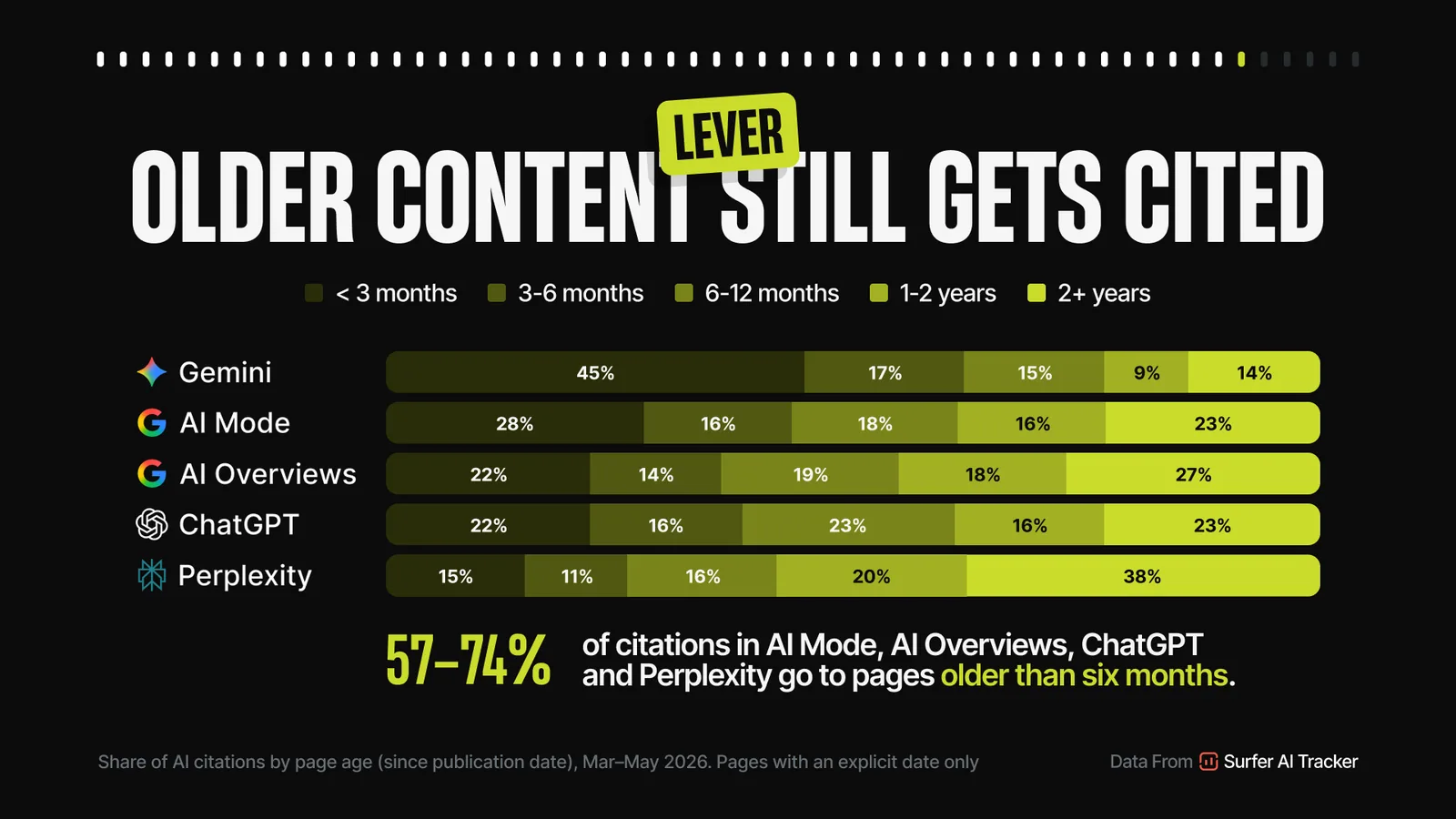
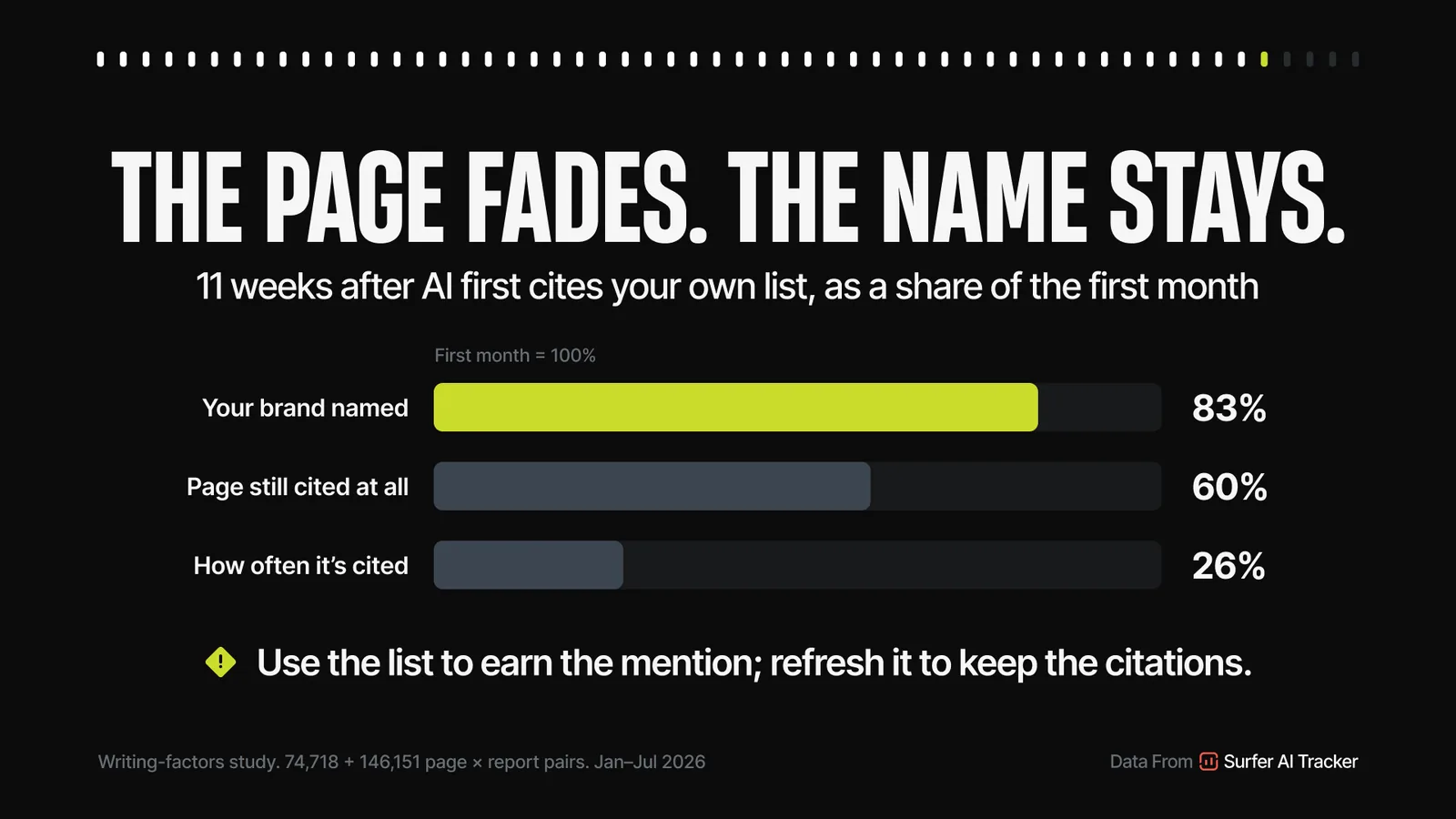
57–74% of citations in AI Mode, AI Overviews, ChatGPT and Perplexity go to pages older than six months. The page fades fast, but the name stays: 83% of the mention survives eleven weeks.
AI instructions
Two audit prompts, backed by data
Two audit prompts: one for a page, one for how you measure. Every check comes with the number behind it, and the numbers travel with the prompt, so the model knows what matters most.
Audit a page
Paste a page and the query you want it cited for. The model checks it against eight data-backed checks and tells you what to fix first, and what to stop doing.
Intent: does the page type match what the query asks? A “which” query needs a comparison, a “how” query needs steps.
42% vs 13%how often an on-intent page vs an off-intent blog post is cited
First 50 words: is there a direct, complete answer before any intro?
≈⅓of all citations come from a page’s first 50 words
Passages: does each paragraph name its subject and make sense if quoted alone?
PassagesAI quotes passages, not whole pages
Fact coverage: list what a complete answer needs and mark which facts are missing.
39% → 26%facts covered by top-3 vs rank-50 sources
Concrete detail: are there specific numbers, settings, examples or first-hand results, or only generic claims?
0.12correlation of a unique, concrete angle with citations
Google: does the page rank in the top 10 for the query or close variants? If not, flag it as the first fix.
95%of cited domains rank in Google’s top 10
Structured data: is JSON-LD present and current (Article, Person as author, dateModified)?
+3.7 ppcitation rate with vs without JSON-LD; Product markup +0.1 pp
Wasted effort: flag llms.txt, “trust” links to Wikipedia, and stats, quotes, FAQs or a TOC added only for a checklist. Mark them low priority, not as fixes.
≈ 0llms.txt −0.04 pp without big hosts; external links 0.03; checklist items 4–5× weaker than an early answer
See the full prompt text
Audit the page below for how likely AI answer engines (ChatGPT, Perplexity, Google AI Overviews and AI Mode, Gemini) are to cite it as a source.

The checks come from Surfer AI Tracker data: about 50 million AI answers scraped daily from the real interfaces of five engines. They describe what cited pages have in common; treat them as strong signals, not guarantees.

INPUTS
- Target query: [the exact question people ask]
- Page: [paste the text or the URL content]
- Our brand: [Brand]
- Google position for the query, if known: [e.g. 7, or "not ranking"]

CHECKS (each with the data behind it)
1. Intent: does the page type match what the query asks? A “which” query needs a comparison, a “how” query needs steps. [data: 42% vs 13% how often an on-intent page vs an off-intent blog post is cited]
2. First 50 words: is there a direct, complete answer before any intro? [data: ≈⅓ of all citations come from a page’s first 50 words]
3. Passages: does each paragraph name its subject and make sense if quoted alone? [data: Passages AI quotes passages, not whole pages]
4. Fact coverage: list what a complete answer needs and mark which facts are missing. [data: 39% → 26% facts covered by top-3 vs rank-50 sources]
5. Concrete detail: are there specific numbers, settings, examples or first-hand results, or only generic claims? [data: 0.12 correlation of a unique, concrete angle with citations]
6. Google: does the page rank in the top 10 for the query or close variants? If not, flag it as the first fix. [data: 95% of cited domains rank in Google’s top 10]
7. Structured data: is JSON-LD present and current (Article, Person as author, dateModified)? [data: +3.7 pp citation rate with vs without JSON-LD; Product markup +0.1 pp]
8. Wasted effort: flag llms.txt, “trust” links to Wikipedia, and stats, quotes, FAQs or a TOC added only for a checklist. Mark them low priority, not as fixes. [data: ≈ 0 llms.txt −0.04 pp without big hosts; external links 0.03; checklist items 4–5× weaker than an early answer]

OUTPUT
1. A table: check | what you found (quote the page where useful) | pass / partly / fail | the fix.
2. The missing facts from check 4 as a list.
3. A rewritten first 50 words that answer the query directly.
4. The 5 fixes that matter most, in order of impact.
5. What to stop spending time on (from check 8), if anything.
Audit my tracking setup
Before you trust any AI visibility number. Describe how you collect answers and the model grades it against eight rules.
How much can you trust one run?
Of the brands you see across several daily runs of the same prompt, this share shows up in every one of them.
Run every prompt many times; never judge a brand from a single answer.
40%of brands are shared by two runs of the same prompt
Track every day, but read trends over weeks.
40% → 28%brand overlap one day vs 90 days later
Expect sources to churn faster than brands.
37% → 13%cited-domain overlap one day vs 90 days later
Track different intents, not rewordings of one question.
−8 vs −19 ppbrand overlap lost by rewording vs by asking another engine
Collect answers from the real chat interface, not the API.
29–42%of API top-3 brands make the chat’s top 3 (chat vs itself: 49–54%)
Report each engine separately, never one blended score.
0.32–0.40how closely ChatGPT and Perplexity track other engines (Google surfaces: 0.58–0.70)
Don’t use domain authority as a stand-in for AI visibility.
≈ 0correlation of PageRank and Domain Score with citations, on every engine
Benchmark against your niche’s sources, not global top domains.
8.9%of a niche’s core sources come from the global top 20
See the full prompt text
Review my AI visibility tracking setup against measurement rules from Surfer AI Tracker data (about 50 million AI answers from five engines, scraped from the real interfaces).

INPUTS
- Tool or method: [how answers are collected]
- Engines: [list]
- Prompts: [how many, how they were chosen]
- Runs per prompt and frequency: [e.g. once a week]
- Reporting: [one score, per engine, per prompt?]

RULES (each with the data behind it)
1. Run every prompt many times; never judge a brand from a single answer. [data: 40% of brands are shared by two runs of the same prompt]
2. Track every day, but read trends over weeks. [data: 40% → 28% brand overlap one day vs 90 days later]
3. Expect sources to churn faster than brands. [data: 37% → 13% cited-domain overlap one day vs 90 days later]
4. Track different intents, not rewordings of one question. [data: −8 vs −19 pp brand overlap lost by rewording vs by asking another engine]
5. Collect answers from the real chat interface, not the API. [data: 29–42% of API top-3 brands make the chat’s top 3 (chat vs itself: 49–54%)]
6. Report each engine separately, never one blended score. [data: 0.32–0.40 how closely ChatGPT and Perplexity track other engines (Google surfaces: 0.58–0.70)]
7. Don’t use domain authority as a stand-in for AI visibility. [data: ≈ 0 correlation of PageRank and Domain Score with citations, on every engine]
8. Benchmark against your niche’s sources, not global top domains. [data: 8.9% of a niche’s core sources come from the global top 20]

For each rule: say pass / partly / fail, why, and the cheapest fix. Then list the conclusions I’ve drawn so far that I shouldn’t trust yet, and what to change first.
Method
Where the numbers come from
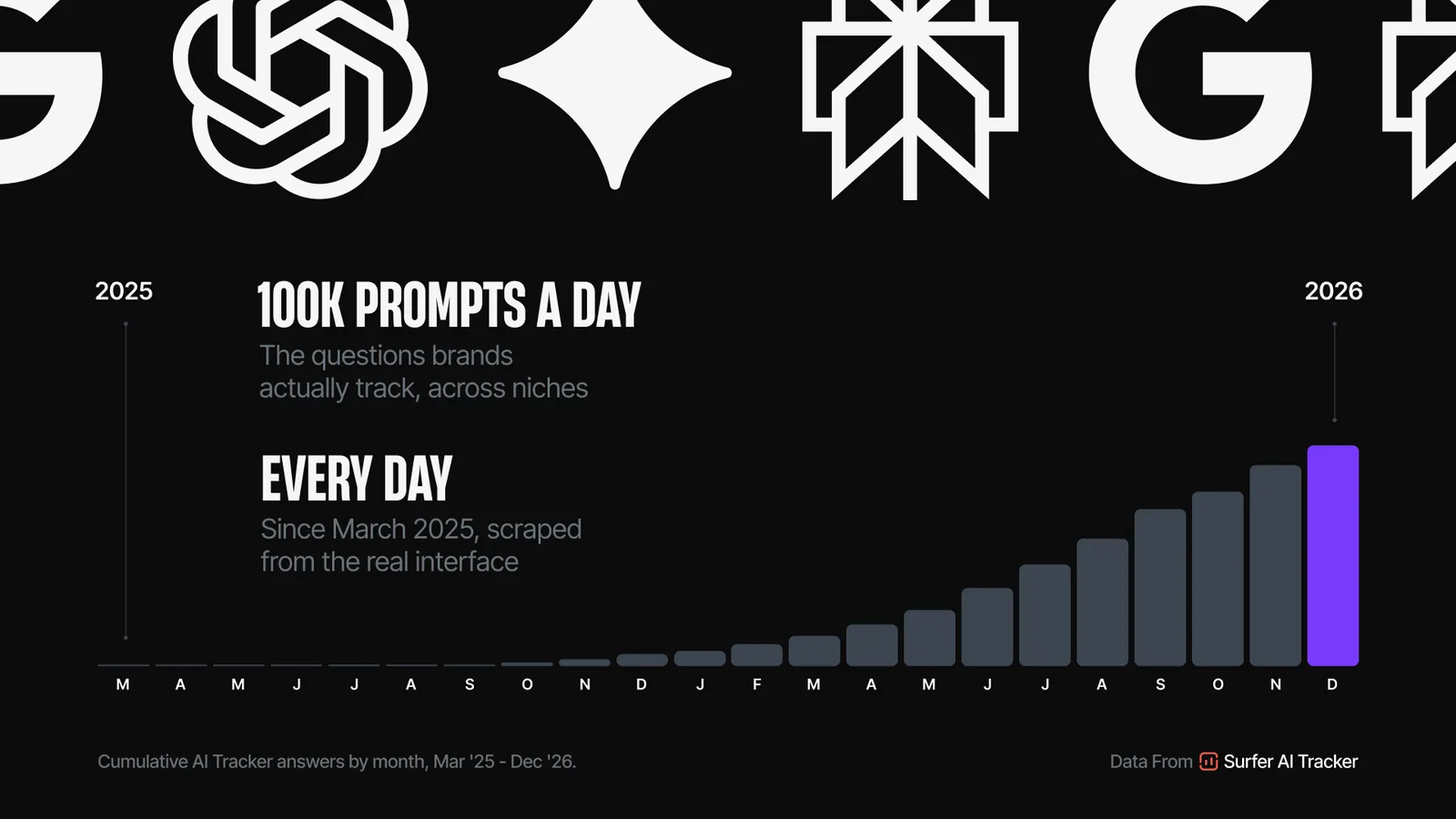
All data comes from Surfer AI Tracker: about 100,000 prompts a day, scraped since March 2025 from the real interfaces of ChatGPT, Perplexity, Gemini, Google AI Overviews and AI Mode, not from APIs. Each slide lists its own sample and period in the footer.
- Answers
- About 50 million AI answers across five engines.
- Noise tests
- Repeated runs, daily re-runs, rewordings, API vs chat and engine-to-engine comparisons of the same prompts. Each slide lists its sample and period.
- Proxies
- Domain-level metrics (PageRank, harmonic centrality, traffic, age) and page features compared with how often pages are cited within the same prompt.
- Listicles
- 238.6M citations in 8,677 reports, January to September 2026. Full detail on the Who writes the list? page.
Correlations and comparisons within prompts and niches, not proven causes. Test on your own pages and prompts before you roll anything out.
Want this talk at your event?
2027 is open, with the first events confirmed in March.