LLM Mastery 2026 · Chiang Mai
Who writes the list?
We read 201,534 self-promo listicles cited in AI answers. What gets a list cited is often what keeps your brand from being named. Here are the slides, the data and a playbook for both.
Slides
The full talk, 55 slides
Use the arrow keys or swipe. Each slide comes with the line I said on stage.

What the data says
Six numbers from the talk
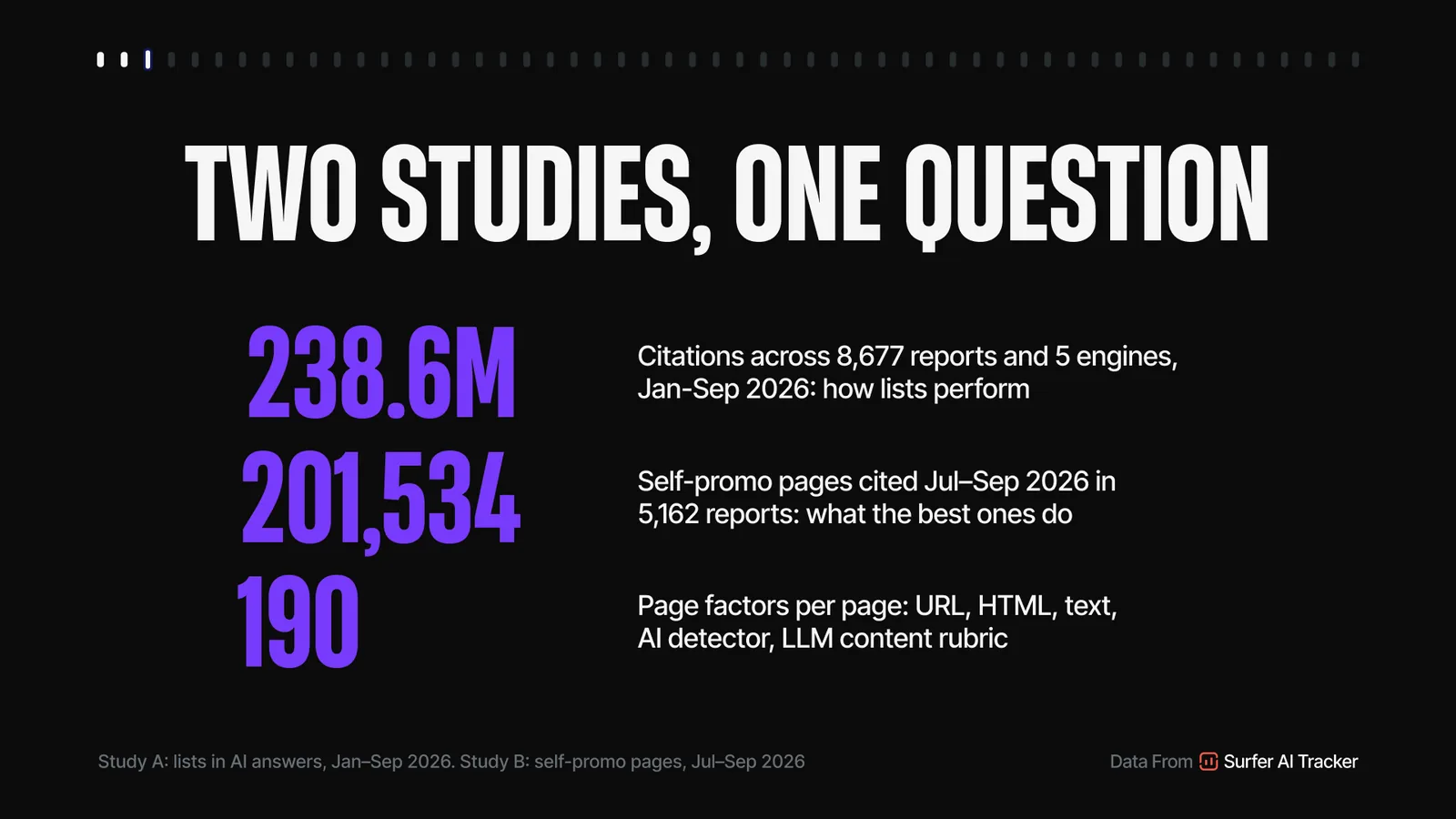
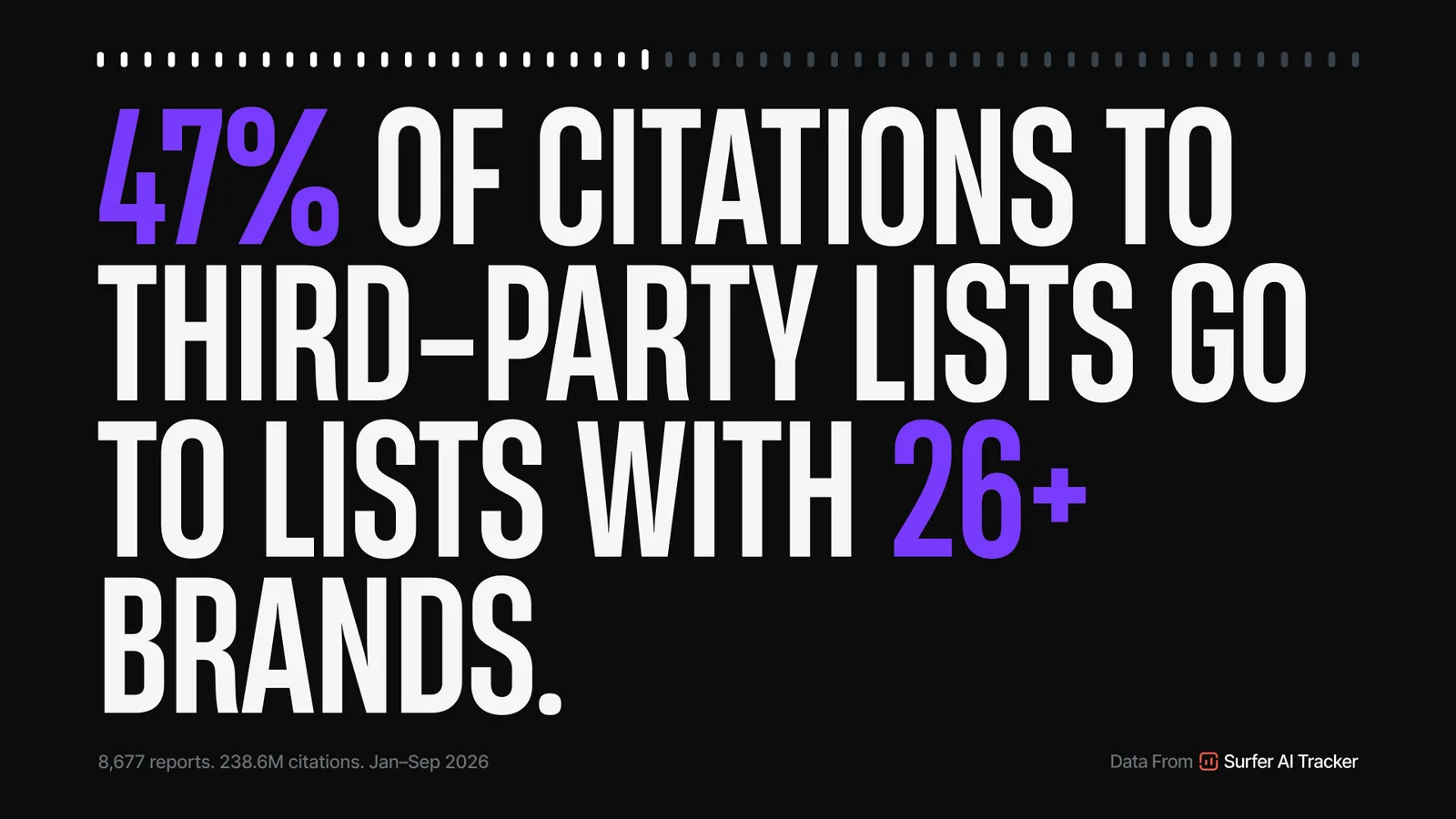
From Surfer AI Tracker data: 238.6M citations across five AI engines and 201,534 self-promo pages.
- ⅓
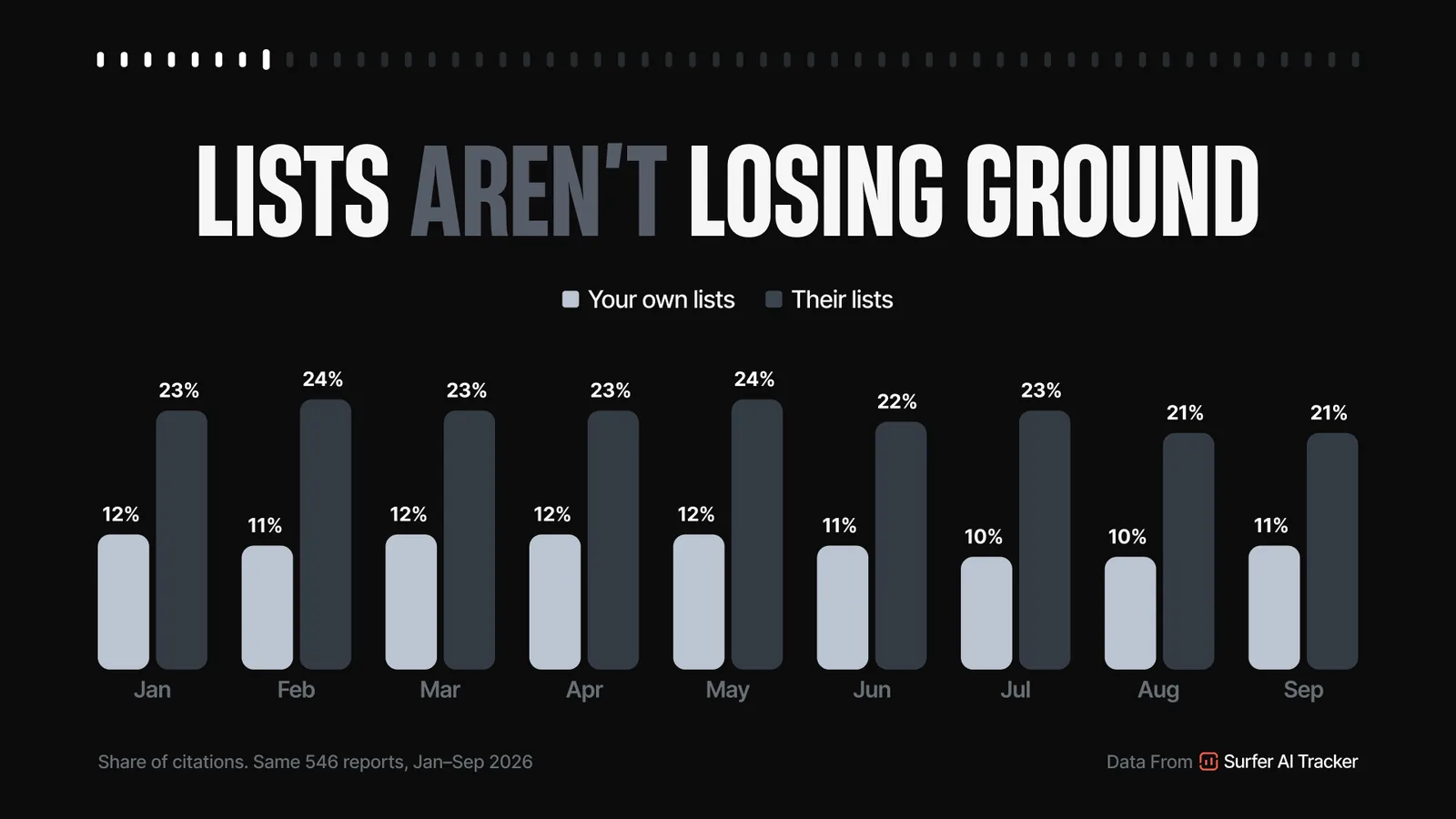
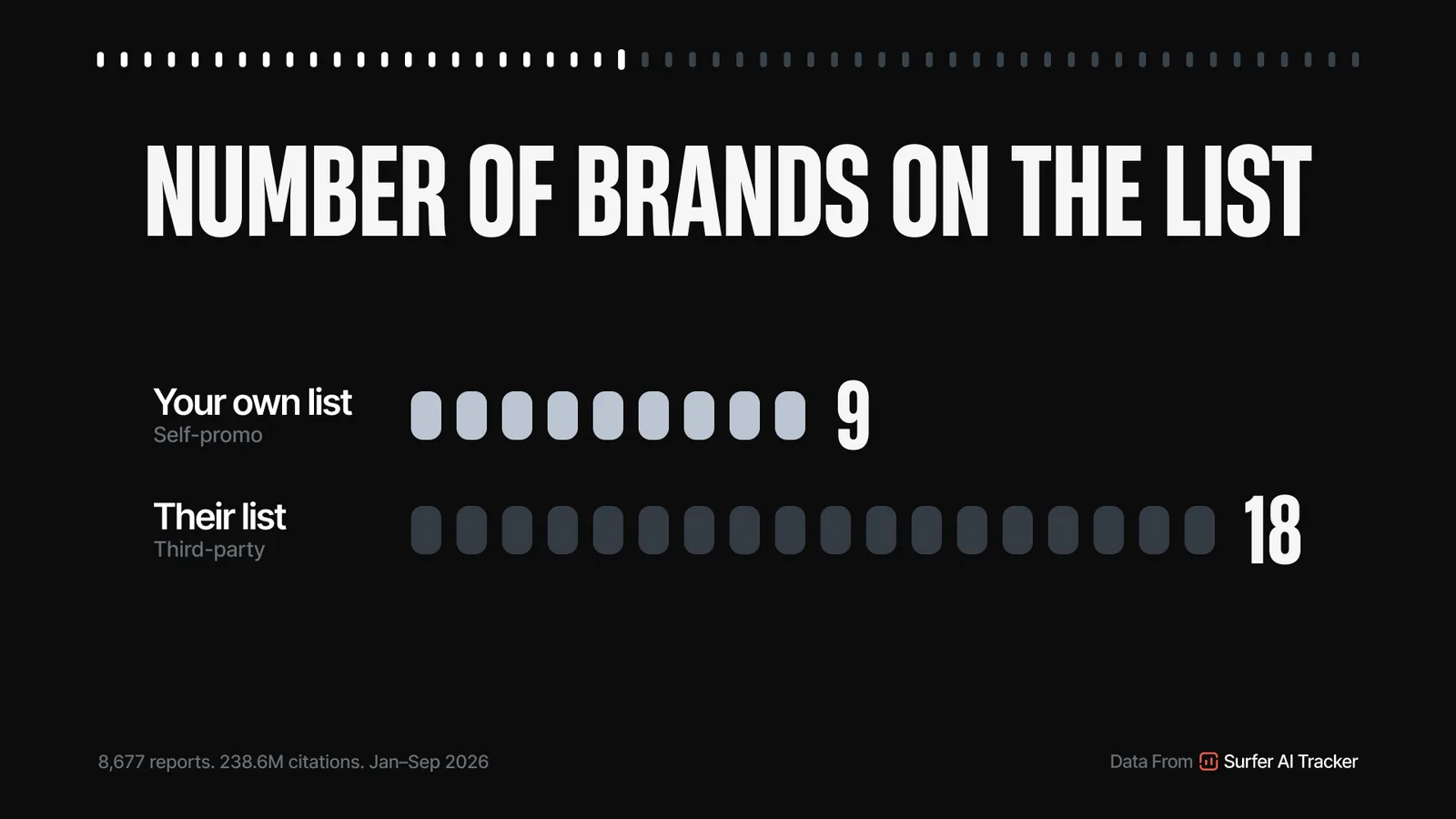
- of AI citations go to listicles, all year. Your own lists about 11%, other people’s about 23%.
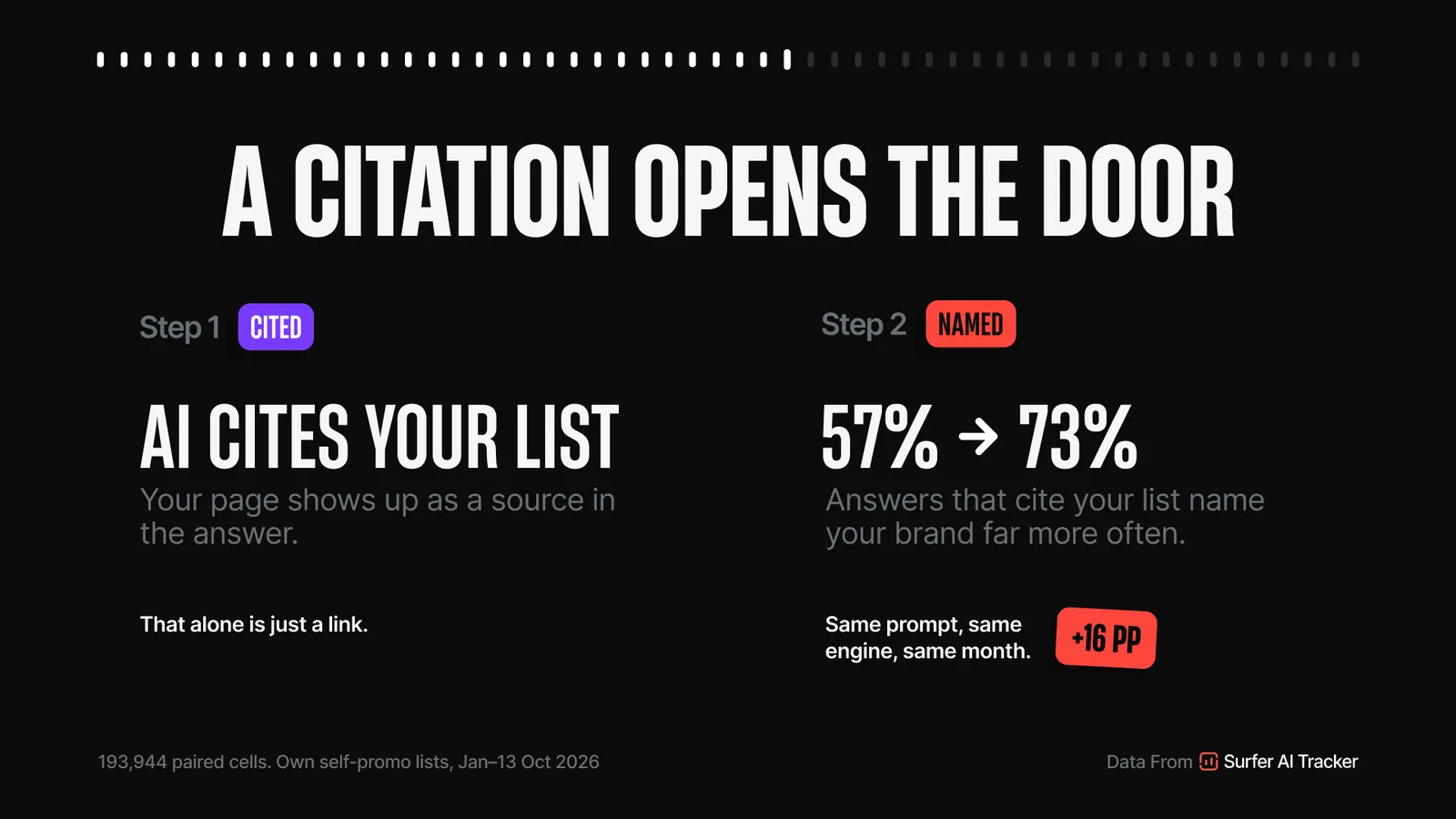
- 57% → 73%
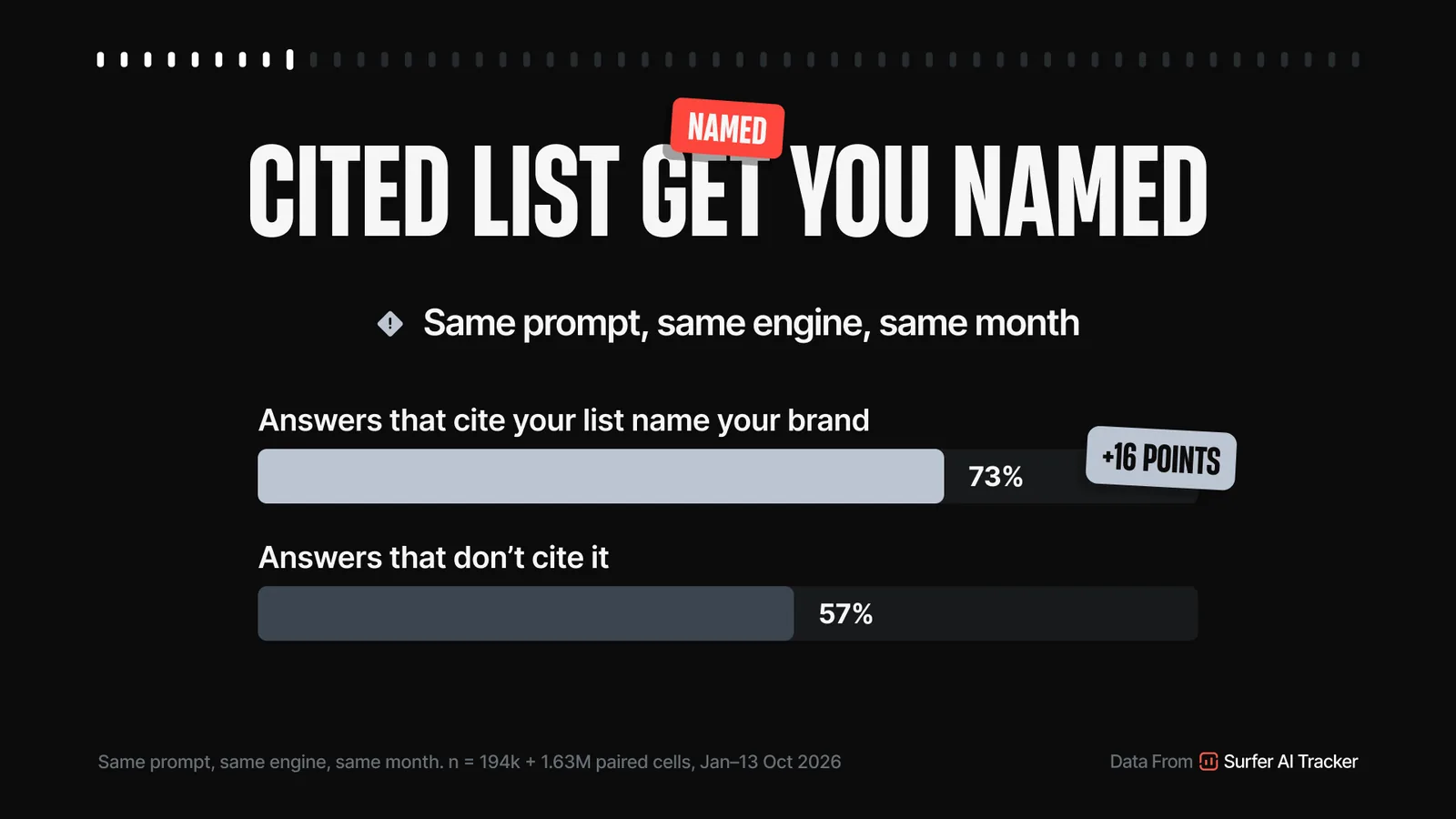
- how often your brand is named when the same prompt cites your own list, compared with when it doesn’t.
- +3.7 pp
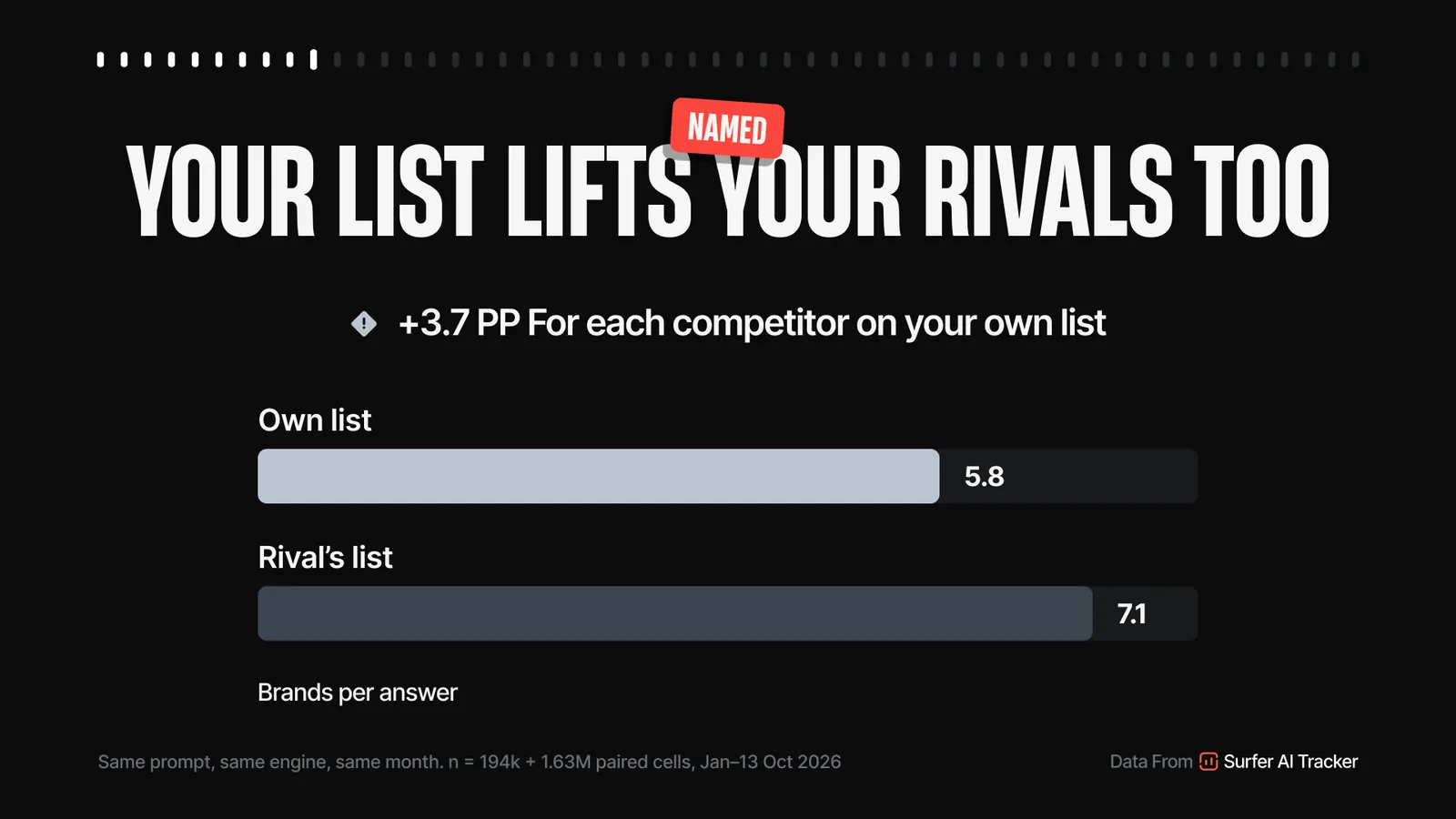
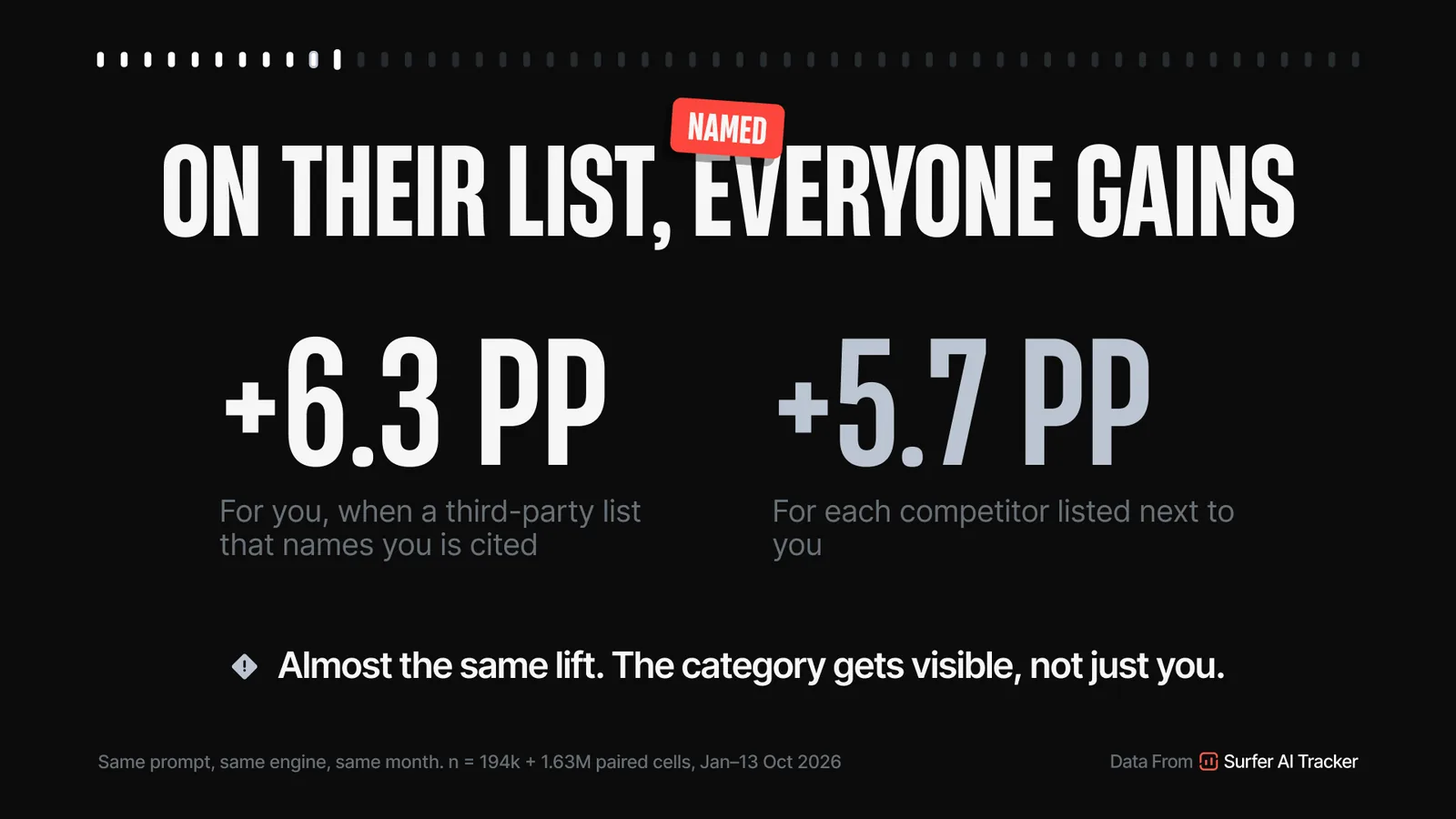
- gained by every competitor you put on your list. On someone else’s list rivals gain almost as much as you.
- 20
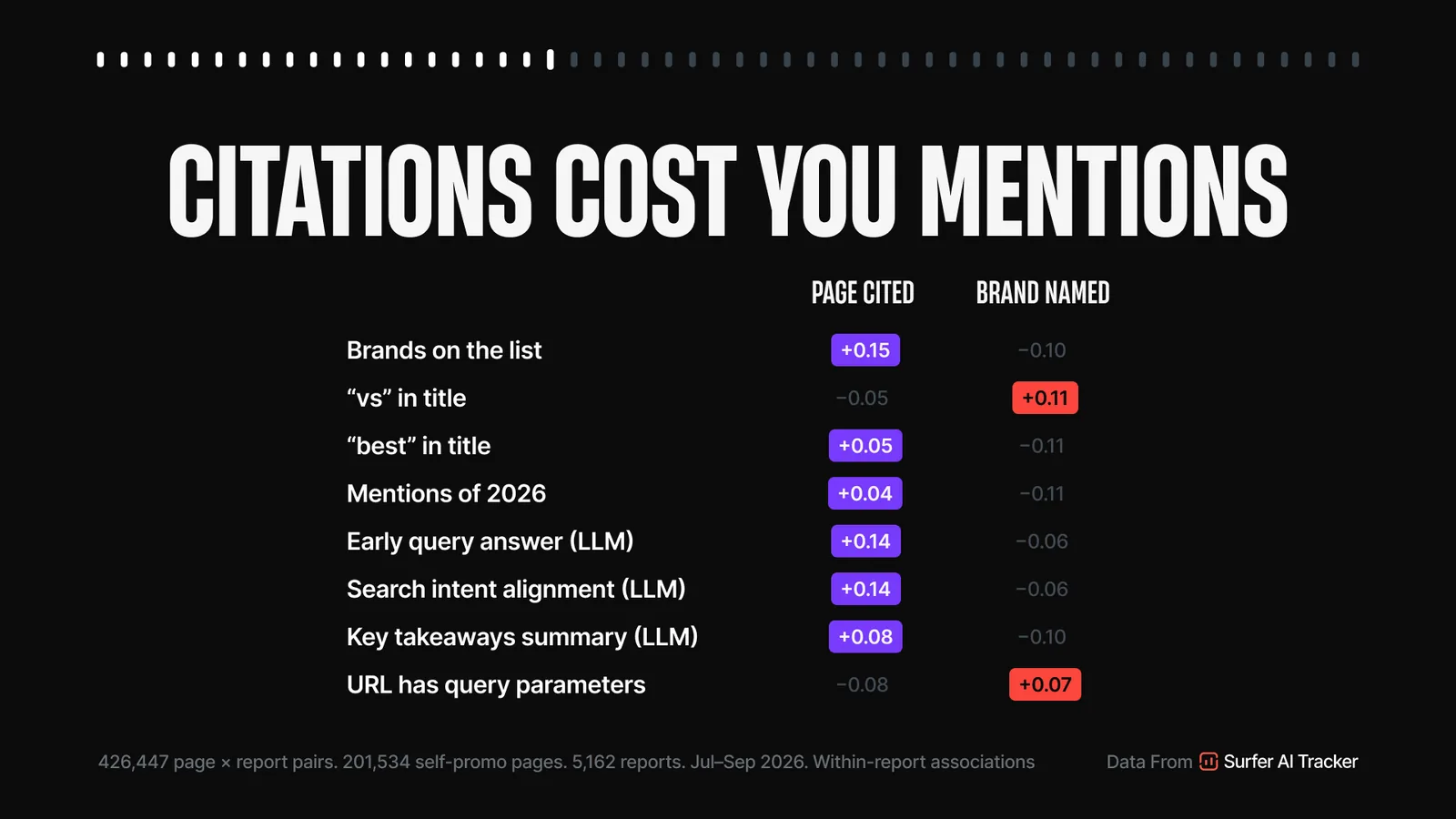
- of 190 page factors push citations and brand mentions in opposite directions.
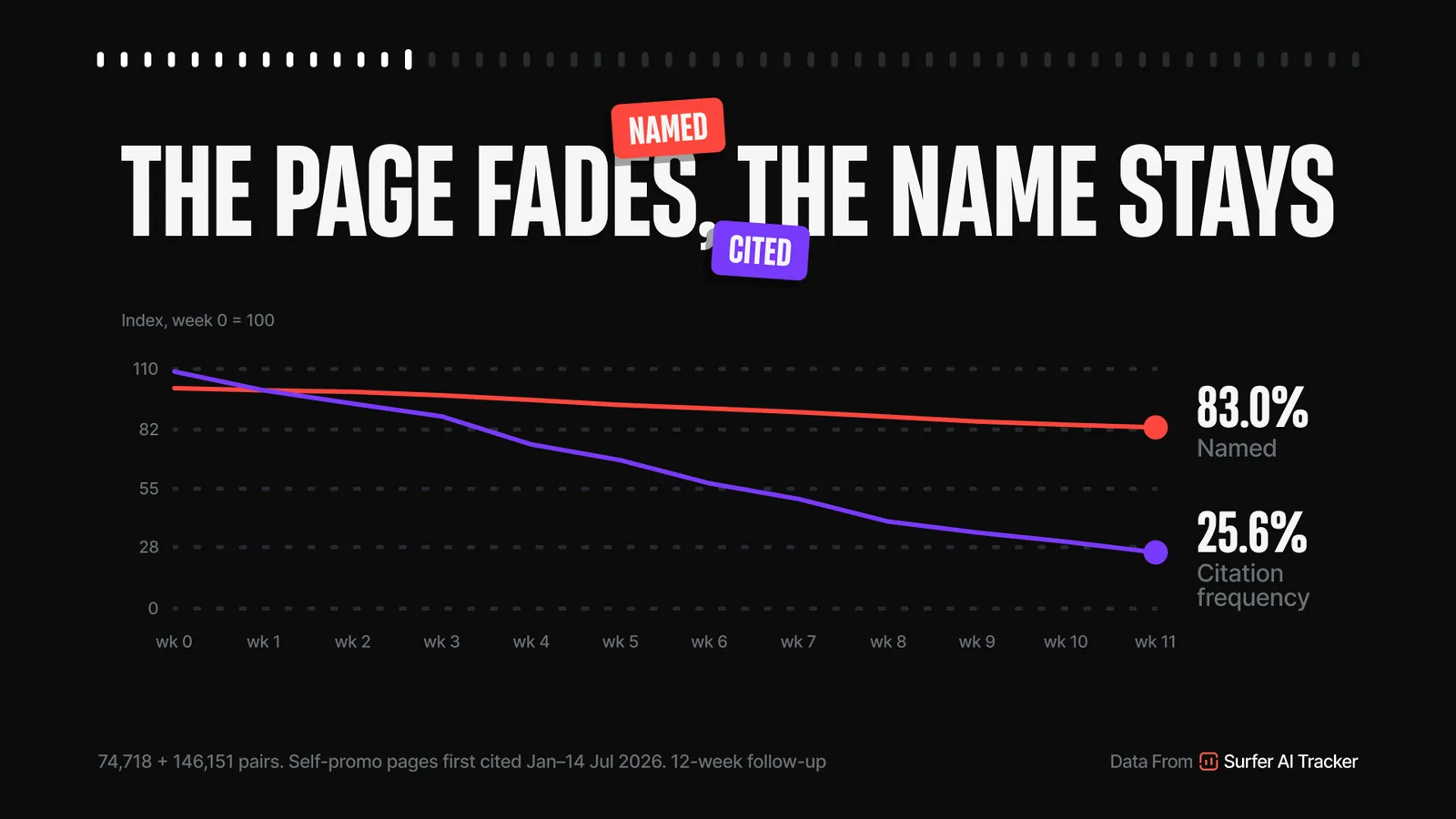
- 26 vs 83
- citation frequency vs brand mentions 11 weeks after the first citation, with the first month at 100.
- 38% vs 27%
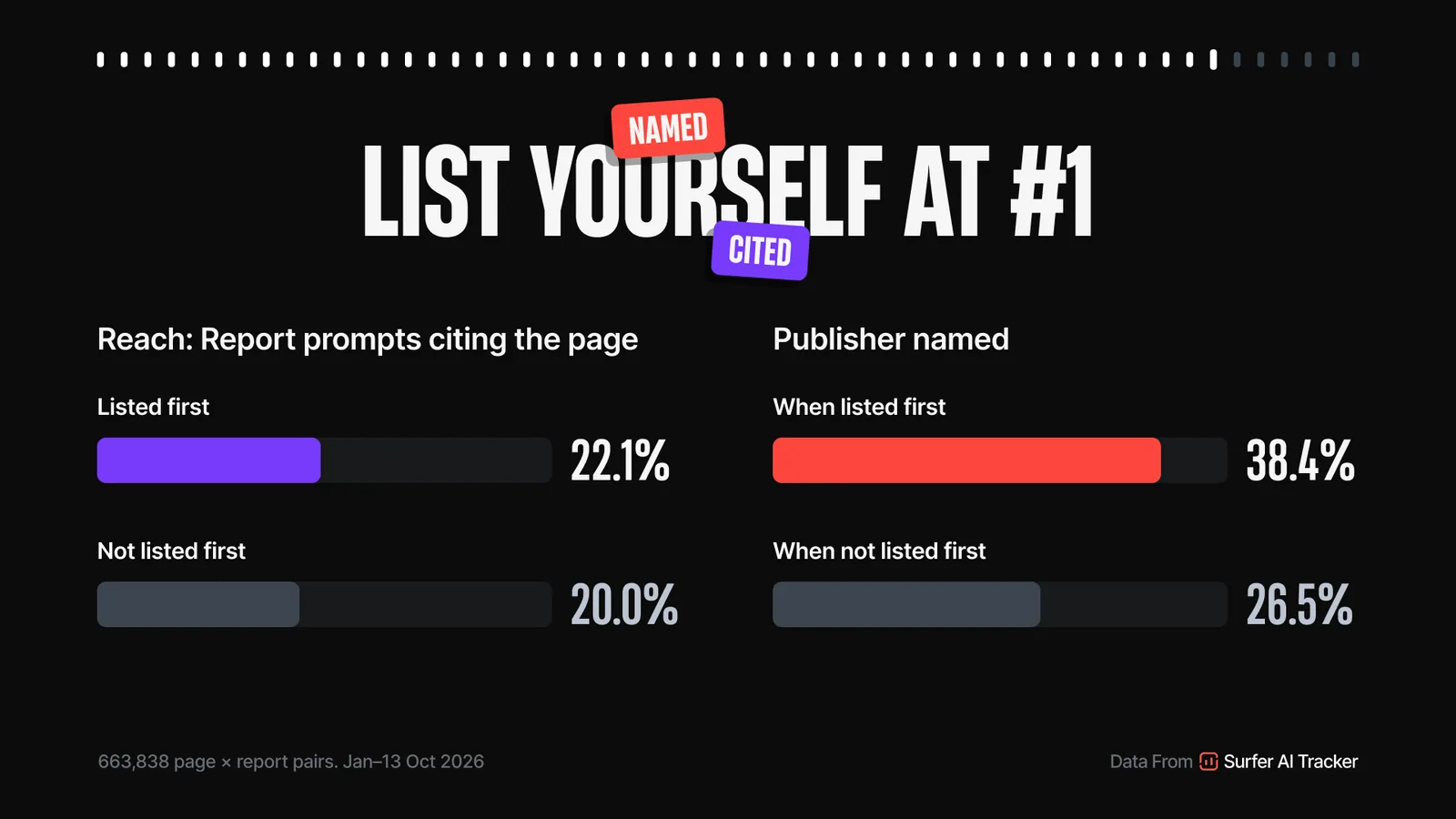
- how often you’re named when you list yourself first, compared with when you don’t. Reach stays the same.
The playbook
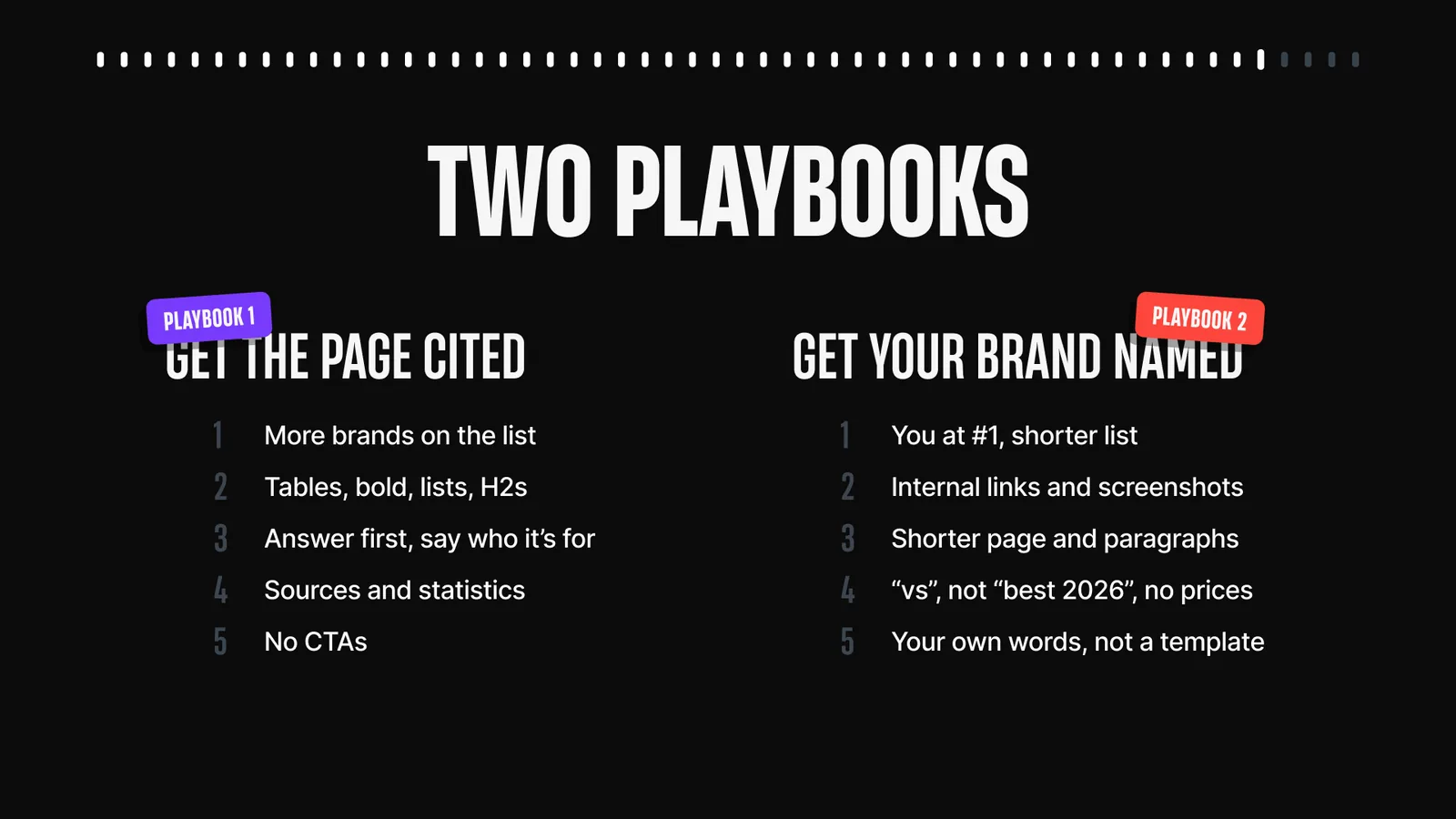
Pick a goal for each list
One page rarely wins both. Choose what this list is for, then follow that column. Rules marked “Beyond the talk” come from the same data but didn’t make it on stage.
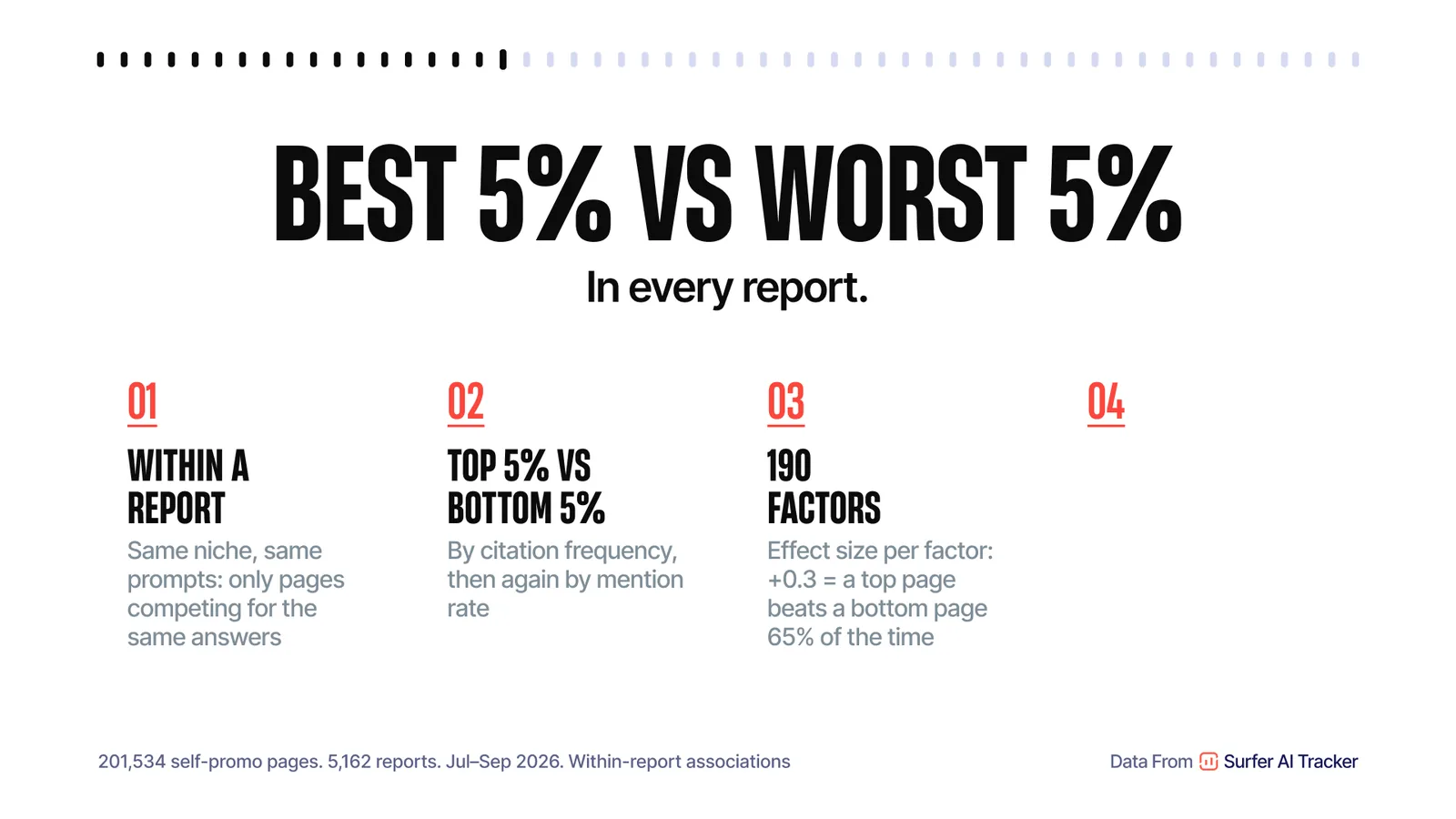
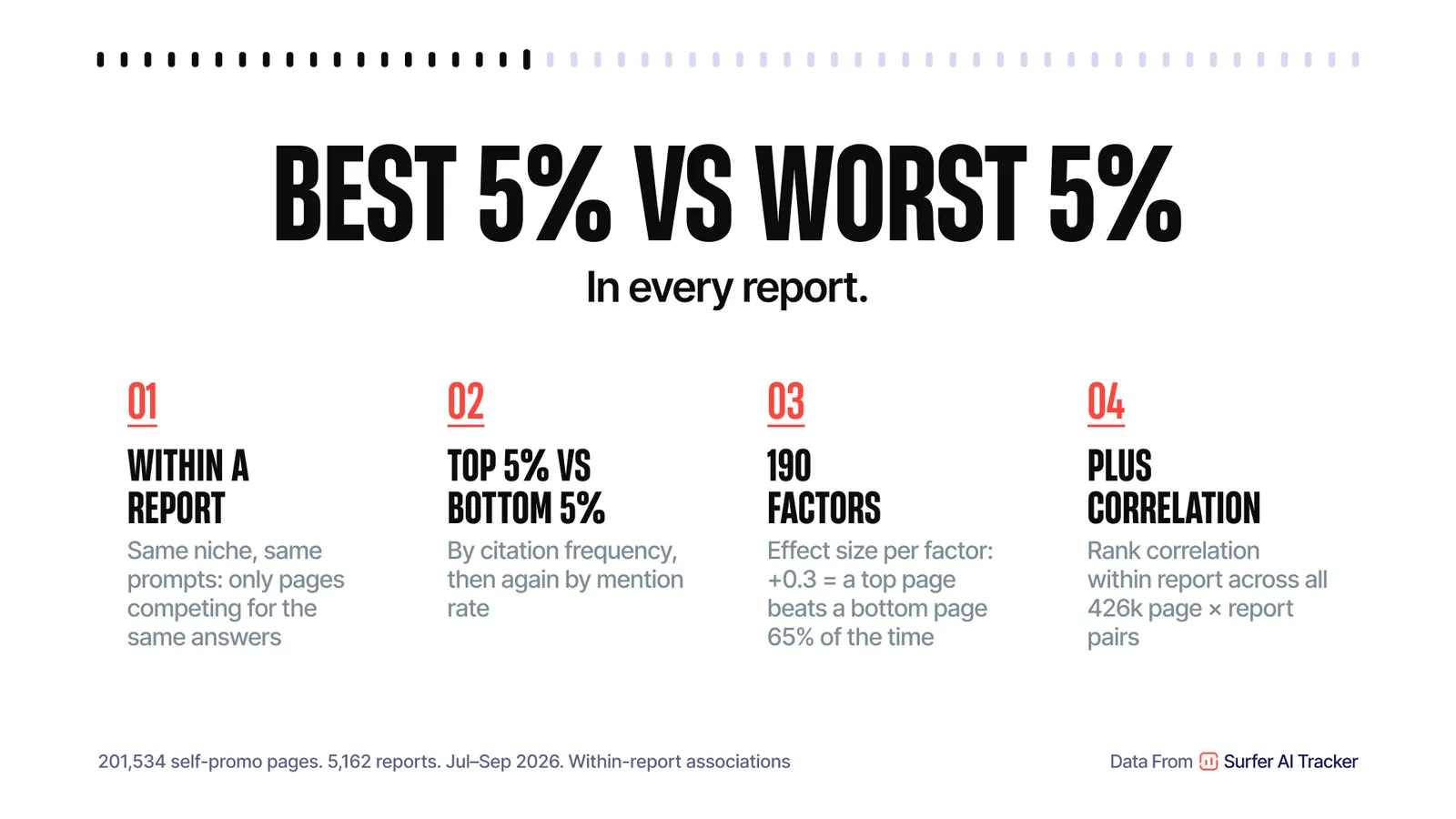
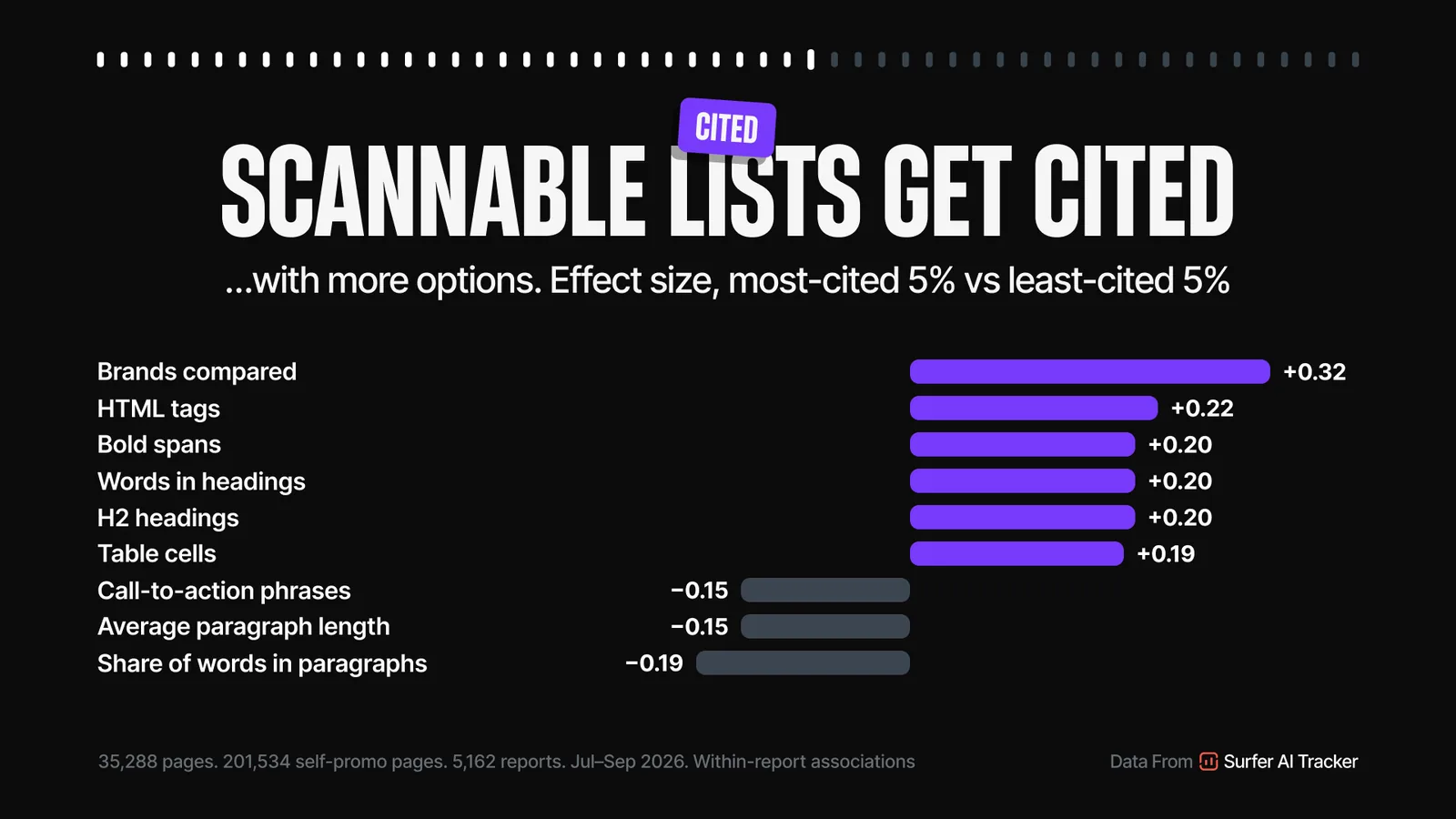
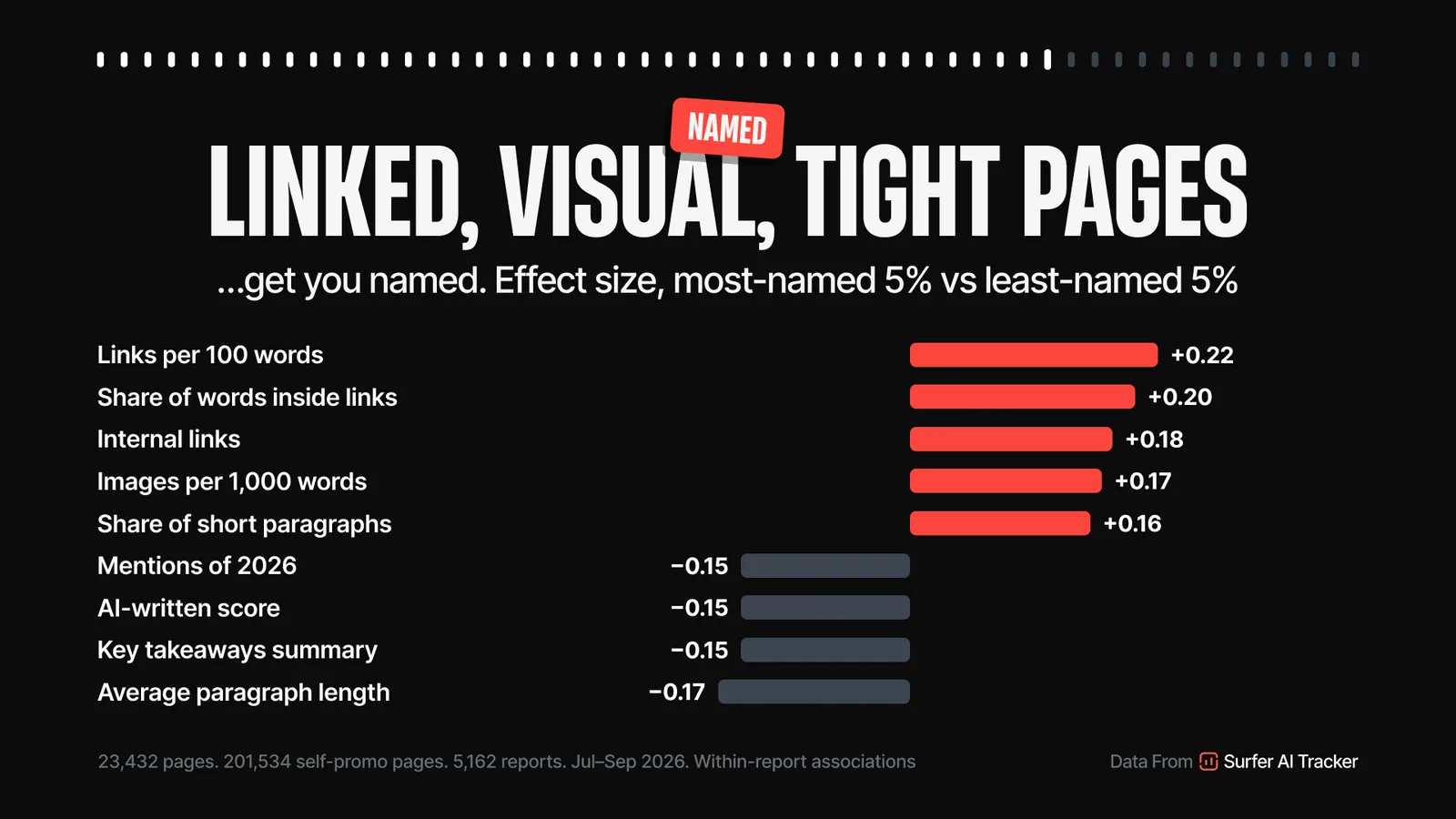
helps hurts. Bars show the effect of following the rule on each scoreboard: the gap between the best and worst 5% of pages in the same niche, where 0.3 means the better page wins about 65% of head-to-heads.
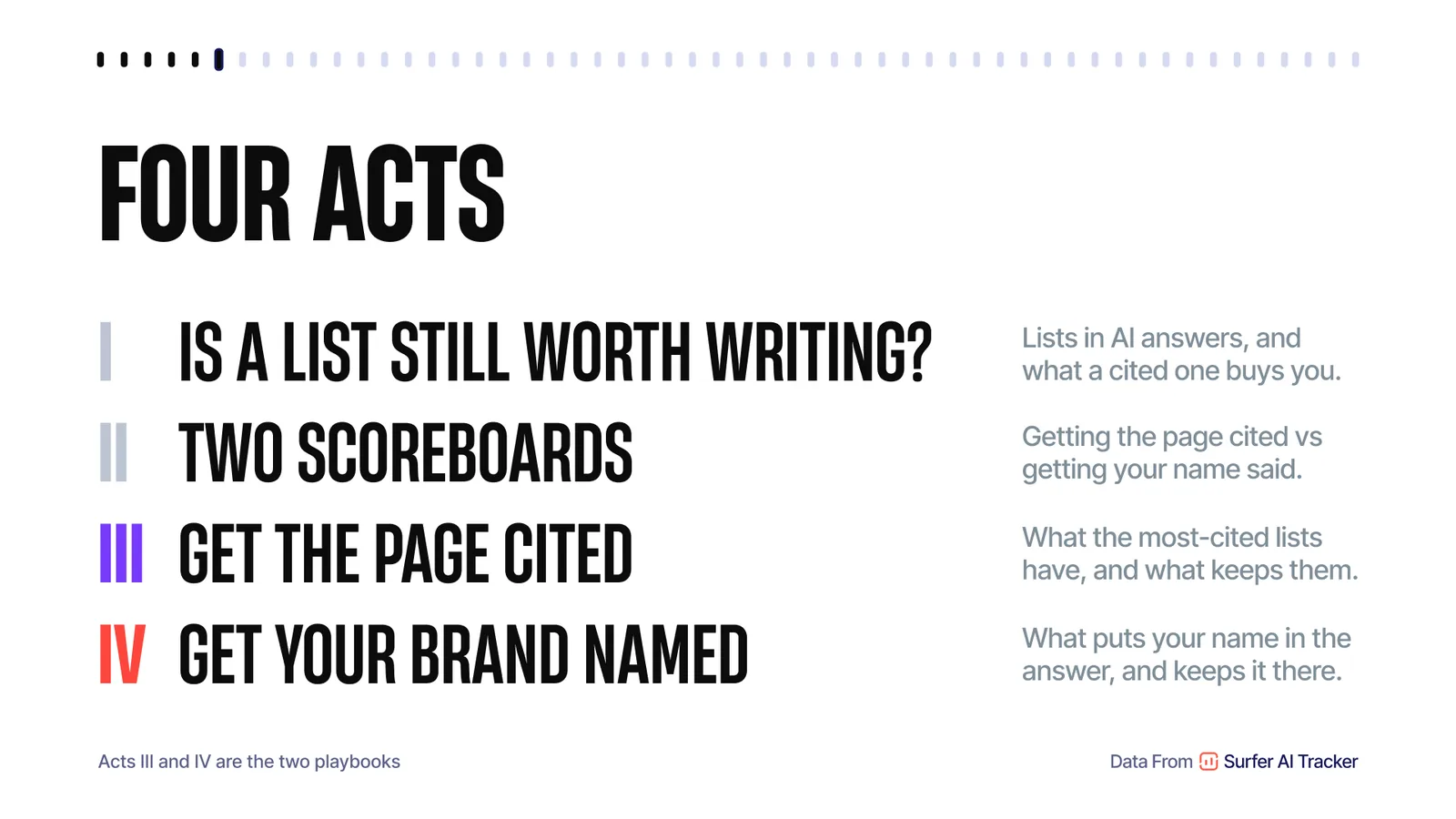
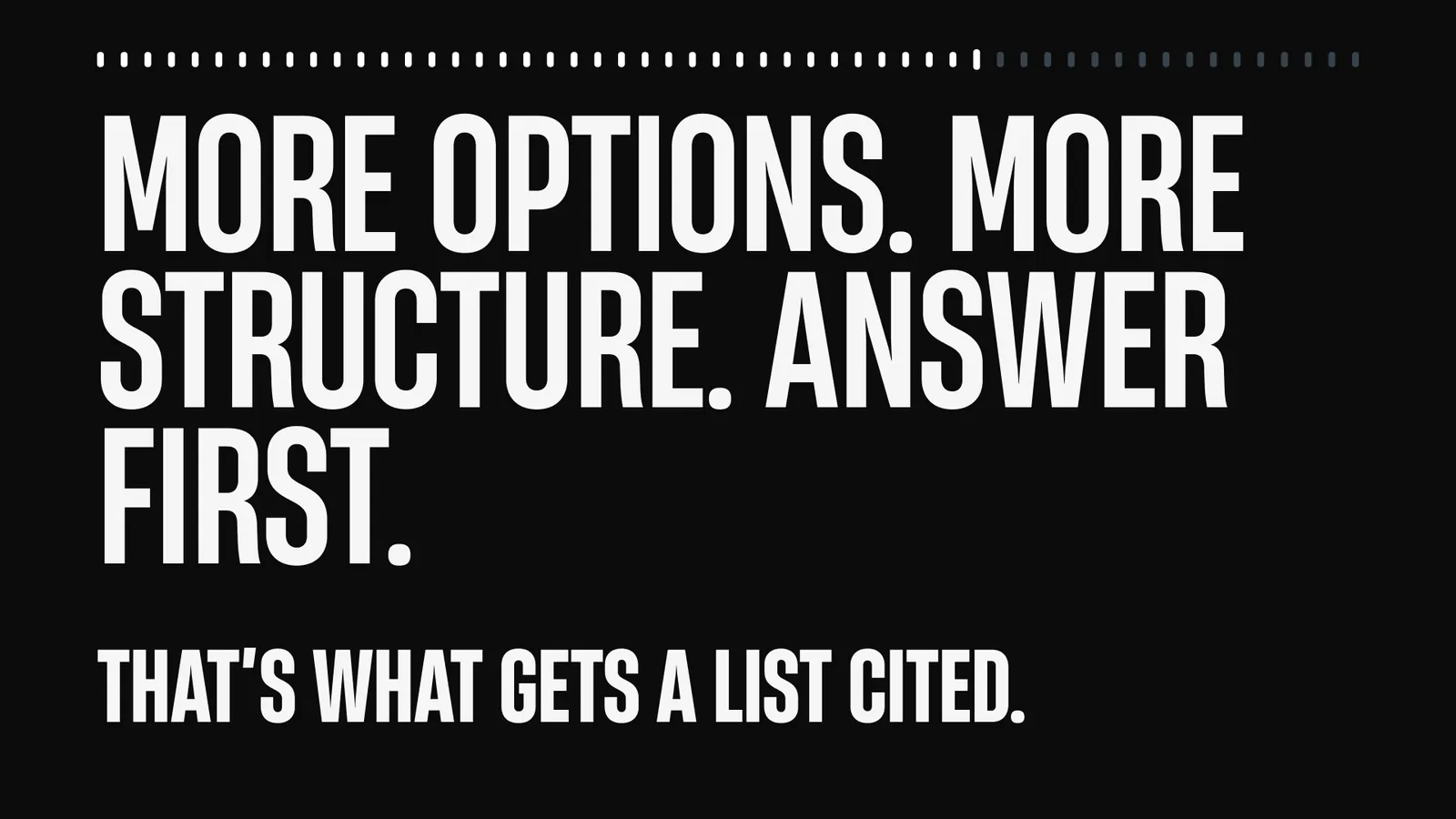
For a hub list that should show up as a source: broad, structured, answer first.
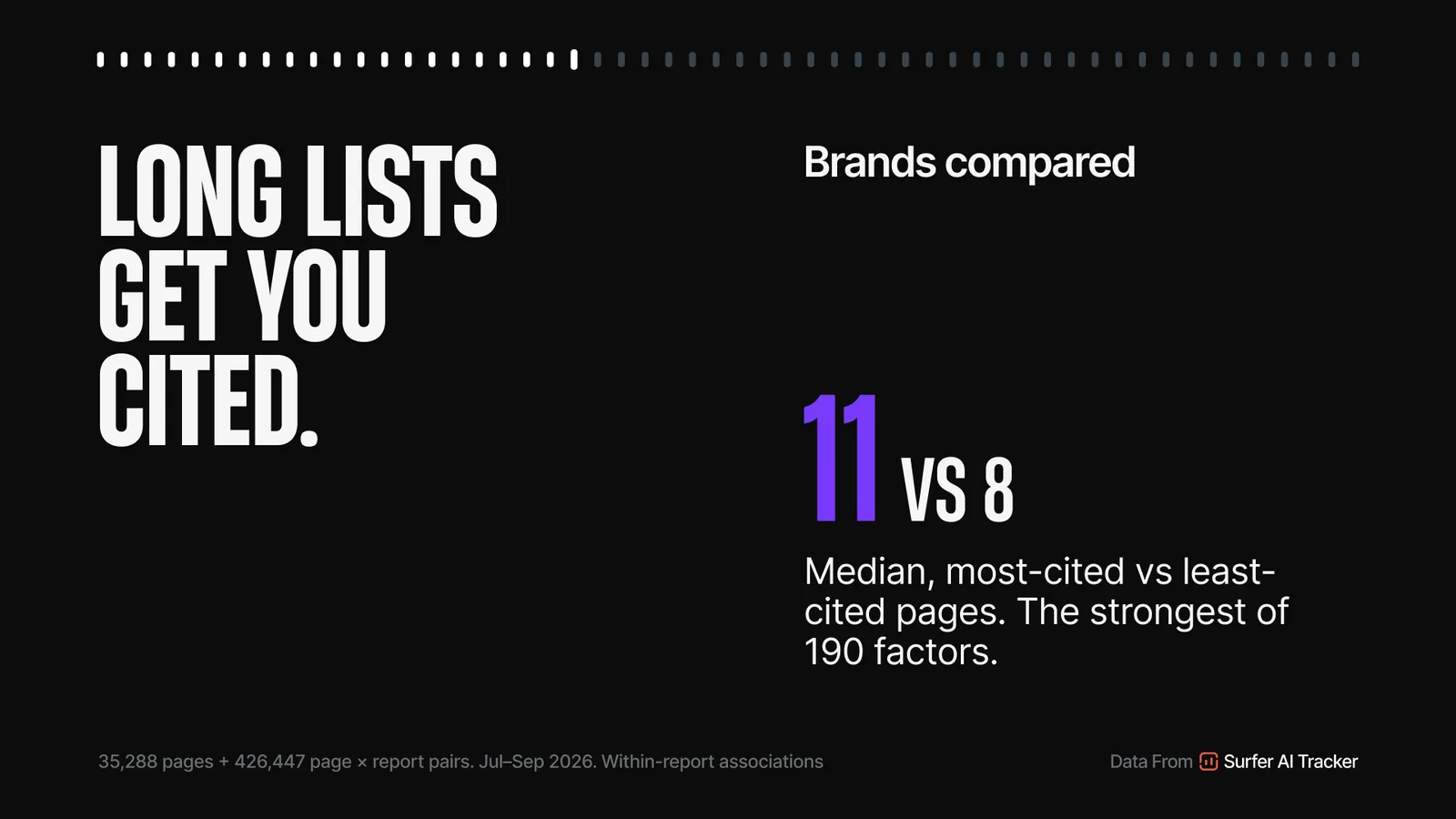
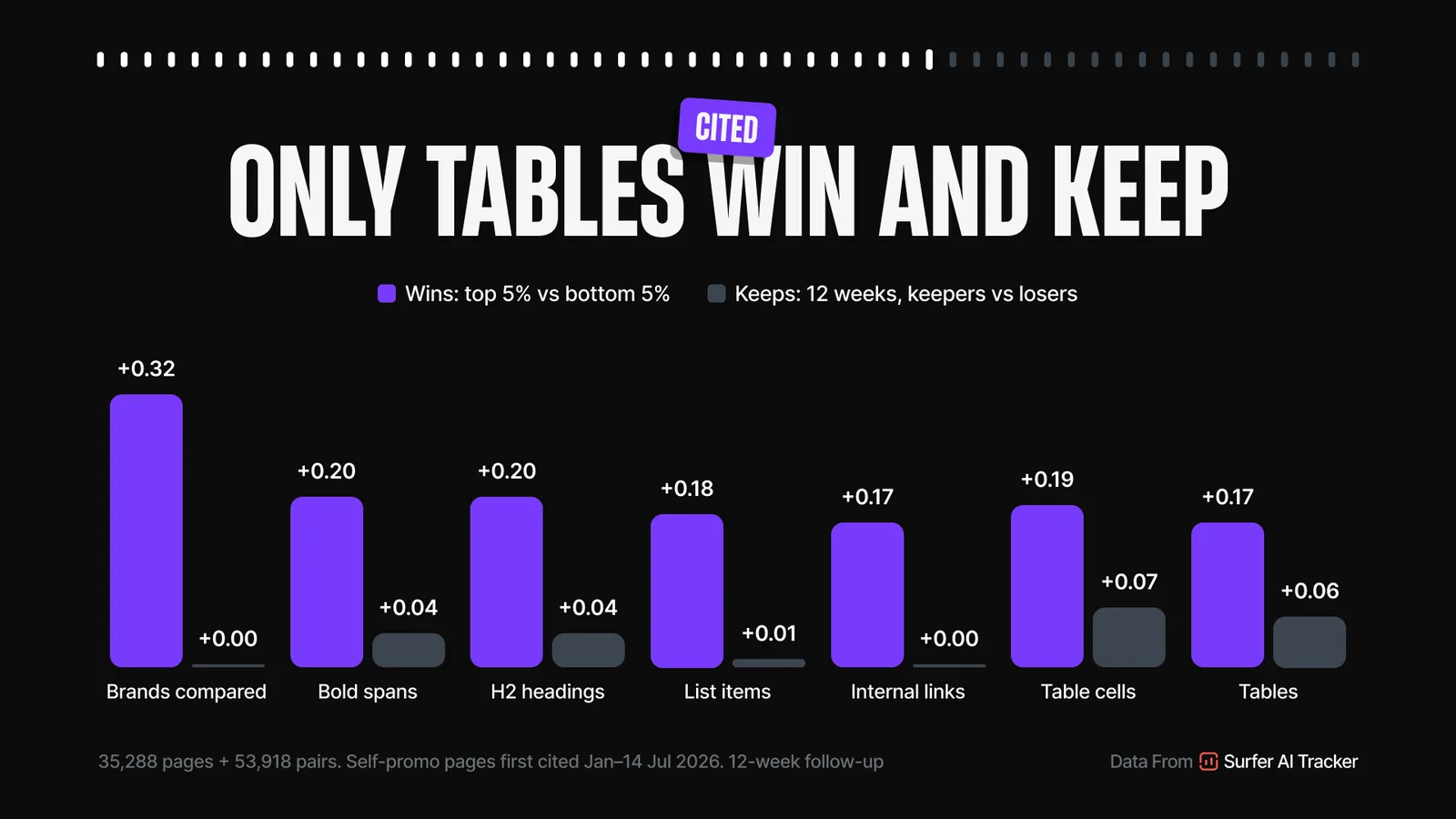
List 10 or more options.
The most-cited lists compare a median of 11 brands, the least-cited 8. The strongest of all 190 factors for citations.
Cited+0.32Named−0.06Put the comparison in a table.
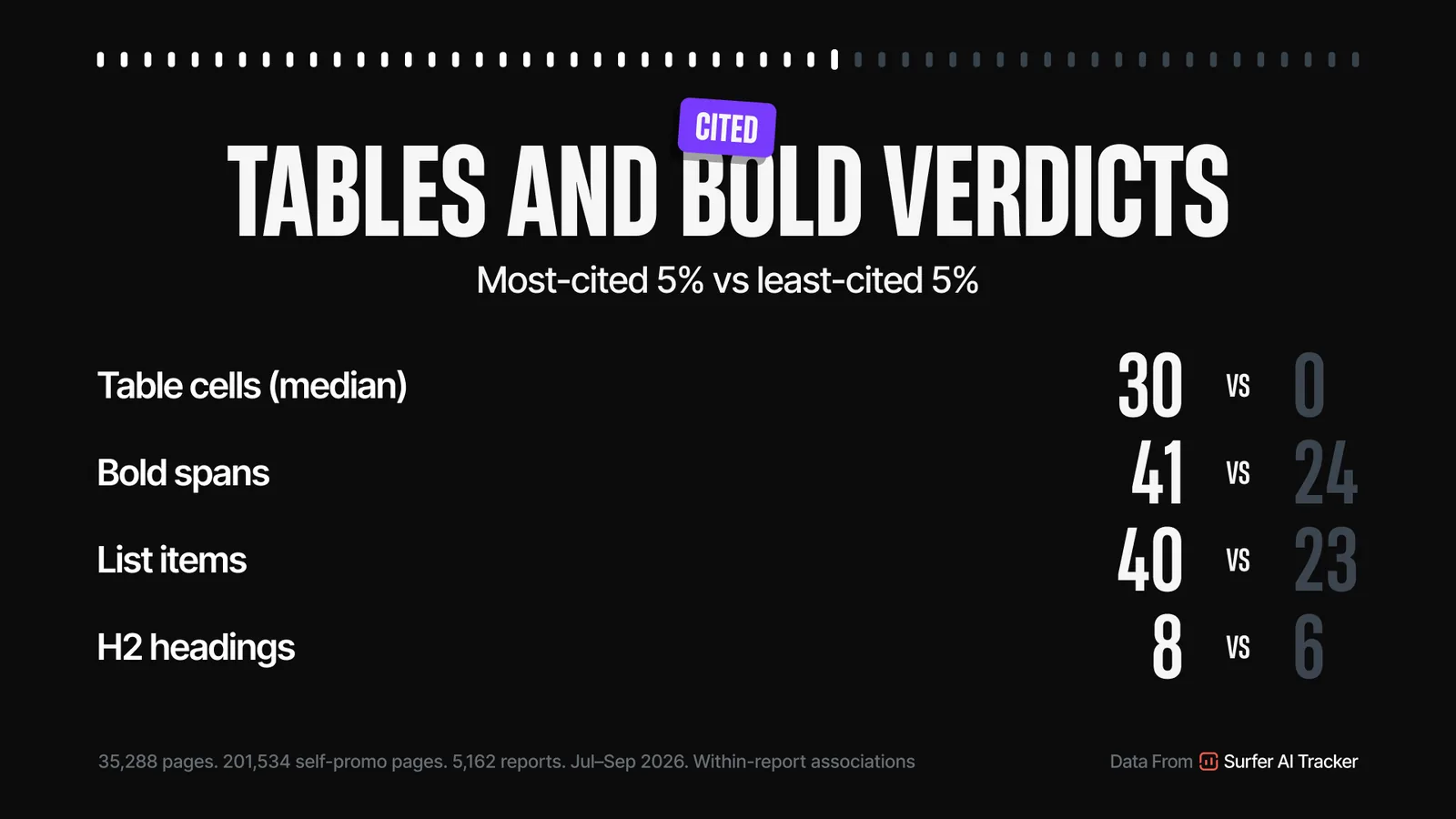
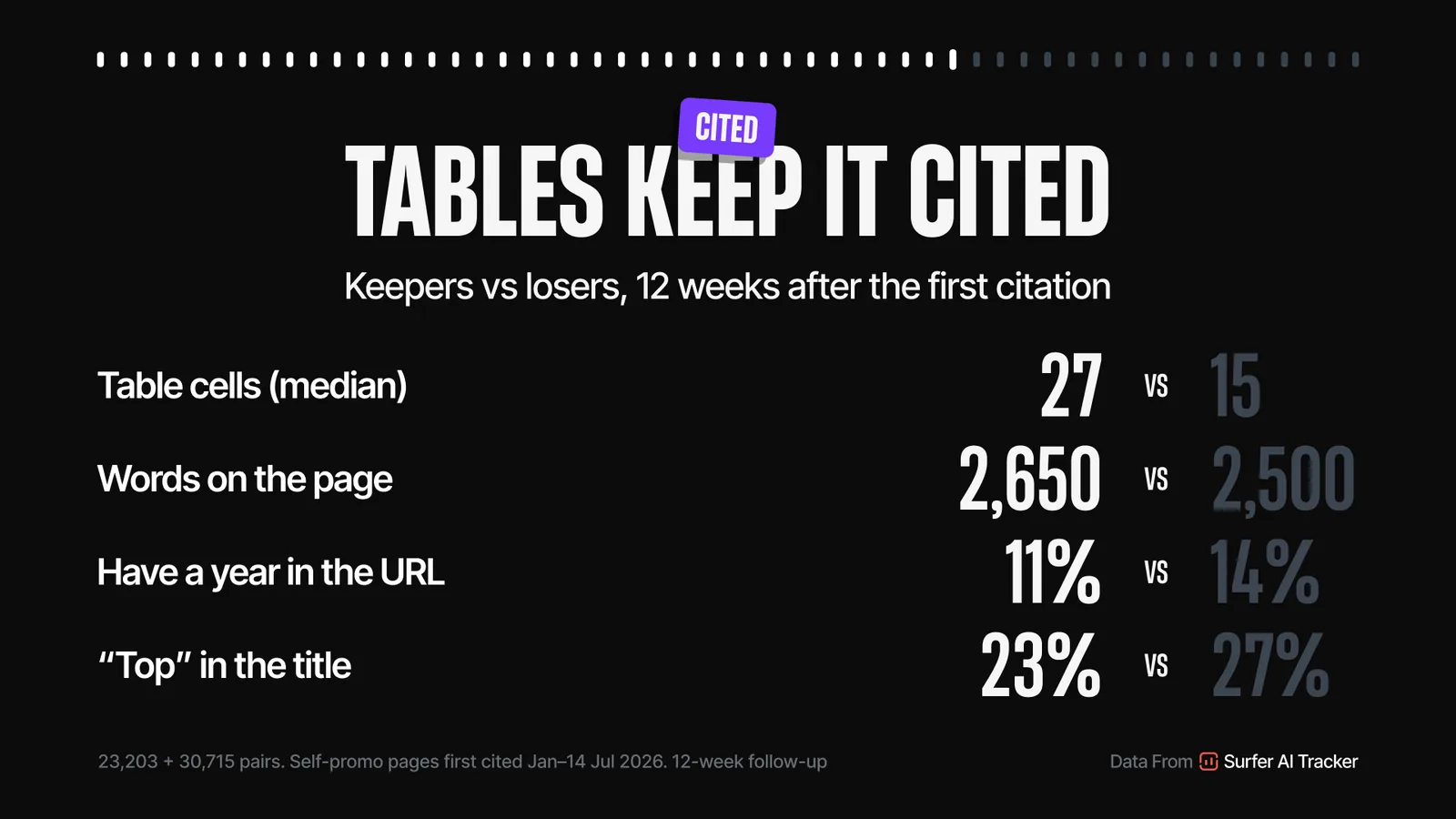
Median 30 table cells on the most-cited lists, 0 on the least-cited. Tables are also the one structure factor that helps a page keep its citations (27 vs 15 cells after 12 weeks).
Cited+0.19Named−0.04Give every option its own H2, and use H3s inside. Beyond the talk
More H2s (8 vs 6) and H3s on the most-cited pages.
Cited+0.20Named+0.06Bold a one-line verdict for each option.
41 bold spans vs 24.
Cited+0.20Named+0.02Move words out of plain paragraphs into lists and tables.
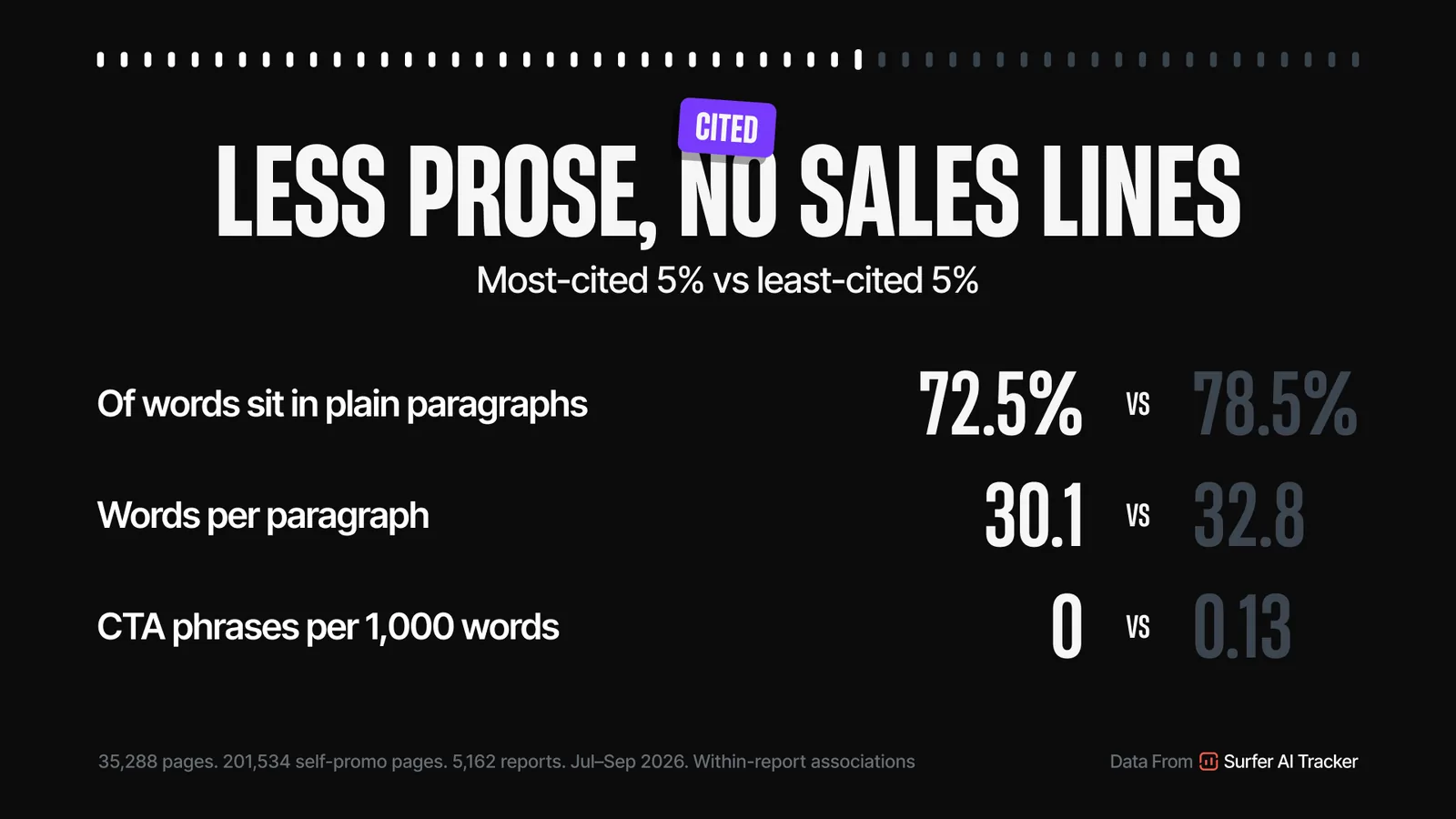
72.5% of words sit in paragraphs on the most-cited pages, 78.5% on the least-cited. More words inside lists helps too.
Cited+0.19Named+0.06Answer the query in the first lines.
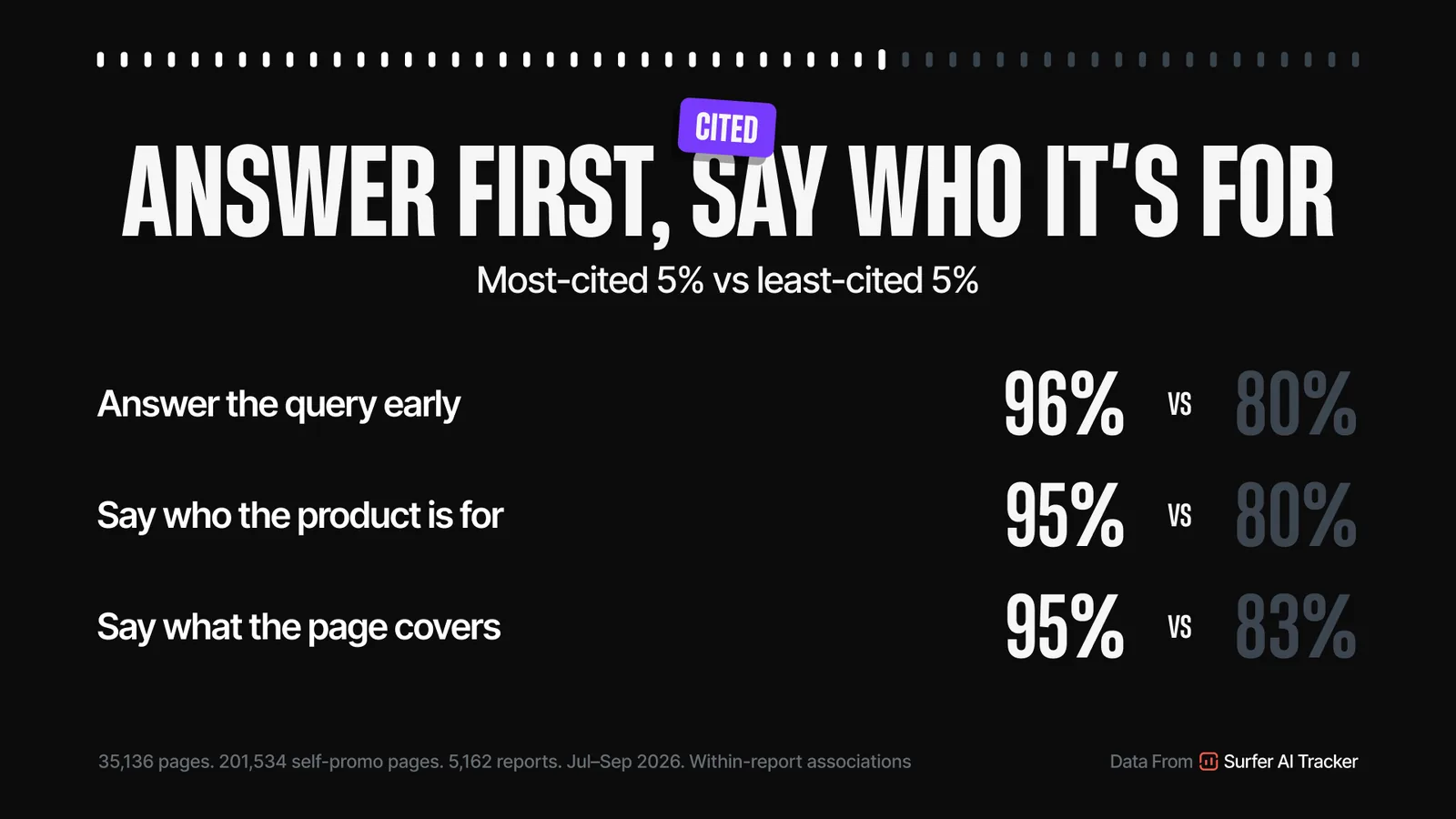
96% of the most-cited lists answer early, against 80% of the least-cited.
Cited+0.15Named−0.02Say who each option is for.
95% vs 80%.
Cited+0.15Named−0.03Open with what the page covers and why it matters. Beyond the talk
An introduction that sets scope (95% vs 83%) and stakes scores higher on the most-cited pages.
Cited+0.16Named−0.04Back every entry with a source, an expert or a number.
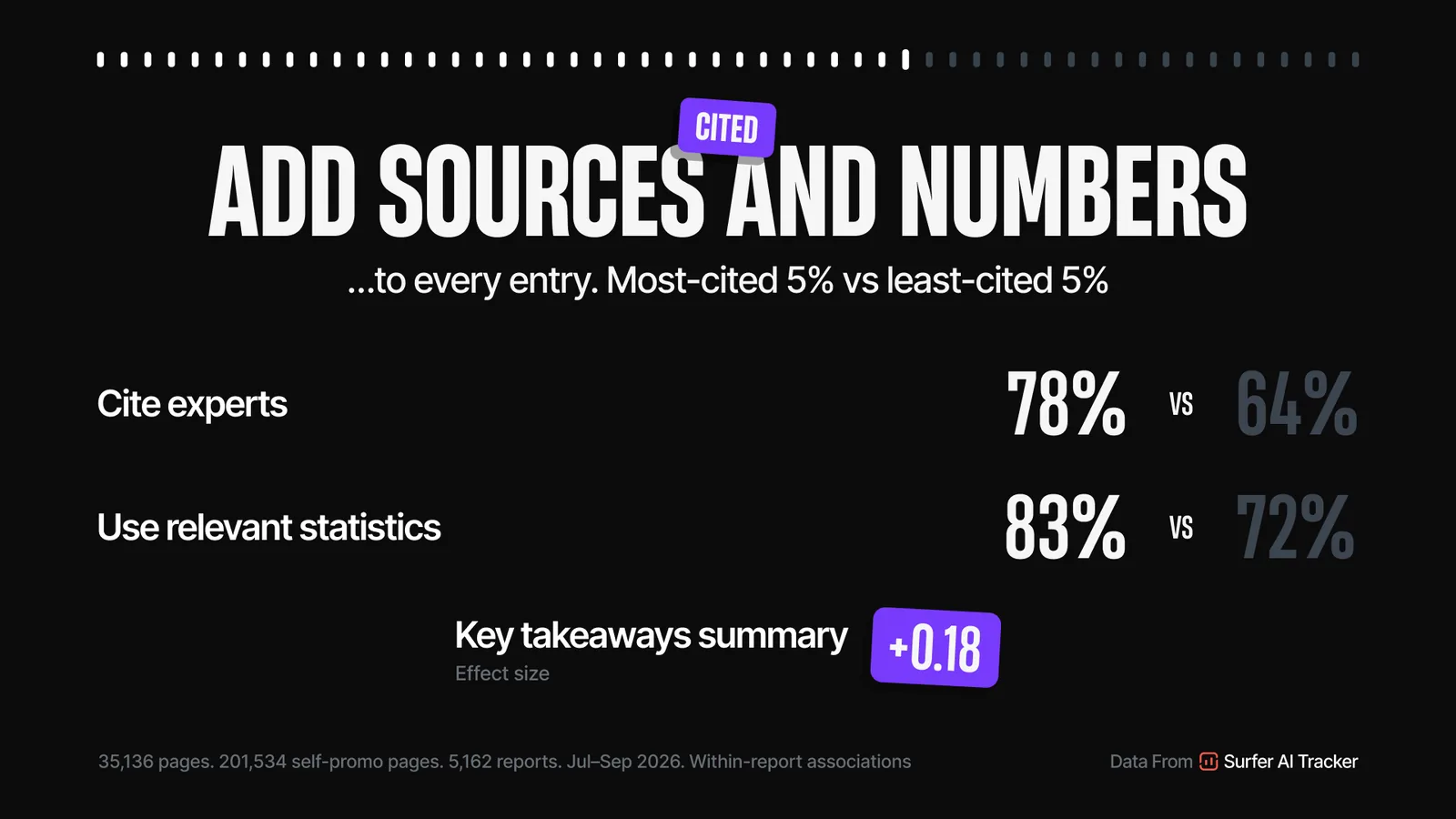
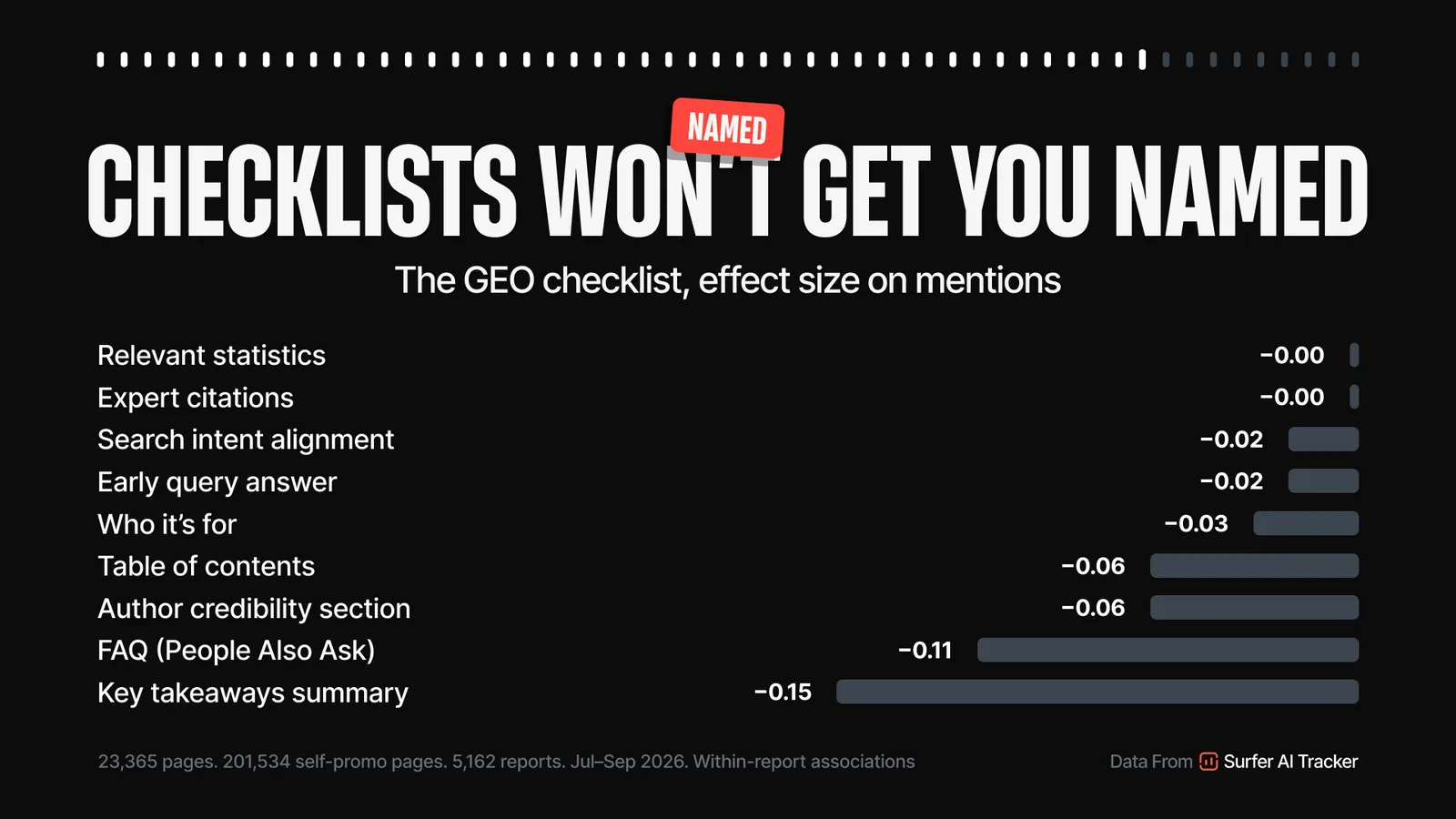
Expert citations 78% vs 64%, relevant statistics 83% vs 72%; attribution quality scores higher too.
Cited+0.16Named−0.03Define terms and make each section stand on its own. Beyond the talk
Concept definitions, self-contained sections and dense, specific writing all score higher on the most-cited lists. Models lift sections, not pages.
Cited+0.14Named−0.03Show first-hand experience. Beyond the talk
Pages with experience signals (tested, used, measured) are over-represented among the most-cited lists.
Cited+0.18Named−0.03Cut sales lines and exclamation marks.
Most-cited pages carry no CTA phrases (median 0 vs 0.13 per 1,000 words). Exclamation marks point the same way.
Cited+0.15Named+0.01“Best” and a year in the title buy reach, not credit.
Both lean towards citations and away from your brand being named. Use them on a list that plays for reach.
Cited+0.09Named−0.14Keep years and digits out of the URL.
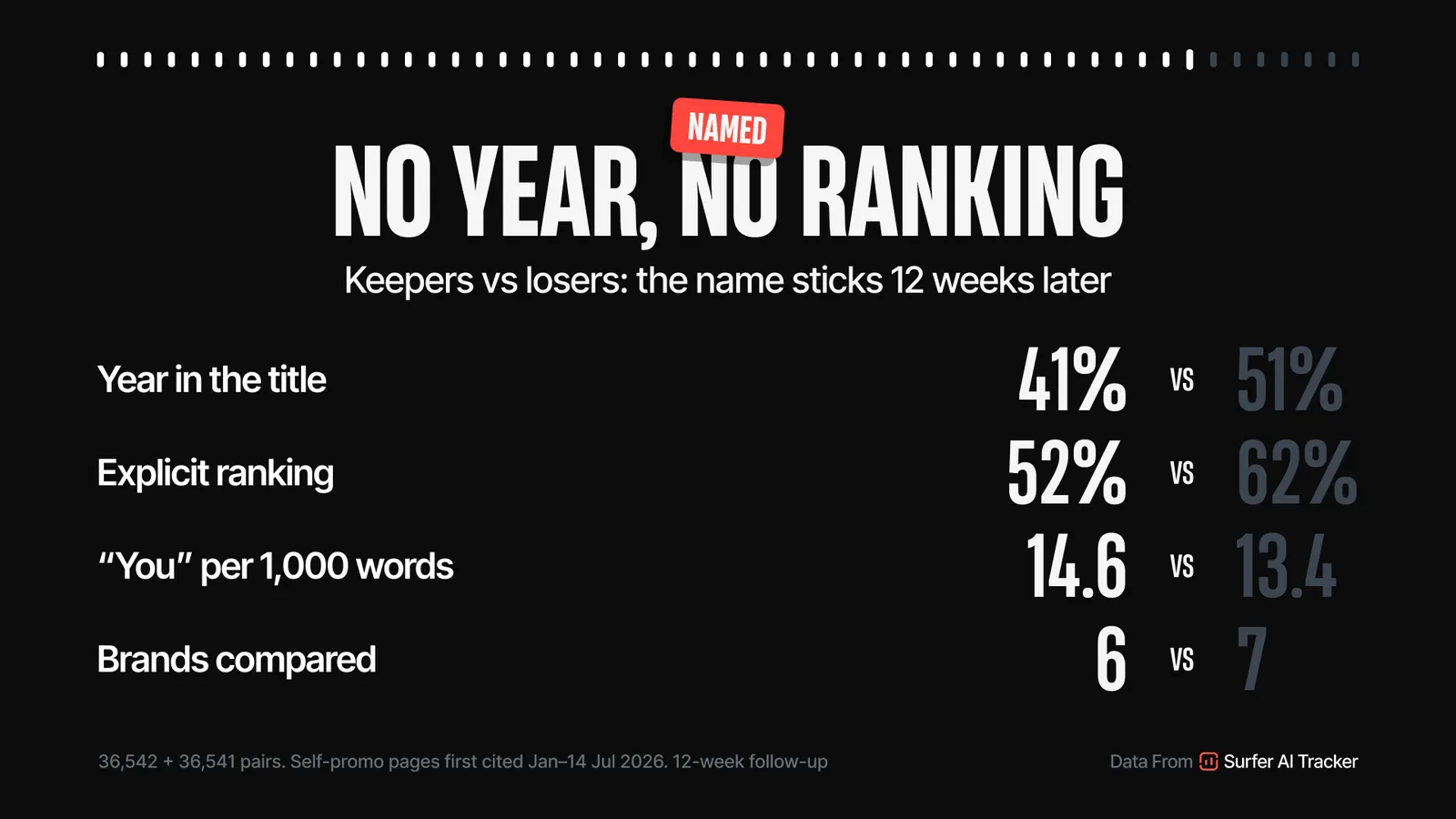
Pages that keep their citations have a year in the URL less often (11% vs 14%).
Plan the refresh.
11 weeks after its first citation, the median page is cited at about a quarter of its first-month rate; 60% are still cited at all.
Aim it at list-seeking prompts. Beyond the talk
On “best / top / vs / alternatives” prompts, listicles take 49% of third-party citations, against 24% on other prompts.
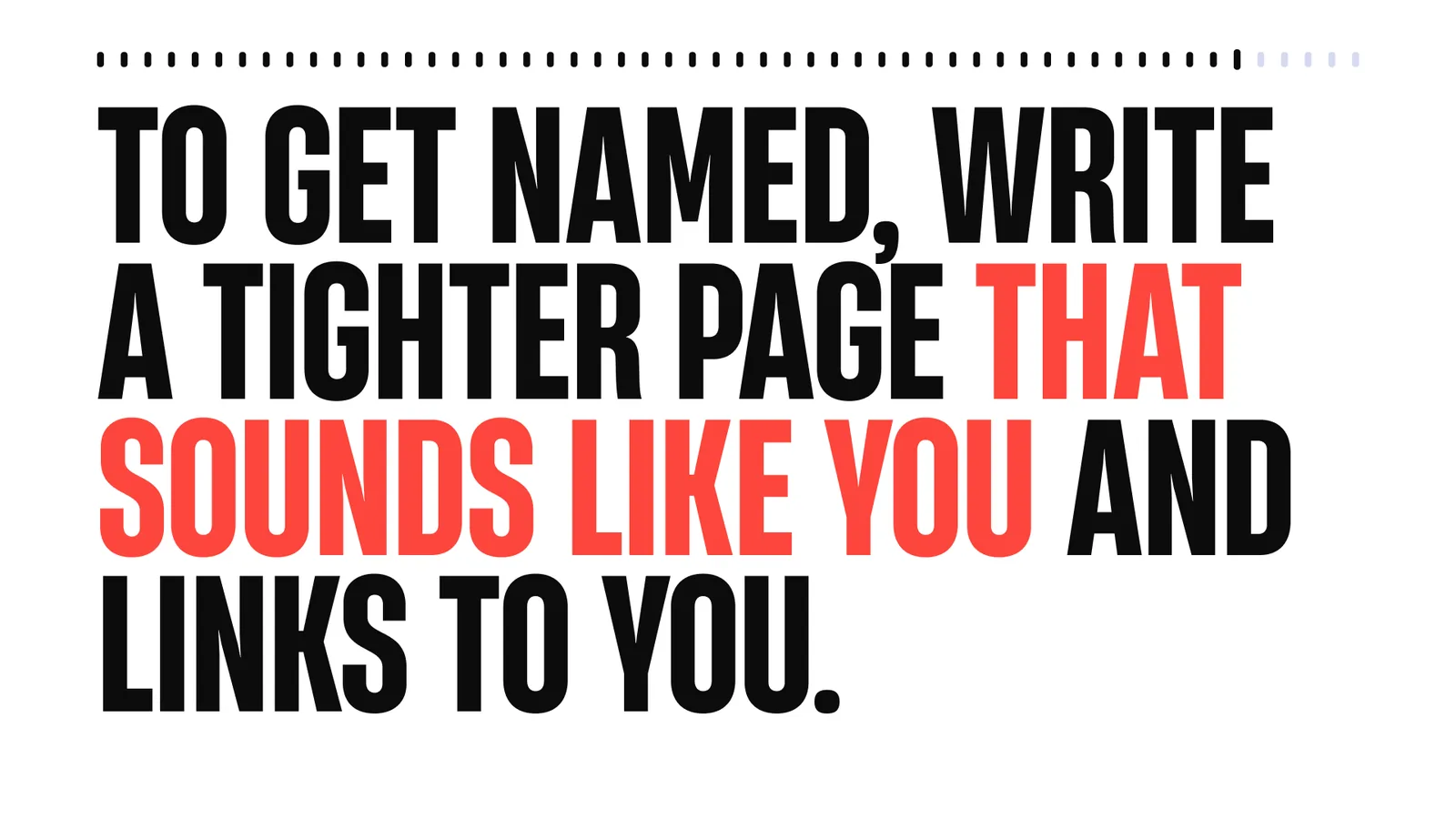
For a page that should put your name in the answer: short, linked, unmistakably yours.
Put yourself at #1.
Publisher named in 38.4% of answers when listed first, 26.5% when not. Reach doesn’t drop (22.1% vs 20.0% of prompts cite the page).
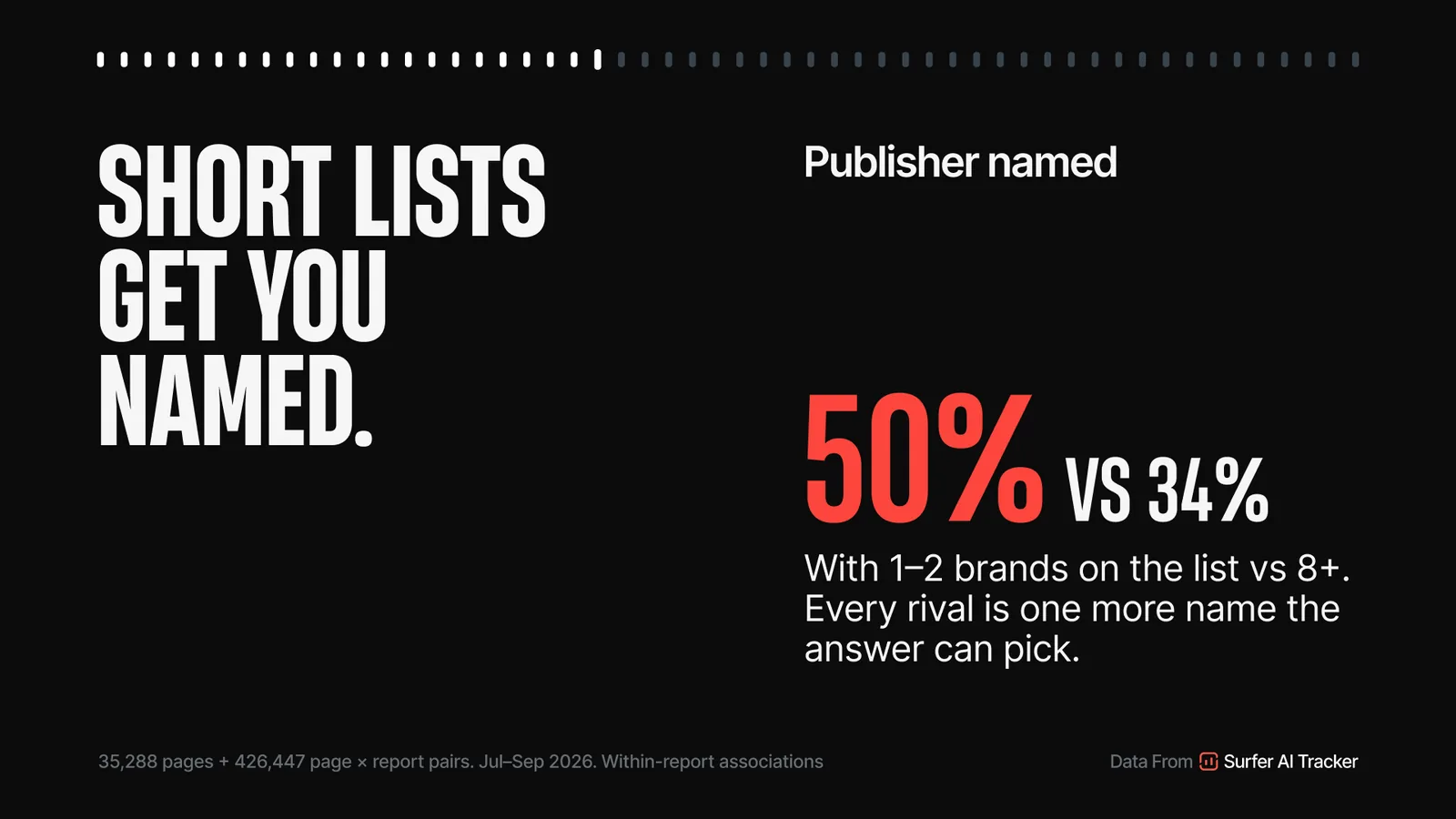
Keep the list short and choose your rivals.
With 1–2 brands the publisher is named in 50% of citing answers, with 8+ in 34%. Each competitor you add gains about 3.7 points from your list.
Cited−0.32Named+0.06Title it “X vs Y” or by use case.
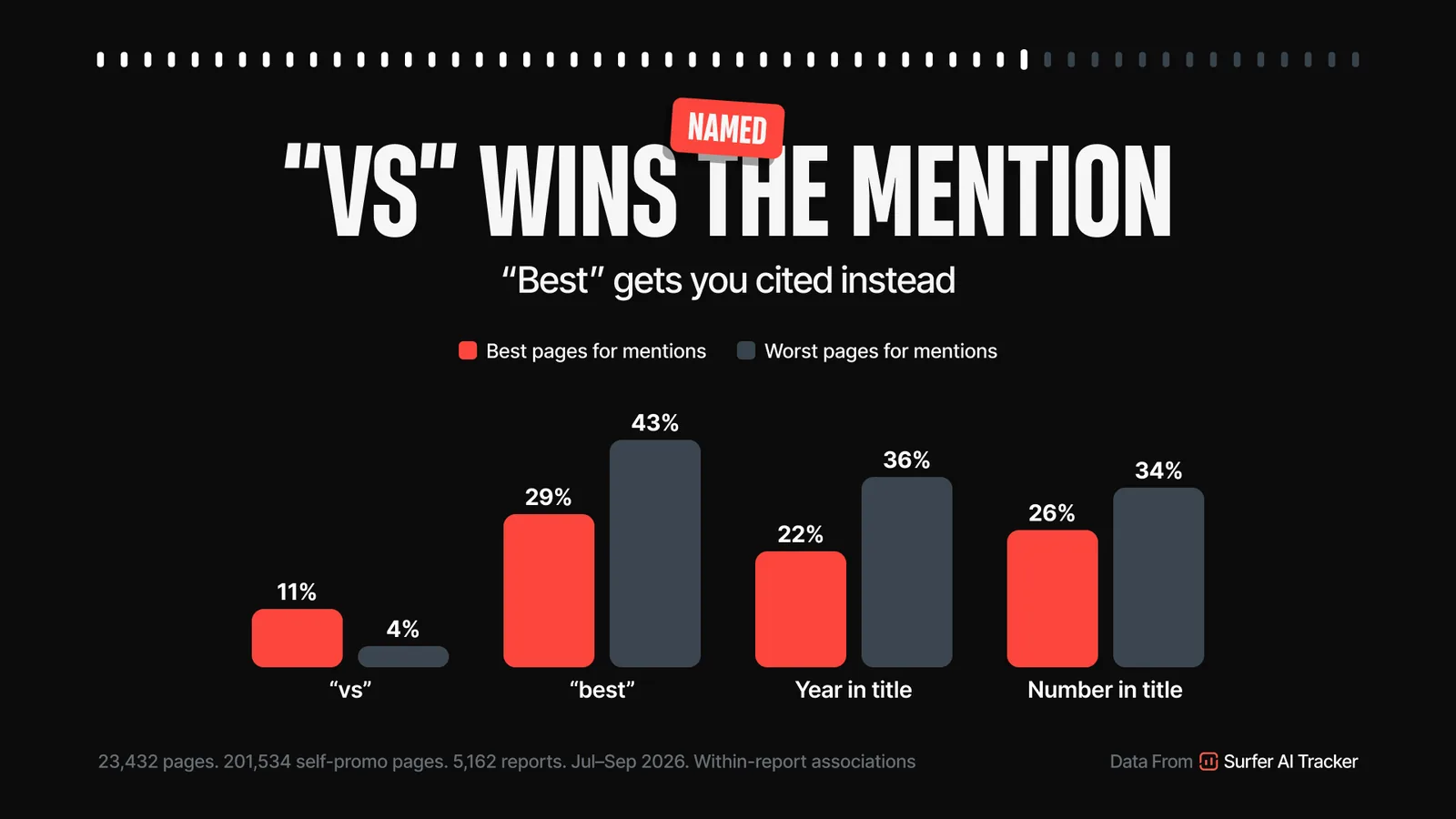
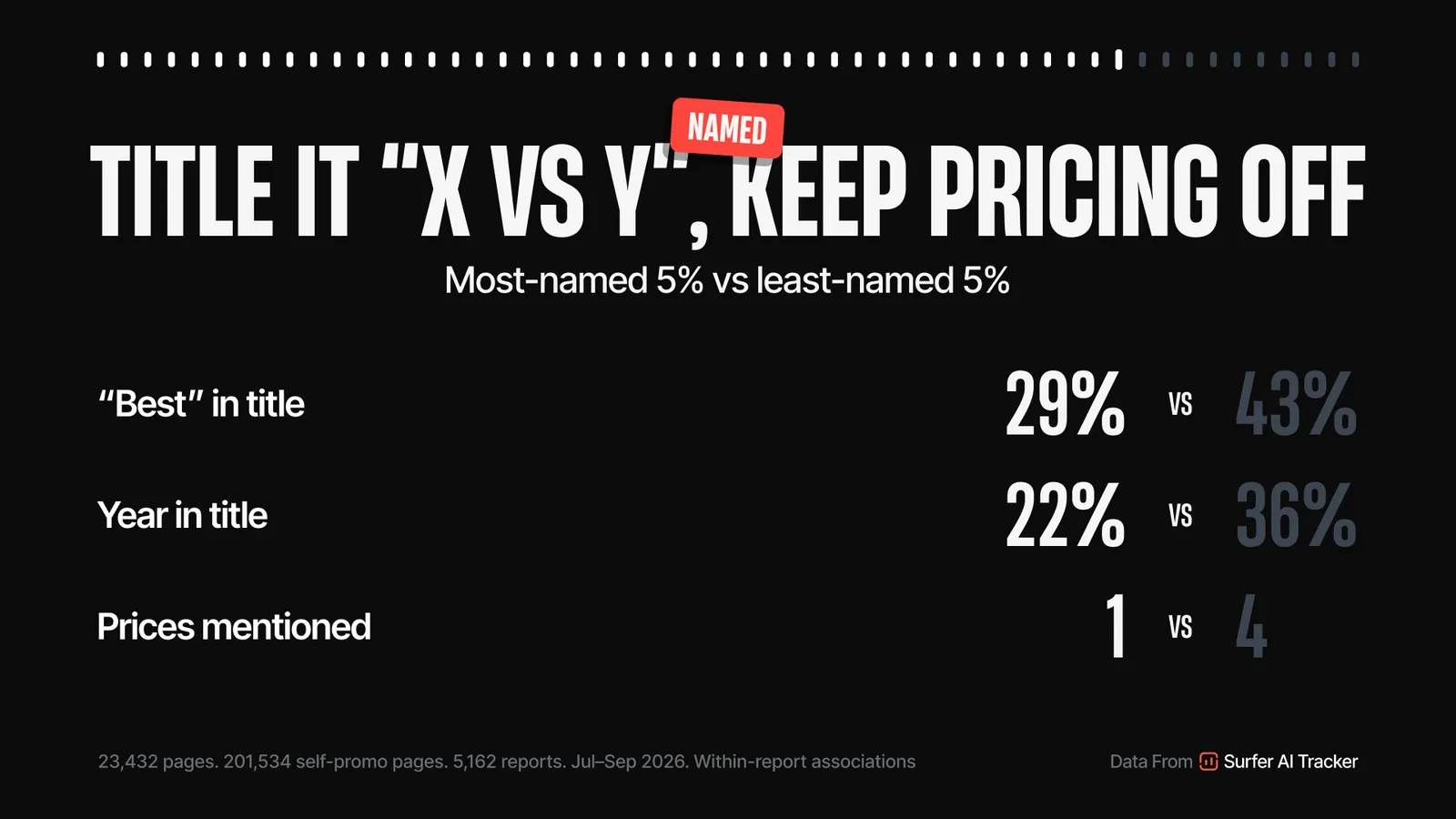
“vs” appears on 11% of the most-named pages and 4% of the least-named. “vs” titles credit the publisher in 52.6% of answers, “top” titles in 31.4%.
Cited−0.04Named+0.07Drop “best”, the year and the number from the title.
“Best” 29% vs 43%, a year 22% vs 36% on the most- vs least-named pages. A number in the title leans the same way.
Cited−0.09Named+0.14Link to your own product pages.
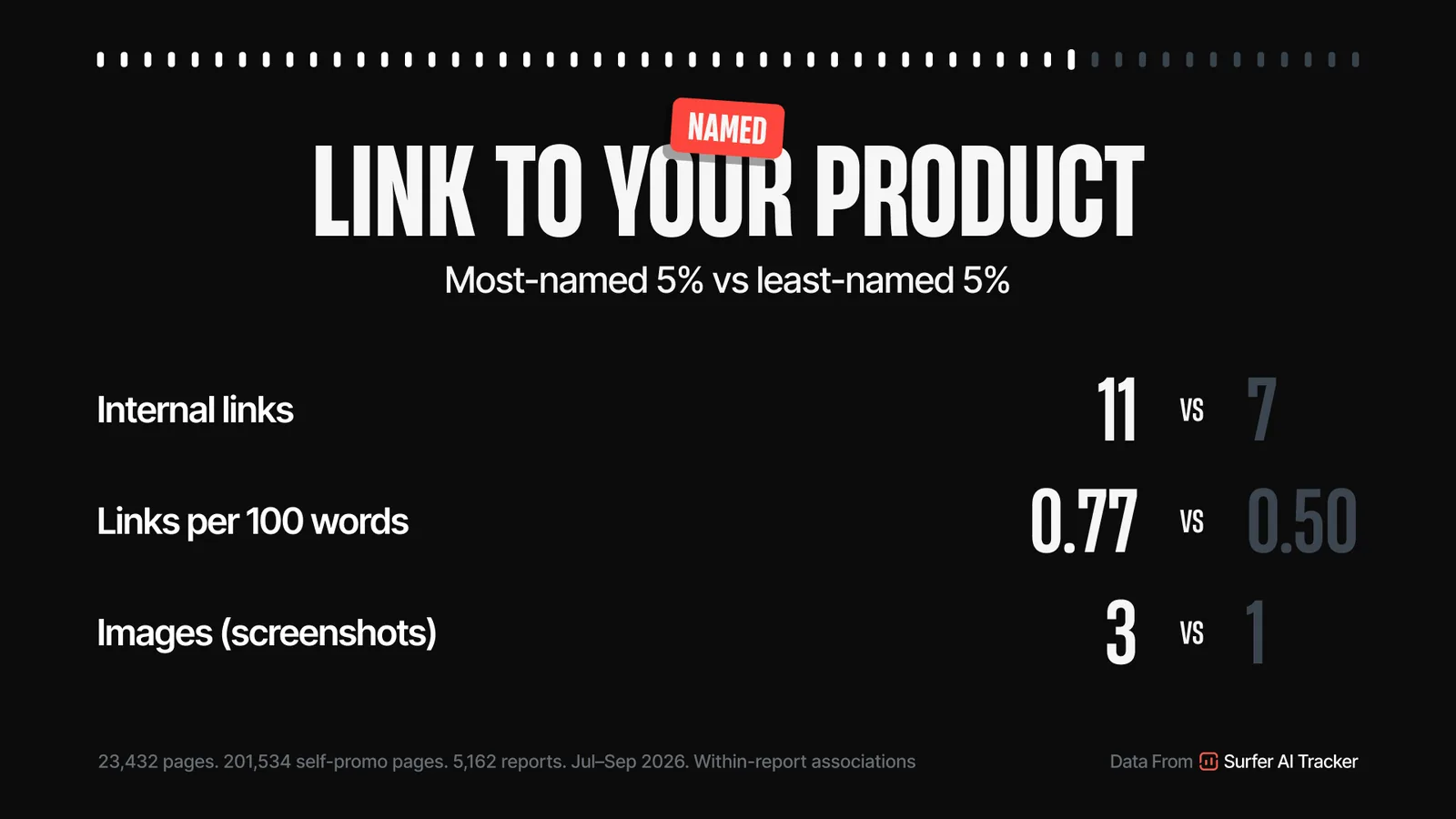
11 internal links vs 7; 0.77 vs 0.50 links per 100 words. The strongest mention signal in the data.
Cited+0.14Named+0.22Show the product.
3 images vs 1 (1.5 vs 0.5 per 1,000 words). Screenshots of your own product do the work.
Cited+0.06Named+0.17Cut the page and the paragraphs.
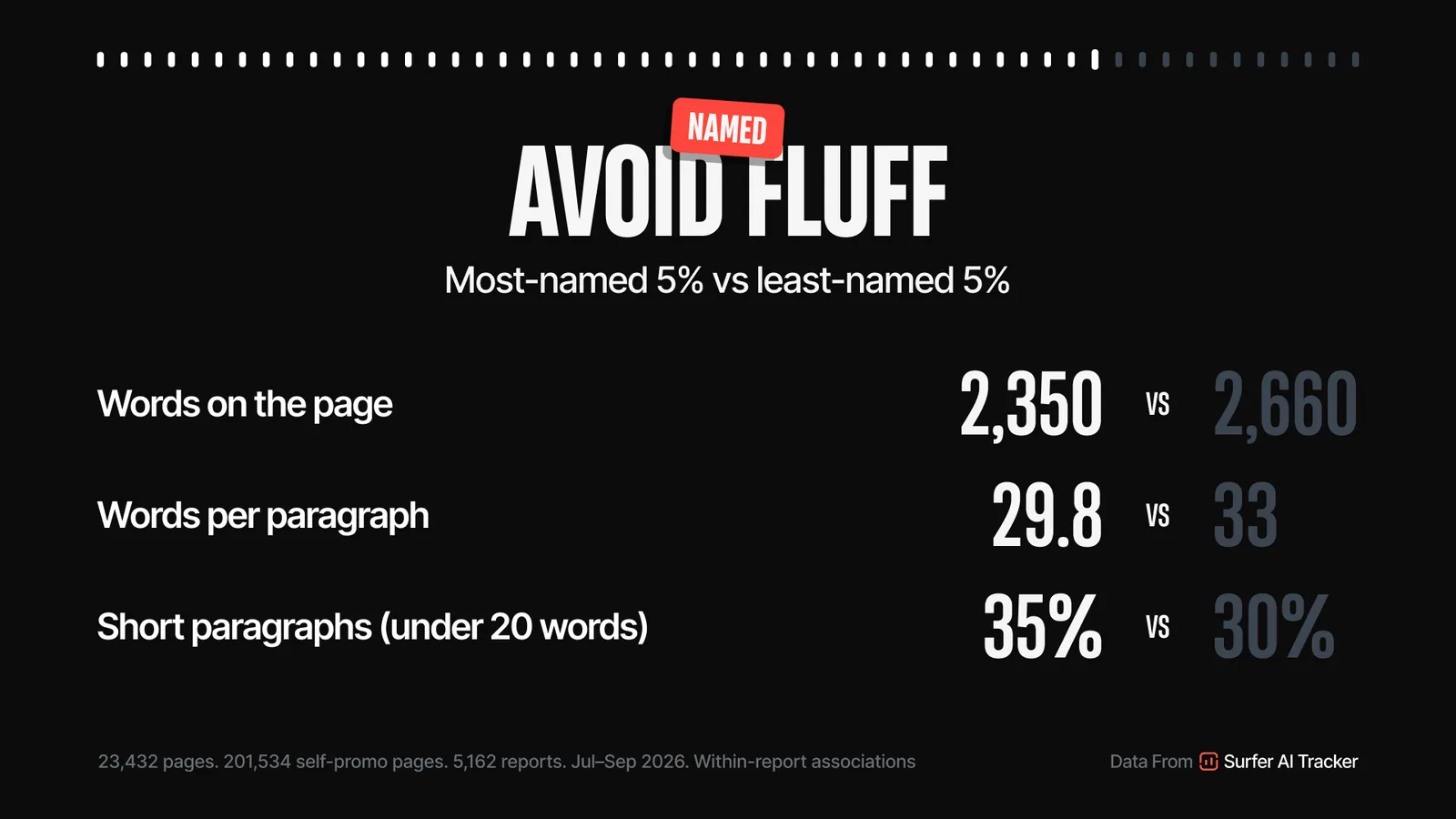
2,350 words vs 2,660; 29.8 words per paragraph vs 33; 35% short paragraphs vs 30%. Your longest paragraph matters too: keep it under 100 words.
Cited−0.05Named+0.12Keep prices off the list.
1 price mentioned vs 4.
Cited−0.04Named+0.14Don’t date the page.
Mentions of 2026 (0 vs 1) and of years in general are lower on the most-named pages.
Cited−0.08Named+0.15Write it yourself.
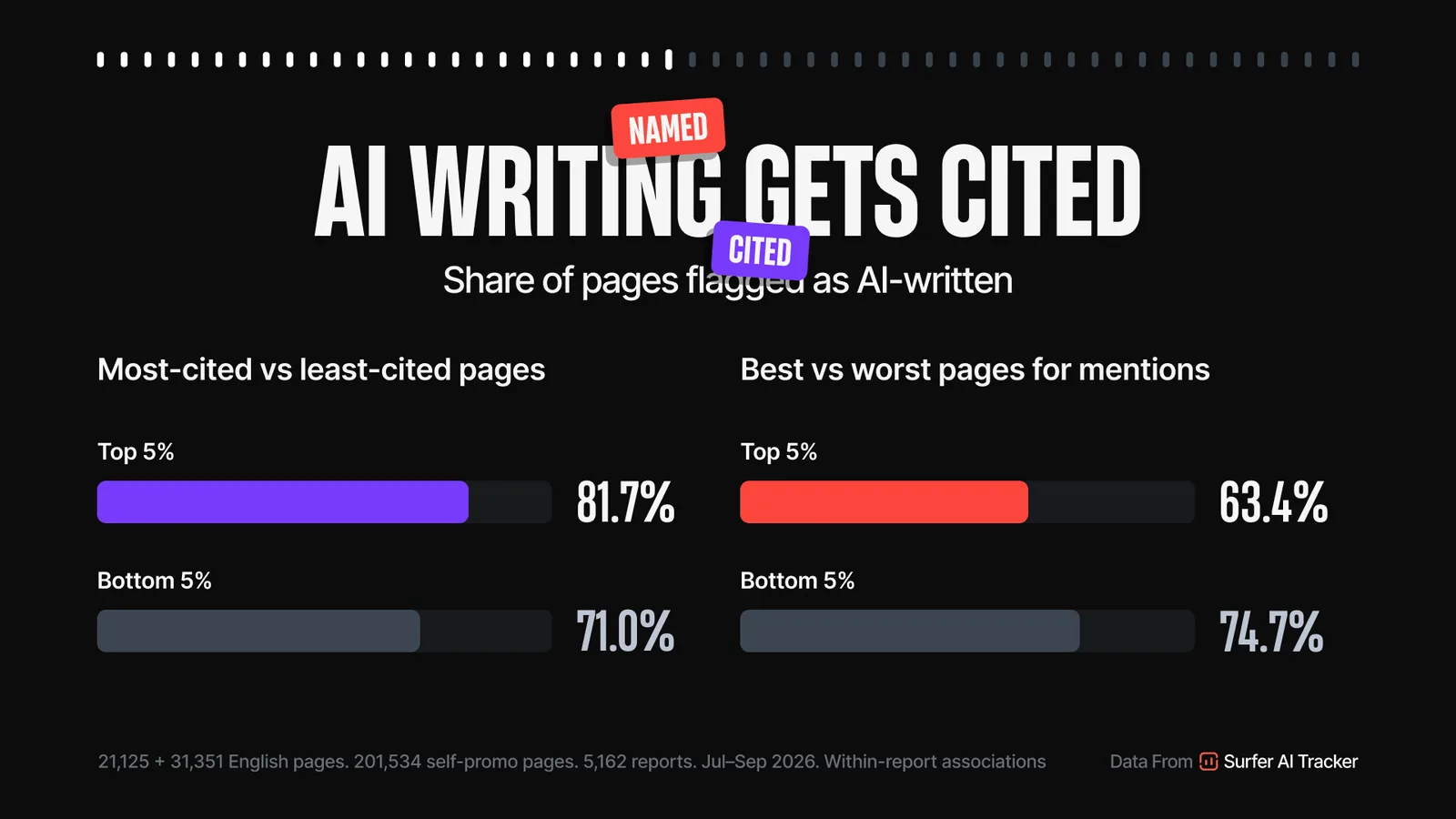
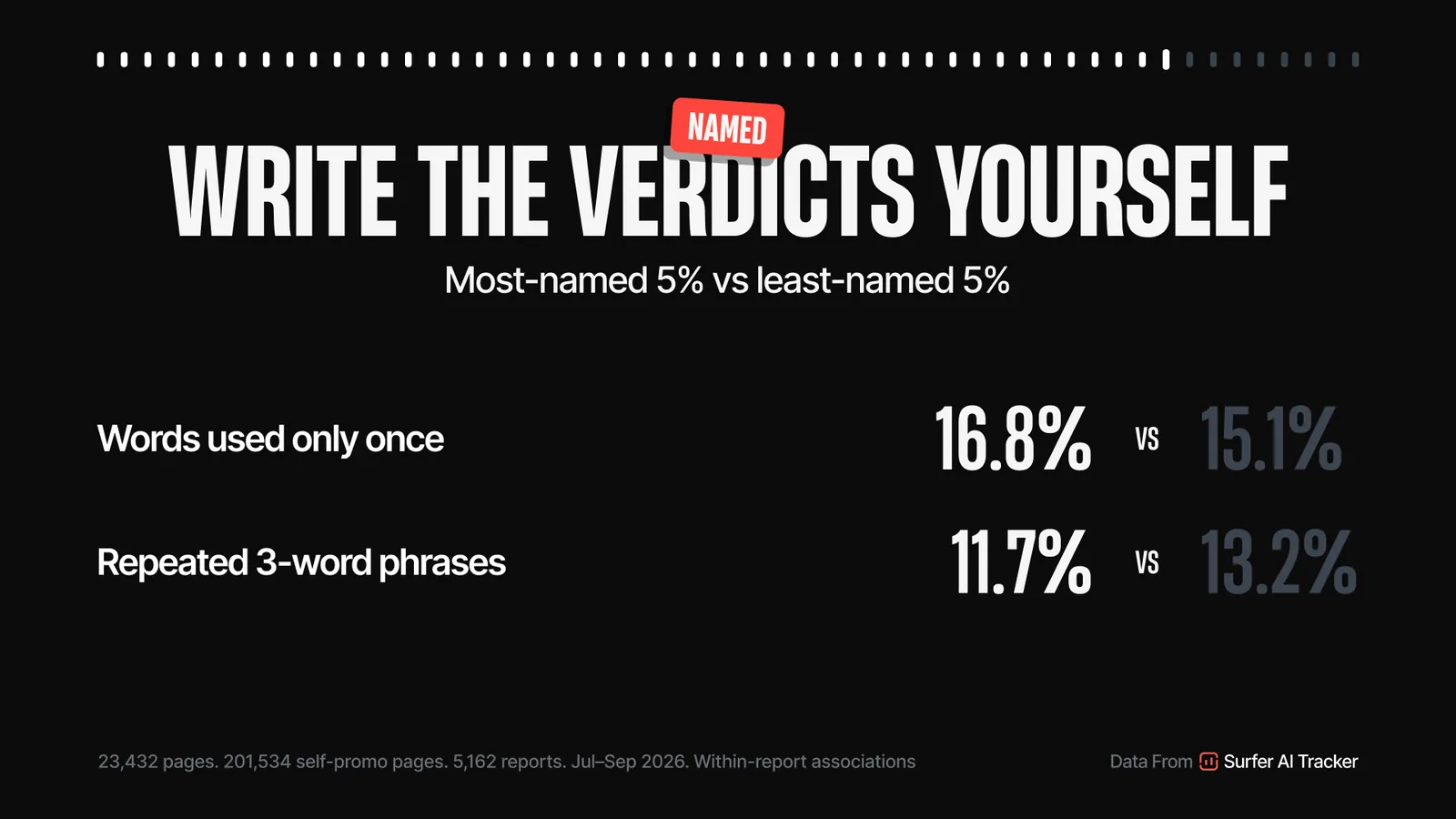
63% of the most-named pages are flagged as AI-written, against 75% of the least-named. More words used only once (16.8% vs 15.1%), fewer repeated three-word phrases (11.7% vs 13.2%).
Cited−0.11Named+0.15Skip FAQ blocks, key-takeaways boxes and question-style subheadings. Beyond the talk
FAQ and key takeaways score lower on the most-named pages (−0.11 and −0.15). Subheadings phrased as questions lean the same way; numbered subheadings too.
Cited−0.18Named+0.15Use a short URL slug. Beyond the talk
Fewer words and hyphens in the slug on the most-named pages; pages that keep the mention have 4 slug words vs 5.
Cited−0.06Named+0.14Skip the numbered ranking.
Pages that keep the mention over 12 weeks use an explicit ranking less often (52% vs 62%).
Cited−0.07Named+0.07Talk to the reader, in your own voice. Beyond the talk
Pages that keep the mention use more “you” (14.6 vs 13.4 per 1,000 words) and more “I/we”.
On other people’s lists, fight for the top three.
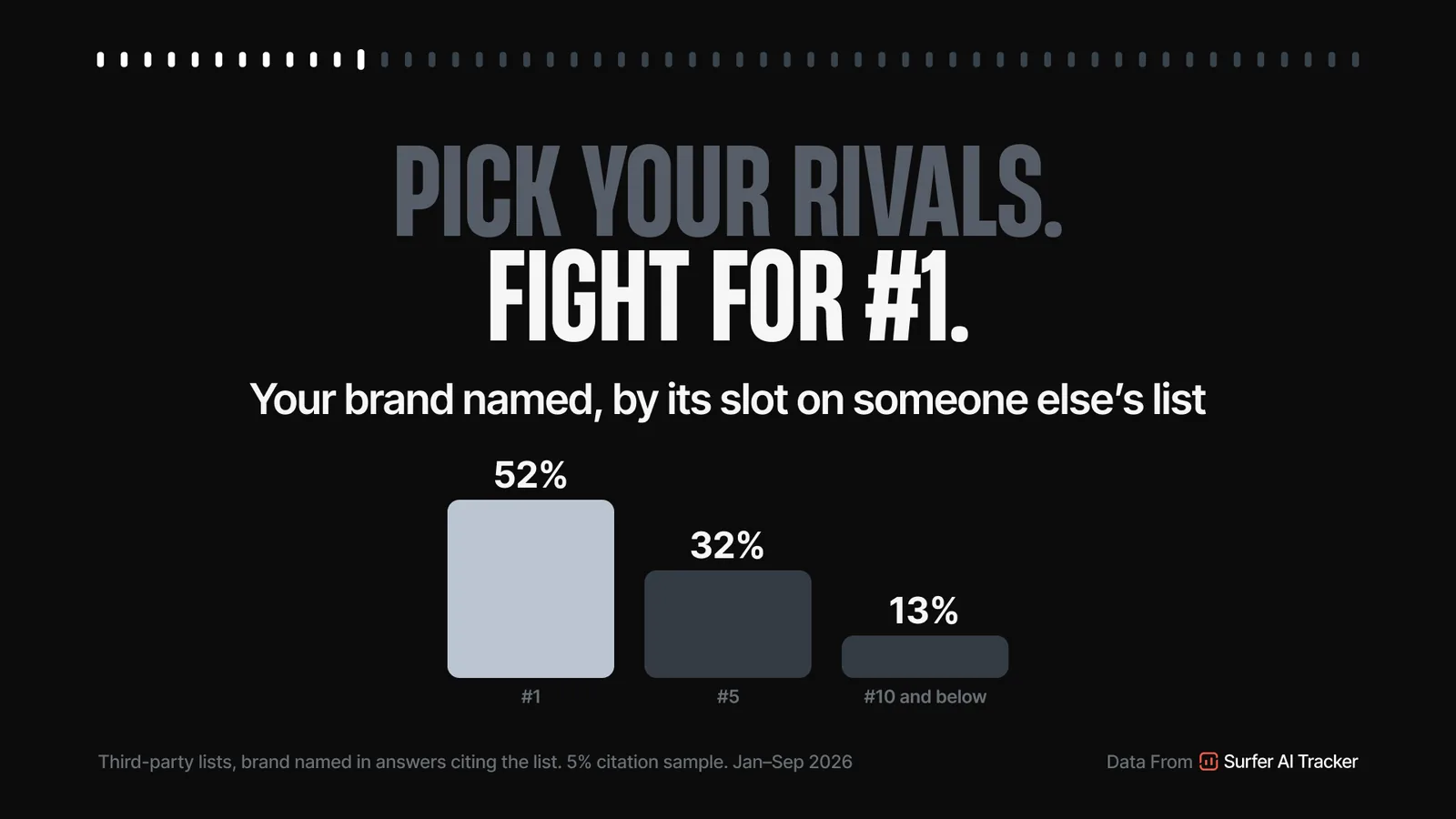
Your brand is named in 52% of answers at #1 on someone else’s list, 32% at #5 and 13% from #10 down.
A few things help on both scoreboards, whatever the list is for.
Break the text into short paragraphs. Beyond the talk
Short paragraphs (under 20 words) help on both scoreboards; paragraphs over 100 words hurt on both.
Cited+0.16Named+0.16Link out and link in. Beyond the talk
Internal links help both citations and mentions; linking to external sources helps too.
Cited+0.17Named+0.18Use H2s, and plenty of them. Beyond the talk
Pages with H2s, and with more headings per 1,000 words, do better on both scoreboards.
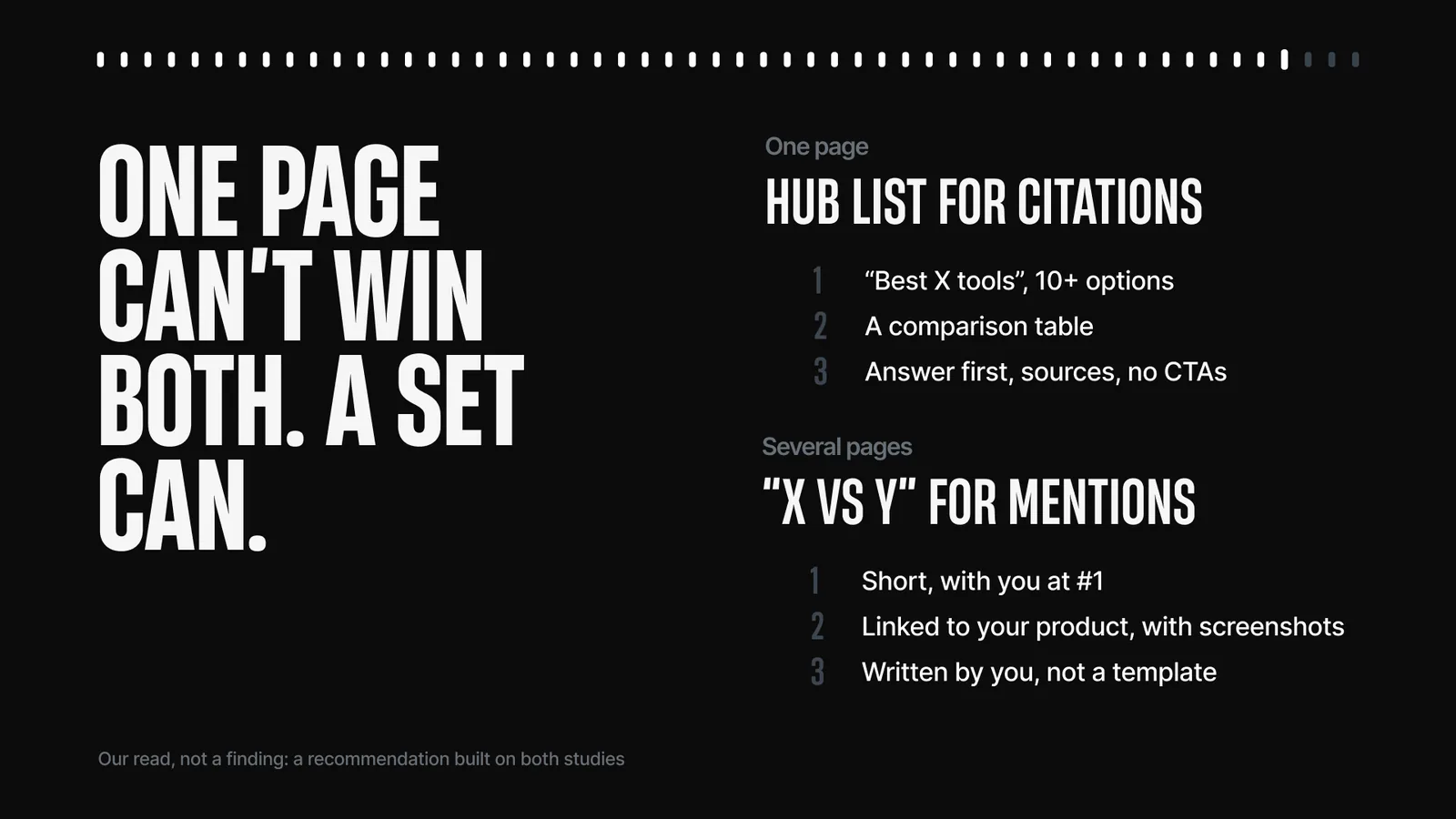
Cited+0.13Named+0.10Run a set of pages, not one page.
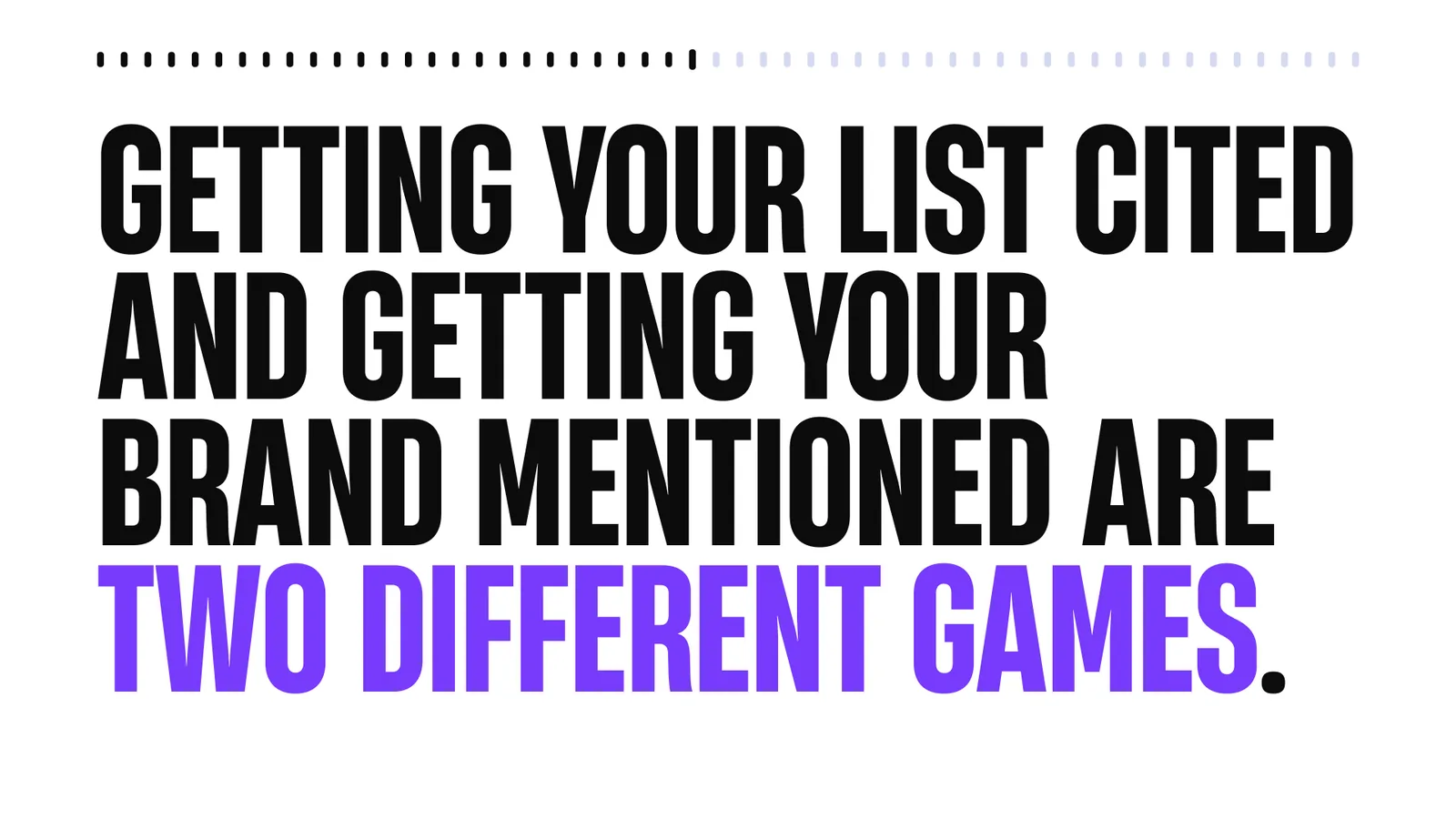
One long hub list for citations, a few tight “X vs Y” pages for your name. That’s our read of the trade-off, not a measured result.
AI instructions
Copy the playbook into your AI writer
Paste into ChatGPT, Claude or your content tool as instructions, fill in the brackets, and go. The audit version checks a list you already have.
You are writing a comparison listicle. The goal: AI answer engines (ChatGPT, Perplexity, Google AI Overviews and AI Mode, Gemini) cite this page as a source.

These rules come from Surfer's analysis of 201,534 self-promo listicles cited in AI answers (Jul–Sep 2026), comparing the most-cited 5% with the least-cited 5% in the same niche. They describe what the most-cited pages have in common; treat them as strong defaults, not guarantees.

INPUTS
- Target query: [e.g. best project management tools for agencies]
- Our brand: [Brand]
- Options to compare: [list, aim for 10–15]
- Audience: [who is choosing]

STRUCTURE
1. Open with a direct answer in the first 2–3 sentences: the top picks and who each one is for.
2. Right after, say what the page covers and how options were chosen (one short paragraph).
3. Add a comparison table near the top: one row per option, 4–6 columns (best for, key strength, key limitation, a hard fact such as a number or feature).
4. One H2 per option. Use H3s inside for "Best for", "What stands out", "Limitations".
5. Start each option with a one-line verdict in bold.
6. Keep plain paragraphs to under 70% of the words: use bullet lists and the table for facts.
7. Paragraphs: mostly under 20 words, never over 100.

CONTENT
- Compare 10 or more options. Coverage is the strongest citation signal in the data.
- For every option: who it is for, one specific fact, and one statistic or expert source with attribution and a link.
- Define the category and any jargon in one plain sentence each.
- Write each section so it makes sense if quoted on its own (repeat the product name, avoid "as mentioned above").
- Add first-hand evidence where you have it: what was tested, how, with what result.

AVOID
- Calls to action ("sign up", "try it free", "book a demo") and exclamation marks.
- Filler intros and generic conclusions.

TITLE AND URL
- Title pattern: "Best [category] for [use case]" (a year is fine here: this page plays for reach, not for your brand being named).
- Short URL slug, no query parameters, no year or other digits in the URL.

MAINTENANCE
- Citations fade: about 11 weeks after the first citation a page is cited at roughly a quarter of its first-month rate. Schedule a refresh every 6–8 weeks: update facts, keep the table current.

OUTPUT
Return: title, URL slug, meta description (under 155 characters), the opening answer, the comparison table, all sections, and a list of sources with links.You are writing a comparison page. The goal: when AI answer engines (ChatGPT, Perplexity, Google AI Overviews and AI Mode, Gemini) answer questions in this category, they name OUR brand.
These rules come from Surfer's analysis of 201,534 self-promo listicles (Jul–Sep 2026), comparing pages whose publisher is named most often with those named least often, in the same niche. They describe what the most-named pages have in common; treat them as strong defaults, not guarantees.
INPUTS
- Our brand: [Brand]
- Main rival(s): [1–3 competitors]
- Use case / audience: [who is choosing and why]
- Our product pages to link to: [URLs]
- Screenshots available: [list]
FORMAT
- Prefer an "X vs Y" page ([Brand] vs [Rival]) or a short use-case comparison.
- Compare 2–5 options in total. Every extra brand on the list is one more name the answer can pick instead of you, and each one gains visibility from your page.
- Put [Brand] first, with a clear, honest reason why.
TITLE AND URL
- Title: "[Brand] vs [Rival]: [the real difference]" or "[Category] for [use case]".
- No "best", no year, no number in the title.
- URL slug: 4 words or fewer.
LENGTH AND RHYTHM
- About 1,500–2,300 words. Cut before you add.
- Average paragraph around 25–30 words, many under 20, none over 100.
LINKS AND MEDIA
- Link to our own product and feature pages throughout: roughly one link per 130 words, at least 10 internal links.
- Include at least 3 screenshots of our product, with descriptive alt text.
VOICE
- Write the verdicts in first person ("we tested", "we use") and talk to the reader ("you").
- Vary your wording; avoid template phrases and repeated three-word phrases. It should not read as AI-written.
AVOID
- Prices and pricing tables.
- Dates and years ("in 2026", "updated for 2026").
- A numbered ranking ("1.", "#2") and question-style subheadings.
- FAQ sections, key-takeaways boxes and tables of contents.
OUTPUT
Return: title, URL slug, meta description (under 155 characters), the full page with headings, link placements marked as [link: URL], and screenshot placements marked as [screenshot: description].Audit the listicle below against two goals: (A) getting the page CITED by AI answer engines, and (B) getting OUR BRAND NAMED in AI answers. Our brand is: [Brand]. Benchmarks come from Surfer's analysis of 201,534 self-promo listicles (Jul–Sep 2026): most-cited vs least-cited 5%, and most-named vs least-named 5%, in the same niche. They are associations, not guarantees. Measure or estimate each item and compare it with both targets: - Brands compared. Cited: 10+ (median 11 on top pages). Named: 2–5, us first. - Our position on the list. Named: #1 (publisher named 38% vs 27% when not first). - Comparison table. Cited: yes, around 30 cells. Named: optional. - Bold verdicts, H2 per option, list items. Cited: yes. Named: neutral. - Share of words in plain paragraphs. Cited: under 73%. - Answer in the first lines, "who it's for", what the page covers. Cited: yes. - Expert sources and statistics with attribution. Cited: yes. - CTA phrases and exclamation marks. Cited: none. - Title. Cited: "best" and a year are fine. Named: "X vs Y" or use case; no "best", no year, no number. - Word count. Named: about 2,300 or fewer. - Average paragraph length. Named: about 30 words or fewer; none over 100. - Internal links. Named: 10+, about 0.8 per 100 words. - Product images. Named: 3+. - Prices, years and dates in the text. Named: none. - FAQ, key takeaways, table of contents, question-style or numbered subheadings. Named: none. - AI-written feel and repeated phrases. Named: low. - URL slug. Named: 4 words or fewer. Both: no query parameters; Cited: no year in the URL. Then: 1. Return a table: item | current | cited target | named target | verdict. 2. Say which goal the page currently serves better, and why, in two sentences. 3. Ask me which goal I want, or if I already said, list the 7 highest-impact changes for that goal in order. Listicle: [paste the page or URL text here]
Method
Where the numbers come from
All data comes from Surfer AI Tracker: answers scraped from the real interfaces of ChatGPT, Perplexity, Gemini, Google AI Overviews and AI Mode.
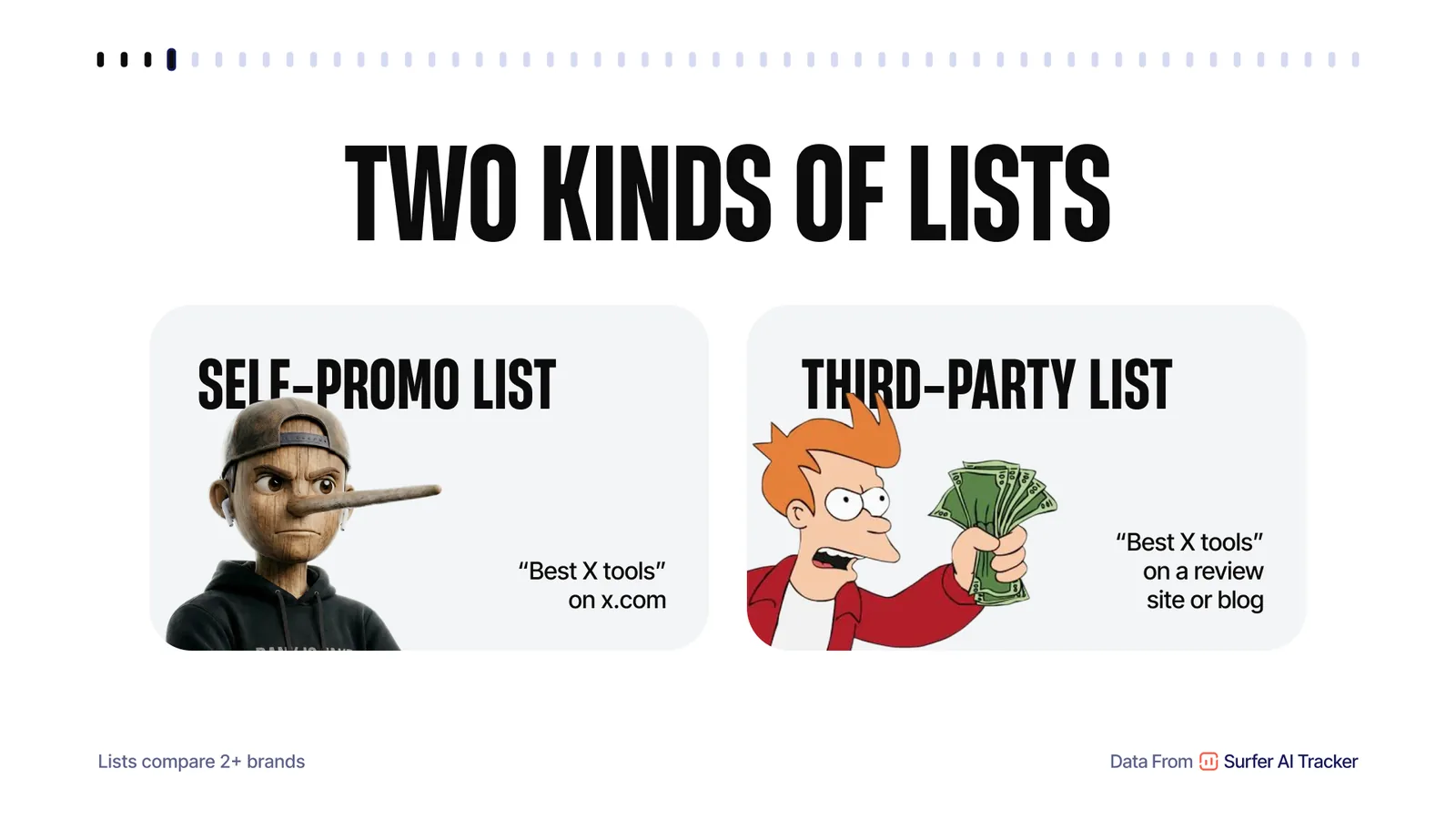
- Self-promo list
- A list on a brand’s own site that compares two or more competing brands, the publisher among them.
- Third-party list
- A comparison list on a site that belongs to none of the listed brands.
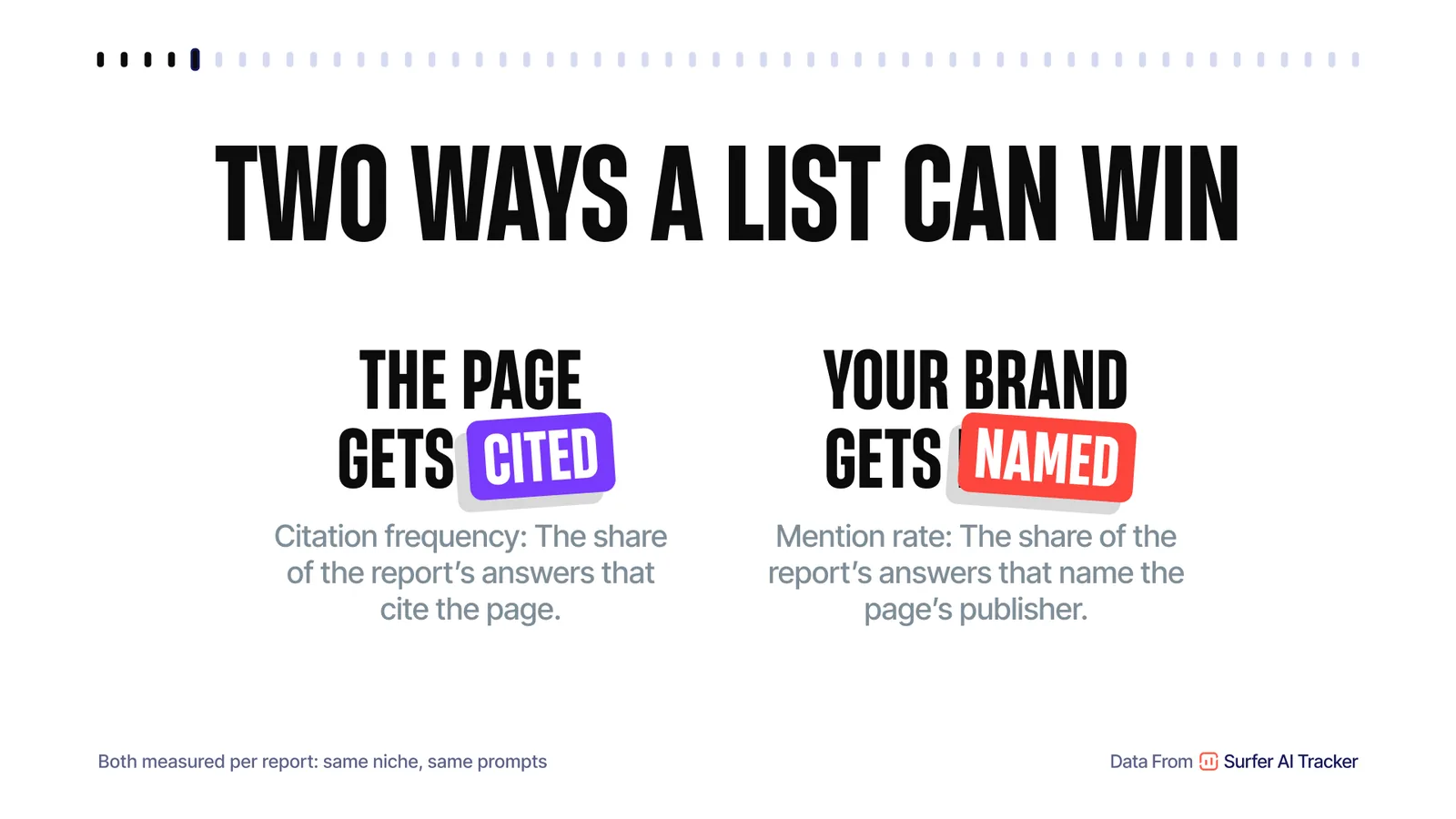
- Getting cited
- The share of a report’s AI answers that cite the page as a source.
- Getting named
- The share of a report’s AI answers that name the page’s publisher.
- Listicle share
- 238.6M citations, 8,677 reports, January to September 2026; the yearly trend uses the same 546 reports in every month.
- Paired test
- 193,944 cells for own lists and 1.63M for third-party lists, each one the same report, page, prompt, engine and month, comparing answers that cite the list with answers that don’t.
- Writing factors
- 201,534 self-promo pages in 5,162 reports, July to September 2026, 190 factors per page from the URL, HTML, text, an AI detector and an LLM content rubric. The best and worst 5% are compared inside each report.
- Over time
- Pages first cited between January and mid-July 2026, followed for 12 weeks.
These are associations within the same niche, not proven causes. How often a brand gets named also depends on how well known it is. Test the rules on your own pages before you roll them out.
Want this talk at your event?
2027 is open, with the first events confirmed in March.